Chapter introductions
And it came to pass in the month Nisan, in the twentieth year of Artaxerxes the king, that wine was before him: and I took up the wine, and gave it unto the king. Now I had not been beforetime sad in his presence.
John Wesley on Nehemiah 2:1
V. 1. Nisan-Four months after he had heard those sad tidings. The reason of this long delay might be either that his turn of attending upon the king did not come ‘till that time: or that ‘till then he wanted a fit opportunity to move it to him.
Adam Clarke on Nehemiah 2:1
Verse 1. Month Nisan] Answering to a part of our March and April. I took up the wine] It is supposed that the kings of Persia had a different cup-bearer for each quarter of the year, and that it had just now come to Nehemiah’s turn.
Joseph Benson on Nehemiah 2:1
Verse 1. In the month Nisan — Which answers to part of our March and April. So that there were almost four months between the time of his hearing the fore-mentioned sad tidings respecting the defenceless condition in which Jerusalem lay, and his requesting leave of the king to go thither. The reason of this long delay might be, either that his turn of attending upon the king did not come till that time; or, that till then he wanted a fit opportunity to move it to him. That wine was before him — He was at dinner or supper, and called for wine, which was ready for him. Now I had not been beforetime sad in his presence — But always appeared cheerful and well pleased, as young men, so advanced, are wont to do.
Joseph Sutcliffe on Nehemiah 2:1
Verse 1. Nisan. See the chronology, Exodus 12. Artaxerxes was well disposed towards the Jews. He had sent Ezra to Jerusalem in the seventh year of his reign; he now sends Nehemiah in the twentieth year, and with a larger commission.
Daniel Whedon on Nehemiah 2:1–8
NEHEMIAH COMMISSIONED TO REBUILD THE WALLS OF JERUSALEM, 1-8.
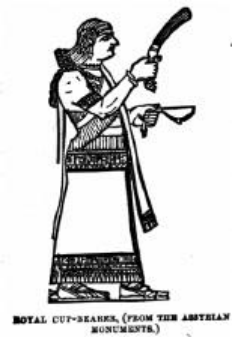
1. The month Nisan — The name, after the exile, of the first month of the Jewish year, corresponding nearly with April, and more anciently called Abib. Exodus 13:4; comp. Nehemiah 12:2. This was the first Nisan that followed the Chisleu (Nehemiah 1:1) when Nehemiah heard the sad tidings from Judah, and four months after that time, but both these months fell in the twentieth year of Artaxerxes. For a notice of this king, see note on Ezra 7:1. Took up the wine, and gave it unto the king — This was a part of the business of the royal cupbearer. See note above, on Nehemiah 1:11. Had not been beforetime sad — We may better omit beforetime and translate the past tense of the verb, as is often proper, so as to express an habitual state or condition, I was not accustomed to be sad in his presence. The Hebrew word for sad (רע) commonly means bad, ill-favoured, evil; and is appropriately used of the troubled and dejected countenance of a cupbearer, which should naturally be cheerful and happy, as became his business, to cheer the heart of the king. Various ancient authors attest the propensity of the Persians for wine. Herodotus says, (i, 133,) “They are very fond of wine, and drink it in large quantities.” And, according to H. Rawlinson, it is customary at the present day for the high livers among the Persians “to sit for hours before dinner drinking wine and eating dried fruits. A party often sits down at seven o’clock, and the dinner is not brought in till eleven.”
Cited across the library (1 reference)
- DictionaryWatson’s Dictionary: Months
Wherefore the king said unto me, Why is thy countenance sad, seeing thou art not sick? this is nothing else but sorrow of heart. Then I was very sore afraid,
John Wesley on Nehemiah 2:2
V. 2. Sad-His fasting joined with inward grief had made a sensible change in his countenance. Afraid-It was an unusual and ungrateful thing to come into the king of Persia’s presence with any token of sorrow. And he feared a disappointment, because his request was great and invidious, and odious to most of the Persian courtiers.
Adam Clarke on Nehemiah 2:2
Verse 2. Then I was very sore afraid.] Probably the king spoke as if he had some suspicion that Nehemiah harboured some bad design, and that his face indicated some conceived treachery or remorse.
Joseph Benson on Nehemiah 2:2
Verse 2. The king said, Why is thy countenance sad? — His fasting, joined with inward grief, had made a sensible change in his countenance. Then I was sore afraid — It was an unusual and ungracious thing to come into the king of Persia’s presence with any token of sorrow. And he feared a disappointment, because his request was great and invidious, and odious to most of the Persian courtiers.
Daniel Whedon on Nehemiah 2:2
2. I was… sore afraid — The king’s question was probably altogether unexpected, and coming on that public occasion, when the queen was also present, (verse 6,) and, perhaps, many nobles of the court, he was filled with confusion, and feared that the presenting of his cause on such an occasion might expose it to failure, and himself to scorn and punishment. Perhaps he feared, too, that the king might suspect some foul designs in his heart.
And said unto the king, Let the king live for ever: why should not my countenance be sad, when the city, the place of my fathers’ sepulchres, lieth waste, and the gates thereof are consumed with fire?
John Wesley on Nehemiah 2:3
V. 3. Why should, &c.-All the grievances of the church, but especially its desolations, ought to be matter of grief to all good people, to all that have a concern for God’s honour, and are of a public spirit.
Adam Clarke on Nehemiah 2:3
Verse 3. Let the king live for ever] Far from wishing ill to my master, I wish him on the contrary to live and prosper for ever. ÆLIAN, Hist. Var. lib. i. c. 32, uses the same form of speech in reference to Artaxerxes Mnemon, one of the Persian kings, βασιλευ Αρταξερξη, δι᾽ αιωνος βασιλευοις, “O King Artaxerxes, may you reign for ever,” when speaking of the custom of presenting them annually with an offering of earth and water; as if they had said, May you reign for ever over these!
Joseph Benson on Nehemiah 2:3
Verse 3. Let the king live for ever — My sadness comes not from any disaffection to the king, for whom my hearty prayers are that he may live for ever, but from another cause. Why should I not be sad, when the place of my fathers’ sepulchres lieth waste? — Which by all nations are esteemed sacred and inviolable. He says not a word for the temple, as he spake before a heathen king, who cared for none of these things. There is a regard due to one’s own country, which ought not to be extinguished by the pleasure or plenty of any other. It is not a weakness to be deeply affected with the distresses, or for the death of our friends and relations, at what distance secret we are from them; nor can any prosperity in another country excuse a man for not being so much afflicted for any calamity that befalls his own as not to entertain mirth and jollity in his heart. Nehemiah was in no mean station when he was cup-bearer to Artaxerxes, and we may very reasonably suppose, from the grace and bounty which that great king showed him, that he might have had any honour or preferment he would have requested in that great and flourishing empire; yet when that great king discerned that there was sorrow of heart in his countenance, and demanded the reason of it, he made no other excuse but, Jerusalem lay waste: and when the king so graciously invited him to ask some favour worthy of his royal bounty, he would require nothing else but permission and power to go and relieve his country. The grievances of the church, but especially its desolations, ought to be a grief to all good people, and will to all that have a concern for God’s honour, and are of a public spirit.
Daniel Whedon on Nehemiah 2:3
3. Let the king live forever — A common form of royal salutation. Compare marginal references. The city, the place of my fathers’ sepulchres — A touching allusion, calculated to affect the hearts both of the king and the queen. Nehemiah here calls Jerusalem, literally, the house of the graves of his fathers, and hence it has been inferred that he was of the seed of David, whose royal sons were “buried in the city of David,” (1 Kings 14:31; 15:24, etc.;) so that city was, in fact, the very house of their graves.
Cited across the library (1 reference)
Then the king said unto me, For what dost thou make request? So I prayed to the God of heaven.
John Wesley on Nehemiah 2:4
V. 4. Let, &c.-My sadness comes not from any disaffection to the king, for whom my hearty prayers are that he may live for ever; but from another cause. Sepulchres-Which by all nations are esteemed sacred and inviolable. He saith not a word of the temple as he spake before a Heathen king who cared for none of these things. I prayed-To direct my thoughts and words, and to incline the king’s heart to grant my request.
Adam Clarke on Nehemiah 2:4
Verse 4. So I prayed to the God of heaven.] Before he dared to prefer his request to the king, he made his prayer to God, that his suit might be acceptable: and this he does by mental prayer. To the spirit of prayer every place is a praying place.
Joseph Benson on Nehemiah 2:4
Verse 4. Then the king said, For what dost thou make request? — Something thou wouldest have, what is it? The king had an affection for him, and was not pleased to see him dejected, and thus gave him encouragement to tell his mind. So I prayed to the God of heaven — I silently in my mind besought God to direct my thoughts and words, and to incline the king’s heart to grant my request.
Daniel Whedon on Nehemiah 2:4
4. For what dost thou make request — The king’s heart was at once touched with sympathy for the sorrow of his cupbearer, and prompted to offer him assistance. Thus God disposeth the hearts of kings. I prayed — That he might so order his request as to secure the king’s favour. He that would prevail with men and kings must first know how to prevail in prayer with God.
And I said unto the king, If it please the king, and if thy servant have found favor in thy sight, that thou wouldest send me unto Judah, unto the city of my fathers’ sepulchres, that I may build it.
Adam Clarke on Nehemiah 2:5
Verse 5. The city of my fathers’ sepulchres] The tombs of the dead were sacred among the ancients, and nothing could appear to them more detestable than disturbing the ashes or remains of the dead. Nehemiah knew that in mentioning this circumstance he should strongly interest the feelings of the Persian king.
Joseph Benson on Nehemiah 2:5
Verse 5. I said, If it please the king, &c. — My request, whatever it is, I humbly and wholly submit to the king’s good pleasure, in which I am resolved to acquiesce. If thy servant have found favour in thy sight — I plead no merit, but humbly supplicate thy grace and favour, of which, having received some tokens, I am imboldened to make this farther request. That thou wouldst send me unto Judah, &c. — Wouldst give me a commission to go and build the walls of Jerusalem, and thereby make it a city again, for it is now in a defenceless state, as an open town, exposed on all sides to the attacks of its enemies. “A generous spirit,” says Lord Clarendon, “can think of nothing but relieving his country while it is under a general misery and calamity.”
Daniel Whedon on Nehemiah 2:5
5. Send me… that I may build it — To obtain this request had been the anxious desire of his heart, and the burden of his prayer for many days — even from the time of his hearing of the desolation of Judah. Nehemiah 1:3, 4.
Cited across the library (1 reference)
And the king said unto me, (the queen also sitting by him,) For how long shall thy journey be? and when wilt thou return? So it pleased the king to send me; and I set him a time.
John Wesley on Nehemiah 2:6
V. 6. The queen-Which is here noted, as an unusual thing; for commonly the kings of Persia dined alone, and perhaps because the queen expressed some kindness to him, and promoted his request. How long-This question shewed the king’s affection to him, and that he was not willing to want his attendance longer than was necessary. A time-He built the walls in fifty two days, Nehemiah 6:15, and probably not long after returned to the king, by whom he was sent a second time with a more ample commission.
Adam Clarke on Nehemiah 2:6
Verse 6. The queen also sitting by him] Who probably forwarded his suit. This was not Esther, as Dean Prideaux supposes, nor perhaps the same Artaxerxes who had taken her to be queen; nor does שגל shegal signify queen, but rather harlot or concubine, she who was chief favourite. The Septuagint translate it παλλακη, harlot; and properly too. See the introduction.
I set him a time.] How long this time was we are not told; it is by no means likely that it was long, probably no more than six months or a year; after which he either returned, or had his leave of absence lengthened; for in the same year we find he was made governor of the Jews, in which office he continued twelve years, viz., from the twentieth to the thirty-second year of Artaxerxes, Nehemiah 5:14. He then returned to Susa; and after staying a short time, had leave to return to rectify some abuses that Tobiah the Ammonite had introduced into the temple, Nehemiah 13:6,7, and several others of which the people themselves were guilty. After having performed this service, it is likely he returned to the Persian king, and died in his office of cup-bearer; but of this latter circumstance we have no mention in the text.
Joseph Benson on Nehemiah 2:6
Verse 6. The queen also sitting by him — Which is here noted as an unusual thing, for commonly the kings of Persia dined alone; and perhaps because the queen expressed some kindness to him, and promoted his request. How long shall thy journey be? — This question showed the king’s affection for him, and that he was not willing to want his attendance longer than was necessary. So it pleased the king to send me — Having told the king how long he desired to be absent from his office, the king permitted him to go. How long that was, is not certain. But it is not likely it was for twelve years, mentioned Nehemiah 5:14, and 13:6, but rather, he asked leave for a year, or perhaps for half that time: which made him so quick in despatching the building of the wall, which he finished in fifty-two days, chap. 6:15. After which, it is likely, he returned to Shushan, according to his appointment, and that the king sent him back as his governor for twelve years; his presence being very serviceable, or perhaps necessary there, for the better ordering of that province to the king’s satisfaction.
Joseph Sutcliffe on Nehemiah 2:6
Ver. 6. The queen also sitting by. Menochius supposes this queen to be Esther, whose interest contributed towards the grant of Nehemiah’s commission: and as he made very great haste in raising the walls of the city, it is highly probable that he returned to Shushan according to the set time, and procured a permanent commission to govern the Jews. We find him appointed to this government in the same year, and he continued in it twelve years: Nehemiah 5:14. He then returned to the king, and shortly afterwards went again to Jerusalem: Nehemiah 13:6, 7.
Daniel Whedon on Nehemiah 2:6
6. The queen also sitting by him — Probably the queen consort, the principal wife, is meant; not one of his concubines, or a mistress, as the Septuagint translates it. The influence of a wife over a Persian monarch is shown in the Book of Esther. How long — The king did not wish to lose this noble officer of his court for a great length of time. I set him a time — This may have been altered afterwards, and Nehemiah’s leave of absence extended. This would necessarily follow from his being appointed governor, which appointment was made that same year. Nehemiah filled that office for the twelve succeeding years. Nehemiah 5:14.
Moreover I said unto the king, If it please the king, let letters be given me to the governors beyond the river, that they may convey me over till I come into Judah;
Joseph Benson on Nehemiah 2:7–8
Verses 7, 8. That they may convey me over till I come into Judah — May conduct me with safety through their several territories, and furnish me with necessaries on my journey. And a letter unto Asaph, the keeper of the king’s forest — The forest of Lebanon, famous for choice trees. That he may give me timber for the gates — The gates of the temple. For though the temple itself was built, yet the several courts seem not to have been walled about, nor the gates made leading to the temple. Of the palace — The king’s palace, which adjoined to the house of God. And for the house that I shall enter into — He desired leave to build a convenient house for himself, and for those that should be future governors. According to the good hand of my God upon me — By the divine favour, which inclined the king to do what he desired; which he calls God’s good hand, because we extend favour with our hands.
Joseph Sutcliffe on Nehemiah 2:7
Ver. 7. Let letters be given me, without which he could not pass the fortified places; nor receive assistance from the Persian garrisons.
Daniel Whedon on Nehemiah 2:7
7. Let letters be given me — This was a wise precaution on the part of Nehemiah, for the governors beyond the river were generally hostile to the Jews. Comp. Ezra 4 and 5.
And a letter unto Asaph the keeper of the king’s forest, that he may give me timber to make beams for the gates of the palace which appertained to the house, and for the wall of the city, and for the house that I shall enter into. And the king granted me, according to the good hand of my God upon me.
John Wesley on Nehemiah 2:8
V. 8. King’s forest-Of the forest of Lebanon, famous for choice trees. Palace-Of the king’s palace, which was adjoining to the house of God. Enter-That I shall build to dwell in while I am there.
Adam Clarke on Nehemiah 2:8
Verse 8. Asaph the keeper of the king’s forest] הפרדס hapardes of the paradise of the king. This I believe is originally a Persian word; it frequently occurs in Arabic, [Arabic] ferdoos, and in Greek, παραδεισος, and in both signifies a pleasant garden, vineyard, pleasure garden, and what we call a paradise.
Above the hall of audience, in the imperial palace at Dehli, the following Persian couplet is inscribed:—
[Persian]
[Persian]
“If there be a paradise on the face of the earth,
this is it, this is it, this is it.”
Thus we find that the word is applied to denote splendid apartments, as well as fine gardens; in a word, any place of pleasure and delight. The king’s forest mentioned in the text might have been the same to Artaxerxes, as the New Forest was to William the Conqueror, or Windsor Forest to the late amiable sovereign of the British people, GEORGE the THIRD.
And the king granted me, &c.] This noble spirited man attributes every thing to God. He might have said, I had been long a faithful servant to the king; and he was disposed, in reward of my fidelity, to grant my request; but he would not say so: “He granted my request, because the good hand of my God was upon me.” God favoured me, and influenced the king’s heart to do what I desired.
Joseph Sutcliffe on Nehemiah 2:8
Ver. 8. The king’s forest, his hunting seat, connected with a palace and parks of pleasure. Xenophon names the kings of Babylon as hunting the boars in their forests.
Daniel Whedon on Nehemiah 2:8
8. Keeper of the king’s forest — The Hebrew word here rendered forest, is פרדס, pardes, a Persian word, from which comes (through the Greek) the word paradise. It occurs in only two other passages, Ecclesiastes 2:5, and Song of Solomon 4:13, and seems to designate an inclosed garden or park, planted with trees and shrubs. “A wide open park, inclosed against injury, yet with its natural beauty unspoiled, with stately forest trees, many of them bearing fruit, watered by clear streams on whose banks roved large herds of antelopes or sheep — this was the scenery which connected itself in the mind of the Greek traveller with the word paradise, and for which his own language supplied no precise equivalent.” — SMITH’S Bib. Dict. The forest, or paradise, mentioned in this verse was one from which Nehemiah wished to procure timber for building purposes, and must have been somewhere in Palestine, and probably not far from Jerusalem. There is no evidence that Nehemiah went as far as Lebanon for materials. Some suggest that the king’s forest may mean the beautiful and well watered gardens which Josephus (viii, 7, 3) mentions as being at Etham, about fifty furlongs from Jerusalem, to which Solomon was wont to ride out in the morning. But the reference may be to all the groves and forests of Palestine, which seem to have been at that time carefully guarded by the kings of Persia, who appointed a special officer to guard them, and see that they were not wantonly destroyed. The palace which appertained to the house — That is, the palace, fortress, or castle, which was connected with the temple. Not the palace of Solomon, which probably stood on the southern slope of Ophel, and from which that king had a magnificent ascent to the temple, (1 Kings 10:5,) for we have elsewhere no hint of any attempt to rebuild the royal palace at Jerusalem, and least of all would Nehemiah have proposed at such a time to build it, for that would look like a design to re-establish the kingdom of Judah. But this palace of the temple, which Nehemiah proposed to build, was probably some such fortress or citadel as that subsequently known as Antonia, called also Baris, (Βαρις seems to have come from בירה, birah, here rendered palace, and includes the meaning both of fortress and palace,) and used under the Asmonean princes as a depository for the vestments of the high priest. Josephus, 15:11, 4. For the wall — Timber would be used for building the gates of the wall. The house that I shall enter into — His own residence, or headquarters, while he superintended the building of the wall and gates of the city. According to the good hand — Compare Ezra 7:6, note.
NEHEMIAH’S JOURNEY TO JERUSALEM AND NIGHT-VIEW OF ITS WALLS, 9-16.
Cited across the library (2 references)
Then I came to the governors beyond the river, and gave them the king’s letters. Now the king had sent captains of the army and horsemen with me.
Joseph Benson on Nehemiah 2:9
Verse 9. Now the king had sent captains of the army and horsemen with me — This the king had done over and above what Nehemiah had desired; and it procured him the greater respect from the governors, when they saw the care which the king took for the safety of his person.
Joseph Sutcliffe on Nehemiah 2:9
Ver. 9. The river, the Euphrates.
Daniel Whedon on Nehemiah 2:9
9. Sent captains of the army and horsemen — For a safe-conduct. Probably Nehemiah retained these for his guard at Jerusalem.
When Sanballat the Horonite, and Tobiah the servant, the Ammonite, heard of it, it grieved them exceedingly that there was come a man to seek the welfare of the children of Israel.
John Wesley on Nehemiah 2:10
V. 10. Horonite-So called either, from the place of his birth or rule, which is supposed to be Horonaim, an eminent city of Moab. The servant-So called probably from the condition from which he was advanced to his present power and dignity: which also may be mentioned as one reason why he now carried himself so insolently, it being usual for persons suddenly raised from a low state, so to demean themselves.
Adam Clarke on Nehemiah 2:10
Verse 10. Sanballat the Horonite] Probably a native of Horonaim, a Moabite by birth, and at this time governor of the Samaritans under the king of Persia.
Tobiah the servant] He was an Ammonite; and here, under the Persian king, joint governor with Sanballat. Some suppose that the Sanballat here mentioned was the same who persuaded Alexander to build a temple on Mount Gerizim in favour of the Samaritans. Pelagius thinks there were two governors of this name.
Joseph Benson on Nehemiah 2:10
Verse 10. Sanballat the Horonite — So called either from the place of his birth or residence, which is supposed to have been Horonaim, an eminent city of Moab. This Sanballat was the person who afterward instigated Alexander the Great to build the temple of Gerizim, in order to occasion a division among the Jews. Tobiah the servant, the Ammonite — So called, probably, from the condition from which he had been advanced to his present power and dignity; which also may be mentioned as one reason why he now carried himself so insolently, it being usual for persons suddenly raised from a low state so to demean themselves. It grieved them exceedingly that there was come a man — With such authority from the king, and in such favour with him, as appeared by the letters he brought with him, and the guard that attended him, and the diligence of the several governors, through whose provinces he passed, to serve him.
Daniel Whedon on Nehemiah 2:10
10. Sanballat the Horonite — This noted man seems to have been an officer of the Persian government, holding a military command at Samaria. Compare Nehemiah 4:2. He is conspicuous in this history solely from his bitter hostility to the Jews. The Horonite designates him as a native of Horonaim, in the land of Moab: (see Isaiah 15:5; Jeremiah 48:3, 5, 34:) and his Moabite origin may partly account for his hostility towards Israel. Tobiah the servant — What gave him this title of the servant is not clear. Perhaps he had been a slave and had gained his freedom, but never lost the title and associations of his former servitude; and in such a case a Jewish writer would naturally emphasize the opprobrious epithet. His own and his son’s marriage with the daughter of a Jew created family relationships which proved a source of trouble, (Nehemiah 6:17-19,) and being allied to the high priest Eliashib (Nehemiah 13:4) he secured a chamber in the courts of the temple, from which Nehemiah finally cast out all his household stuff. Nehemiah 13:7, 8. He is here designated as the Ammonite, having sprung from that hated race; and, perhaps, his bitterness towards the Jews was owing largely to Ezra’s recent legislation in requiring all Jews to put away their foreign wives, (Ezra 10,) for they had intermarried with the Ammonites and Moabites. Ezra 9:1. And these two men, Sanballat and Tobiah, were fit representatives of the ancient and hereditary hatred of their respective races towards Israel.
Cited across the library (2 references)
- DictionaryWatson’s Dictionary: Sanballat
- DictionaryWatson’s Dictionary: Tobiah
So I came to Jerusalem, and was there three days.
Daniel Whedon on Nehemiah 2:11
11. Three days — See note on Ezra 8:32.
And I arose in the night, I and some few men with me; neither told I any man what my God had put in my heart to do at Jerusalem: neither was there any beast with me, save the beast that I rode upon.
John Wesley on Nehemiah 2:12
V. 12. Night-Concealing both his intentions as long as he could, knowing that the life of his business lay in secrecy and expedition. Beast-To prevent noise.
Joseph Benson on Nehemiah 2:12
Verse 12. I arose in the night — Concealing both his intentions and actions as far and as long as he could, as knowing that the life of his business lay in secrecy and expedition. Neither was there any beast with me, &c. — To prevent noise, and that no notice might be taken of what he did.
Daniel Whedon on Nehemiah 2:12
12. I arose in the night — Probably the first night after his arrival. He wished to see how great a work was before him, and he yearned to take a view of the city of his fathers’ sepulchres, of which he had heard so much, but had never seen till now; and so with only some few attendants, and the solitary beast on which he rode, he made this night survey. Peculiarly touching and impressive is the thought of this tender-hearted child of the exile viewing by night, and alone, the ruins of the holy city of his fathers.
And I went out by night by the gate of the valley, even before the dragon well, and to the dung port, and viewed the walls of Jerusalem, which were broken down, and the gates thereof were consumed with fire.
John Wesley on Nehemiah 2:13
V. 13. I went-The footmen who accompanied him directing and leading him in the way. His design was to go round the city, to observe the compass and condition of the walls and gates, that he might make sufficient provisions for the work.
Adam Clarke on Nehemiah 2:13
Verse 13. The dragon well] Perhaps so called because of the representation of a dragon, out of whose mouth the stream issued that proceeded from the well.
Dung port] This was the gate on the eastern side of the city, through which the filth of the city was carried into the valley of Hinnom.
Joseph Benson on Nehemiah 2:13
Verse 13. I went out by night — The footmen who accompanied him directing and leading him in the way. His design was to go around the city, to observe the compass and condition of the walls and gates, that he might make sufficient provisions for the work. By the gate of the valley — Of which see Nehemiah 3:13. Even before the dragon-well — A fountain of water so called, either from some figure of a dragon or serpent which was by it, or from some living dragon which had taken up its abode there when the city was desolate. To the dung-port — Through which they used to carry the dung out of the city.
Joseph Sutcliffe on Nehemiah 2:13
Ver. 13. The gate of the valley of Jehoshaphat, through which the brook Kedron flows, and receives the foul waters of the Gihon, after washing the streets of the city.
Daniel Whedon on Nehemiah 2:13
13. The gate of the valley — The gate that opened into the valley of Gihon, on the west side of the city, and just at the point where that valley takes a bend off towards the northwest. This would be at the northwestern corner of Zion, where afterwards stood the Tower of Hippicus, erected by Herod. Before the dragon well — The modern upper pool of Gihon, towards which the gate just mentioned must have opened. What gave it this name is now unknown. The dung port — Why our translators rendered the same word port here, which they render gate above, is not apparent. This dung gate is supposed to have been at or near the southwestern corner of the city wall, where the filth and garbage of this part of the city were carried out and thrown down into the deep valley below. See on Nehemiah 3:13.
Cited across the library (1 reference)
Then I went on to the gate of the fountain, and to the king’s pool: but there was no place for the beast that was under me to pass.
John Wesley on Nehemiah 2:14
V. 14. No place-The way being obstructed with heaps of rubbish.
Adam Clarke on Nehemiah 2:14
Verse 14. The gate of the fountain] Of Siloah.
The king’s pool] Probably the aqueduct made by Hezekiah, to bring the waters of Gihon to the city of David. See 2 Chronicles 32:30.
Joseph Benson on Nehemiah 2:14–16
Verses 14-16. I went on to the gate of the fountain — That is, which led to the fountain, to wit, of Siloah or Gihon. And to the king’s pool — That which King Hezekiah had made, of which see 2 Chronicles 32:3-30. But there was no place for the beast, &c. — The way being obstructed with heaps of rubbish. Then went I up by the brook — Of Kidron, of which see on 2 Samuel 15:23. And so returned — Having gone around about the city. Nor to the rest that did the work — Or were to do it, that is, whom he intended to employ in it.
Joseph Sutcliffe on Nehemiah 2:14
Ver. 14. The gate of the fountain, of Siloam.
Daniel Whedon on Nehemiah 2:14
14. Gate of the fountain — This was doubtless the gate situated at the mouth of the Tyropoeon, and near the fountain, or pool of Siloam. It is to be identified with “the gate between two walls,” (2 Kings 25:4,) by which king Zedekiah fled from the city. The king’s pool — Probably that now commonly known as the fountain of the Virgin, a little north of the pool of Siloam, and connected with it by a subterranean passage. By many this is now believed to be the same as the Bethesda of the New Testament. John 5:2. No place for the beast… to pass — So filled had the narrow valley become with the rubbish of the long desolate city.
Then went I up in the night by the brook, and viewed the wall, and turned back, and entered by the gate of the valley, and so returned.
Adam Clarke on Nehemiah 2:15
Verse 15. By the brook] Kidron.
By the gate of the Valley] The valley through which the brook Kidron flowed. It was by this gate he went out; so he went all round the city, and entered by the same gate from which he had gone out.
Joseph Sutcliffe on Nehemiah 2:15
Ver. 15. By the brook, Kedron. Thus he went all round the city, and entered at the gate of the valley through which he went out: ver. 13.
Daniel Whedon on Nehemiah 2:15
15. Then went I up… by the brook — He probably left his beast by the king’s pool, and went on foot up the brook, or valley of the Kedron, and viewed the wall on the east side of the city; then he turned back, walking down the brook Kedron again to the place where he left his beast, and then rode back around the southern and western walls, and again entered the city by the same gate of the valley through which he had gone out.
And the rulers knew not whither I went, or what I did; neither had I as yet told it to the Jews, nor to the priests, nor to the nobles, nor to the rulers, nor to the rest that did the work.
John Wesley on Nehemiah 2:16
V. 16. That did-Or, were to do, whom he intended to employ in it.
Adam Clarke on Nehemiah 2:16
Verse 16. The rulers knew not whither I went] He made no person privy to his design, that he might hide every thing as much as possible from their enemies till he had all things in readiness; lest they should take measures to defeat the work.
Daniel Whedon on Nehemiah 2:16
16. Jews… priests… nobles… rulers — The various ranks and classes among the Jewish community. Nehemiah did not at that time make known his night journey around the walls to any one of these various classes. The Jews here means the common body of the people, the laity, as distinguished from the priests. The nobles were those who were known and honoured as descendants of the royal family of David. The rulers were the chief officers of the Jewish community living in and about Jerusalem. Nor to the rest that did the work — The workmen among the people, as distinguished from the other classes previously mentioned. In every great public work such as Nehemiah was now contemplating, the builders, (Ezra 3:10,) and all classes of workmen, would have an important interest; yet Nehemiah means to say that while he held important papers from the king, and had come to build the walls and gates of Jerusalem, and made his night survey with this end in view, he had not as yet communicated his design to any of the people, nor to their officers and leading men, nor to the workmen upon whom would fall the chief burden of rebuilding the fallen gates and walls.
Then said I unto them, Ye see the distress that we are in, how Jerusalem lieth waste, and the gates thereof are burned with fire: come, and let us build up the wall of Jerusalem, that we be no more a reproach.
Joseph Benson on Nehemiah 2:17–18
Verses 17, 18. That we be no more a reproach — Exposed to the scorn and insults of the people around about. I told them of the hand of my God, &c. — That is, he informed them how favourable God had made the king to him, and what discourse he had had with him, and what authority and commission he had received from him. They said, Let us rise up and build — Let us begin and proceed with vigour, diligence, and resolution, as those that are determined to go through with the work. They strengthened their hands — Their own and one another’s.
Daniel Whedon on Nehemiah 2:17–18
PREPARATIONS TO BUILD, 17, 18.
17. Ye see the distress — The same word is rendered affliction in Nehemiah 1:3. Nehemiah had now seen with his own eyes that the report was true which informed him in Shushan of the desolation of Jerusalem. The distress to which the Jews were subjected by inability to rebuild their city, so long desolate, could be regarded by them in no other light than as a reproach.
Then I told them of the hand of my God which was good upon me; as also the king’s words that he had spoken unto me. And they said, Let us rise up and build. So they strengthened their hands for this good work.
John Wesley on Nehemiah 2:18
V. 18. Rise up-Let us do it with vigour, and diligence, and resolution, as those that are determined to go through with it. Their hands-Their own and one anothers.
Adam Clarke on Nehemiah 2:18
Verse 18. Then I told them] He opened to them his design and his commission.
Daniel Whedon on Nehemiah 2:18
18. The king’s words — Nehemiah informed them, doubtless, not only of what the king had spoken to him, but also of the letters of authority which he held from the king. They strengthened their hands — Encouraged each other, and set vigorously about the work. For this good work — Literally, for good. Vatablus explains it, on account of the favour of God and of the king. But the words seem better taken in the more general sense which the literal rendering gives; they encouraged one another for good, not for evil; they set about the work with a good will.
But when Sanballat the Horonite, and Tobiah the servant, the Ammonite, and Geshem the Arabian, heard it, they laughed us to scorn, and despised us, and said, What is this thing that ye do? will ye rebel against the king?
Adam Clarke on Nehemiah 2:19
Verse 19. Geshem the Arabian] Some chief of the Arabs contiguous to Samaria, who had joined with Sanballat and Tobiah to distress the Jews, and hinder their work.
Will ye rebel against the king?] This they said in order to raise jealousies in the king’s mind, and induce him to recall his ordinance.
Joseph Benson on Nehemiah 2:19–20
Verses 19, 20. When Sanballat, Tobiah, and Geshem, &c. — These three seem to have been chief men among the Samaritans, and perhaps were invested with some offices or authority by the king of Persia. You have no portion nor right — Do not trouble yourselves about this matter, who have no possession among us, no authority over us, nor interest in our church or state; nor memorial in Jerusalem — No testimony or monument either of your relation to us by birth or religion, or of your kindness to us or to this place, but you are aliens from the commonwealth of Israel: therefore mind your own business, and do not meddle with ours.
Daniel Whedon on Nehemiah 2:19–20
SCORN OF THE SAMARITANS, 19, 20.
19. Sanballat… Tobiah — See on verse 10. Geshem the Arabian — Written Gashum in Nehemiah 6:6. Whether he was associated with Sanballat and Tobiah in the government at Samaria, or represented some Arab tribe in another quarter, is uncertain; but in either case he was in league with the Samaritans against the Jews, and most malignant was his enmity to the latter. Compare his vile slander, Nehemiah 6:6. The Arabians of the desert south of Palestine would naturally oppose the re-establishment of the kingdom of Jerusalem, for it might oppose a barrier to their predatory invasions of that section of the country. Will ye rebel — The building of the walls was construed into a design to fortify themselves, and then revolt and become an independent state.
Then answered I them, and said unto them, The God of heaven, he will prosper us; therefore we his servants will arise and build: but ye have no portion, nor right, nor memorial, in Jerusalem.
John Wesley on Nehemiah 2:20
V. 20. No portion-You have no authority over us, nor interest in our church and state, but are aliens from the common-wealth of Israel. Memorial-No testimony, or monument, either of your relation to us by birth or religion, or of your kindness to us, or to this place.
Adam Clarke on Nehemiah 2:20
Verse 20. Ye have no portion, nor right] To be a citizen of Jerusalem was a high honour; and they would not permit those who did not belong to the tribes of Israel to dwell there. Zerubbabel gave the same answer to the Samaritans, Ezra 4:3.
Daniel Whedon on Nehemiah 2:20
20. Ye have no portion — Compare Ezra 4:2, note.
Closing reflections and analysis
Joseph Sutcliffe
REFLECTIONS.
Nehemiah having gained the favour of heaven, awaited opportunity till his daily prayer, and frequent fasting, should attract the attention of the king. God in regard to providential blessings may seem slow to help his people, but his help is happily timed.
Nehemiah was a man of great prudence and modesty. Not willing to obtrude himself precipitately on the royal notice, his dejected appearance, a natural consequence of his grief, spoke for him, even before a fit opportunity, as he thought, presented to urge his supplication. This was most evidently an answer to prayer. And when the king enquired the cause of his dejection, he said it was because his fathers’ sepulchres and the walls of the city lay in ruins, reciting at the same time the particulars of those calamities which had originated in the revocation of the edict of Cyrus, obtained by the malice and falsehoods of Sanballat and others. Grace harmonizes with prudence, but is opposed to obstinacy and folly. Having before seen that the zeal of Nehemiah was disinterested, we here see that it was free from ostentation. He came to Jerusalem as a private person, though accustomed to the pomp of so great a court. He spent three days in acquainting himself with the situation of his people, and surveyed the fortifications by night to avoid the notice of the enemies’ spies. Having now availed himself of perfect information, and arranged his plans, he assembled the elders and priests, and told them of the good hand of God, in the renewal of Cyrus’s grant. This was a burst of glad tidings to the afflicted. Overpowered with joy, their hearts kindled with a hallowed patriotic flame, and they said with one voice, “Let us rise up and build.” Little till now did this poor and despised city think what a friend the Lord had sent from the east. While they slept, little did they dream who was perambulating their demolished walls, and fired gates; and little did they imagine the strong defence he was about to throw round the Zion of God. Just so Christ comes more especially in seasons of affliction to his church. He surveys at a hopeless time the low and dejected state of Zion, and opens the rich designs of grace that he may revive his people with joy, and prompt every soul to energy and zeal in his work. Oh how valuable are the spiritual and the temporal shepherds of the Lord’s flock. They built the wall, without acquainting the wicked with it. Zion shall flourish, while Samaria shall grieve.
Sanballat in Samaria, and other governors, who had wished to keep Zion in servitude, heard of the great works by actions rather than words; and they laughed at the efforts of the people, for they intended to demolish the works as before. But while they laughed, and hoped, they secretly grieved, and were haunted with despair. Hence their first efforts were to throw discouragements on the work by accusations of revolt against the king. The sight of Israel’s prosperity was insupportable to their pride. In the artifice, malice, and persecution of those wicked men, we have a general portrait of the enemies of the church. And as God frustrated all their foul designs, so he will be the help and defence of his people in every age of the world. Their hope is to ruin the work of the Lord, when it does not accord with their interest; but the ruin shall recoil on their own heads, and in blots of shame which cannot be wiped away. The wicked shall see it, and be grieved; they shall gnash with their teeth; the desire of the wicked shall fail.
John Wesley
CHAPTER 2.
Artaxerxes sends Nehemiah to Jerusalem, with a commission to build the wall, ver. 1-8. He comes thither, to the grief of his enemies, ver. 9-11. He secretly views the ruins of it, ver. 12-16. He informs the rulers of his commission, ver. 17, 18. Answers them that derided him, ver. 19, 20.
Adam Clarke
CHAPTER 2
Artaxerxes, observing the sorrow of Nehemiah, inquires into the cause, 1, 2. Nehemiah shows him the cause, and requests permission to go and rebuild the walls of Jerusalem, 3-6. The king grants it, and gives him letters to the governors beyond the river, 7, 8. He sets out on his journey, 9. Sanballat and Tobiah are grieved to find he had got such a commission, 10. He comes to Jerusalem; and, without informing any person of his business, examines by night the state of the city, 11-16. He informs the priests, nobles, and rulers, of his design and commission, 17, 18. The design is turned into contempt by Sanballat, Tobiah, and Geshem, 19. Nehemiah gives them a suitable answer, 20.
NOTES ON CHAP. 2
Joseph Benson
CHAPTER 2.
A.M. 3559. — B.C. 445.
Artaxerxes sends Nehemiah to Jerusalem, with a commission to build the wall, 1-8. He comes thither, to the grief of his enemies, 9-11. He secretly views the ruins of it, 12-16. He informs the rulers of his commission, 17, 18. Answers them that derided him, 19, 20.
NOTES ON CHAPTER 2.
Joseph Sutcliffe
CHAPTER 2.
Daniel Whedon
CHAPTER 2.