Footnotes
Editorial note: The independent 1872 Jackson edition, volume X, page 27 (PDF page 40), prints τοιουτον in the Origen quotation. The supplied Latin-letter “toiouton” is corrected to τοιουτον, without supplying additional accents. Source type on physical PDF page 546; Independent printed edition, PDF page 40.
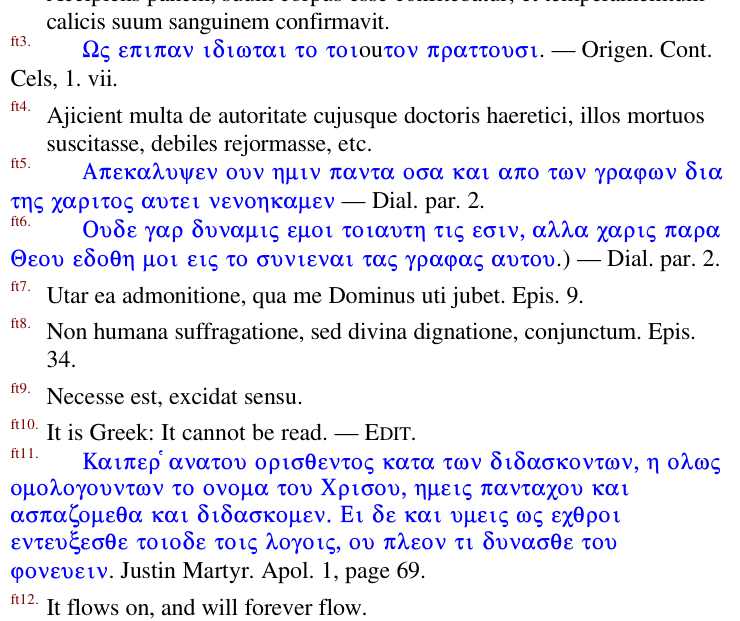
Editorial note: Source-reading note (WES_WW10.PDF, physical page 546): the Greek/Hebrew forms and their layout near “in marcum 16 17 accipiens panem suum corpus esse confitebatur et temperamemtum calicis suum sanguinem confirmavit wv epipan idiwtai to toiou”; “dignatione conjunctum epis 34 necesse est excidat sensu it is greek it cannot be read edit kaiper janatou orisqentov kata twn didaskontwn h ” are not fully established by the transcription. The linked source image preserves the original type for comparison. Other readings are retained without supplying uncertain letters, accents, or points. The Origen footnote’s “toiouton” has now been checked against the 1872 Jackson edition, volume X, page 27 (PDF page 40), and corrected to τοιουτον; the other forms covered by this broad note remain unverified. Source type and layout, physical PDF page 546; John Wesley, Works, Jackson edition (1872), volume X, PDF page 40.
FOOTNOTES 1. Non omnibus omnia — ita tamen cuilibet credenti tunc data sit admirabilis facultas, quae se, non semper quidem, sed data occasione explicaret. — GROTIUS in Marcum 16:17.
2. Accipiens panem, suum corpus esse confitebatur; et temperamemtum calicis suum sanguinem confirmavit.
3. Ως επιπαν ιδιωται το τοιουτον πραττουσι. — Origen. Cont. Cels, 1. vii.
4. Ajicient multa de autoritate cujusque doctoris haeretici, illos mortuos suscitasse, debiles rejormasse, etc.
5. Απεκαλυψεν ουν ημιν παντα οσα και απο των γραφων δια της χαριτος αυτει νενοηκαμεν — Dial. par. 2.
6. Ουδε γαρ δυναμις εμοι τοιαυτη τις εσιν, αλλα χαρις παρα Θεου εδοθη μοι εις το συνιεναι τας γραφας αυτου.) — Dial. par. 2. 7. Utar ea admonitione, qua me Dominus uti jubet. Epis. 9. 8. Non humana suffragatione, sed divina dignatione, conjunctum. Epis. 34.
9. Necesse est, excidat sensu.
10. It is Greek: It cannot be read. — EDIT.
11. Καιπερ ανατου ορισθεντος κατα των διδασκοντων, η ολως ομολογουντων το ονομα του Χρισου, ημεις πανταχου και ασπαζομεθα και διδασκομεν. Ει δε και υμεις ως εχθροι εντευξεσθε τοιοδε τοις λογοις, ου πλεον τι δυνασθε του φονευειν. Justin Martyr. Apol. 1, page 69.
12. It flows on, and will forever flow.
13. Dicimus, definimus, pronunciamus absolute necessarium ad salutem, onmi humanae creaturae subesse Romano Pontifici. Extravag. c. Unam sanctam de Majoritate et Obedientia.
“We say, define, and pronounce, that it is absolutely necessary to salvation, for every man to be subject to the Pope of Rome.” 14. Bellarm. De Eccles. milit. 1. 3, c. 2, sec. Nostra, autem sententia; et cap 5, sec. Respondeo neminem.
15. Sacrosancta synodus omnibus Christi fidelibus interdicit, ne posthac de sanctissima Eucharistia aliter credere, docere, aut praedicare audeant, quam ut est hoc praesenti decreto explicatum, atque difinitum. — Concil. Trid. Sess. 13, Decret. de Euchar. So again, Sess. 25, Decret. de Purgatorio. And there are above a hundred anathemas in that Council in point of doctrine against such as do not so believe. 16. Hanc veram catholicam fidem, extra quam nemo salvus esse potest: That is, “This is the true Catholic faith, without which no man can be saved.” — Bulla Pii IV., super Form. Juram.
17. These books are so sacred, as that they are of infallible truth. — Bellarm. De Verbo, 1. 1, c. 10, sec. Ecclesia vera. 18. Wherefore doth the Council add, “with all their parts;” unless that all should understand those parts also, about which there was some time a dispute, to belong to the sacred canon of the Bible? — Ibid., c. 7, sec. Denique.
19. Bellarm. de Indulgent. 1. 1, c. 9, init. “Plenary indulgence doth take away all the punishment due to sin.” Ibid. sec. Indulgentia Quadragen.) 20. Ibid. c. 7, sec. Et quidem.).
21. This is implied Concil. Trid. Sess. 21, c. 9, though it is called by the soft name of alms.
22. So many are granted to particular churches in Rome, for the benefit of pilgrims.
23. So those that upon his motion took up arms against the Albigenses, had by an indulgence the promise of an eternal reward. Baron. ad A. D. 1179 n. 7.
24. So Pope Alexander VI. granted to those that recited this prayer to the blessed Virgin, and St. Ann her mother, 30,000 years’ indulgence. “Hail Mary! full of grace! The Lord be with thee, thy grace with me! Blessed by thou among women; and blessed be St. Ann thy mother, from whom, O Virgin Mary, thou hast proceeded without sin and spot; but of thee hath Jesus Christ been born, the Son of the living God. Amen.” Thesaur. Var. Exercit. in Grat. Sodal. B. V. M. Bruxel. Edit. 2 An. 1658, p. 287.
25. “That supererogation is necessary to indulgence, no one can deny.” saith Bellarm. de Indulg. 1. 1, c. 2, init.
26. So Pope Clem. VI., Constit. Extrav. in Bellarm, Ibid. sec. ult. 27. Εδουλευσατε, “Ye did service to them that were no gods.” (Galatians 4:8.), Ελατρευσαν, “They serve the creature.” Romans 1:25.)
28. “Our Lord Jesus Christ,” saith he, “hath knit Christians together, with sacraments most few in number, most easy to be kept, most excellent in signification; as are baptism and the Lord’s supper.” — Epist. ad Januar. 118.
29. N. B. Where this mark (†) stands, the sign of the cross is made. 30. The Bull of Pius IV. concerning the form of the oath on the profession of faith. — EDIT.)
31. As a perpetual memorial of this matter. — EDIT.) 33. The words printed as quotations, within inverted commas, are transcribed from late authors. I am not willing to name them. 34. But Palaemon ought to possess a good memory. — EDIT. 35. So as nothing can exceed it. — EDIT.
36. The following is Francis’s translation of this quotation from Horace: “Wondrous indeed! that bulls ne’er strive to bite,
Nor wolves with desperate horns engage in fight.” — EDIT. 37. This quotation from Terence is thus translated by Colman: — “If he raves not of himself enough,
Do irritate him.” — EDIT.
38. The following is Lord Roscommon’s translation of this verse from Horace: —
“Medea must not draw her murdering knife,
Nor spill her children’s blood, upon the stage.” — EDIT. 39. But now in these private communications they have no place. — EDIT. 40. This quotation from Horace is thus translated by Boscawen: — “With what strong chain can I o’erpower
This Proteus, changing every hour?” — EDIT.
41. Advice to the People called Methodists.
42. A Presbyter of a pillaged and groaning Church. — EDIT. 43. This Church which is torn asunder and groaning. — EDIT. 44. The following is Pitt’s translation of these lines from Virgil: — “Patriots who perish’d for their contry’s right,
Or nobly triumph’d in the field of fight:
There holy priests and sacred poets stood,
Who sung with all the raptures of a God;
Worthies who life by useful arts refined,
With those who leave a deathless name behind,
Friends of the world, and fathers of mankind.”
— EDIT.
45. This accommodated quotation from Terence is thus rendered by Colman: —
“Growing desperate, and making towards him
With a determined gladiatorial air.”
— EDIT.
46. The very number of propositions extracted out of Quesnel’s writings, and condemned as dreadful heresies in the bull Unigenitus! Exemplum placet! See how good wits jump! Mr. H., Father Walsh, and the Pope of Rome!
47. A doctrine without which there can be no Christian Church. All who do not hold it must perish everlastingly. vs. Justification by faith alone is not articulus stantis vel cadentis ecclesiae. Some may doubt of it, yea, deny it, and yet not perish everlastingly. (Page 127.) 48. The only-begotten Son of God. — EDIT.
49. This quotation from Horace is thus translated by Francis: — “It breathes the spirit of the tragic scene.” — EDIT. 50. This quotation from Juvenal is thus rendered by Mr. Madan: — “The censure of a severe laugh is easy to any one.” — EDIT. 51. Persons of dull understandings. — EDIT.
52. A doctrine without which there can be no Christian Church. 53. Page 35.
54. O rare Wesleyan Logic! He who is clear in making distinctions is an able teacher. — I bless God, I can distinguish reason from sophistry; unkind, unjust, ungenteel sophistry, used purely for this good end, — to asperse, to blacken a fellow-Christian, because he is not a Calvinist! 55. This quotation from Horace is thus translated by Boscawen: — “Not half so justly matche’d engage
Bithus and Bacchius on the stage.”
— EDIT.
56. Two thunderbolts of war. — EDIT.
57. Hence proceed those tears. — EDIT.
58. This line from Horace’s Art of Poetry is thus translated by Roscommon: —
“Forget their swelling and gigantic words.” — EDIT. 59. “Behold the token!” — EDIT.
60. This quotation from Orvid is thus translated by Tate: — “I see my error, yet to ruin move.” — EDIT.
61. This quotation from Horace is thus translated by Francis: — “Yet soon as Fate shall round your head,
With adamantine strength, its terrors spread,
Not the Dictator’s power shall save
Your soul from fear, your body from the grave.” — EDIT. 62. A correct consideration of particular things which are capable of being done. — EDIT.
63. Who, what, where, with what helps, why, how, when. — EDIT. 64. This quotation from Terence is thus translated by Colman: — “Love in its last degree.” — EDIT.
65. This quotation from Horace is thus translated by Boscawen: — “This is fell poison’s blackest juice.” — EDIT.