Chapter introductions
Now these are the names of the children of Israel, which came into Egypt; every man and his household came with Jacob.
John Wesley on Exodus 1:1
V. 1. Every man of his household-That is, children and grand-children.
Adam Clarke on Exodus 1:1
Verse 1. These are the names] Though this book is a continuation or the book of Genesis, with which probably it was in former times conjoined, Moses thought it necessary to introduce it with an account of the names and number of the family of Jacob when they came to Egypt, to show that though they were then very few, yet in a short time, under the especial blessing of God, they had multiplied exceedingly; and thus the promise to Abraham had been literally fulfilled. See the notes on Gen. xlvi.
Joseph Benson on Exodus 1:1
Verse 1. These are the names — This list of names is here repeated, that by comparing this small root with the multitude of branches which arose from it, we may see and acknowledge the wonderful providence of God in the fulfilment of his promises. Every man and his household — That is, his children and grand-children.
Joseph Sutcliffe on Exodus 1:1
Verse 1. The children of Israel. Some think we should read here, the sons of Israel. Paul, Galatians 4:3, 5, makes a distinction between children and sons, in the words νηπιοι and υιοθεσιαν.
Daniel Whedon on Exodus 1:1–6
DESCENDANTS OF ISRAEL, 1-6.
1-5. These are the names — The heads of the tribes are recounted, and the statement of Genesis 46:27 is repeated, that seventy souls went down into Egypt; the writer, from the covenant associations of the number, loving to consider Israel as a seventy-fold people, though at the same time himself furnishing data by which we see that he did not intend to give an exact census. See notes on Luke 10:1-16, and Acts 1:15. All… that came out of the loins of Jacob — The idiom which represents Jacob himself as one of the “souls that came out of the loins of Jacob” gave the original readers no difficulty, and we are not to expect Occidental rhetoric in Oriental documents. See notes on Genesis 46.
Cited across the library (1 reference)
Reuben, Simeon, Levi, and Judah,
Issachar, Zebulun, and Benjamin,
John Wesley on Exodus 1:3
V. 3. And Benjamin-Who tho’ youngest of all is placed before Dan, Naphtali, &c. because they were the children of the hand-maidens.
Joseph Benson on Exodus 1:3
Verse 3. And Benjamin — Who, though youngest of all, is placed before Dan, Naphtali, &c., because they were the children of the hand-maidens.
Dan, and Naphtali, Gad, and Asher.
And all the souls that came out of the loins of Jacob were seventy souls: for Joseph was in Egypt already.
John Wesley on Exodus 1:5
V. 5. Seventy souls-According to the computation we had, Genesis 46:27, including Joseph and his two sons. This was just the number of the nations by which the earth was peopled, Genesis 10:1-32, for when God separated the sons of Adam, he set the bounds of the people according to the number of the children of Israel, Deuteronomy 32:8.
Joseph Benson on Exodus 1:5
Verse 5. Seventy souls — Or persons, according to the computation we had, Genesis 46:27, including Joseph and his two sons. This was just the number of the nations by which the earth was peopled, (Genesis 10.,) for when “God separated the sons of Adam, he set the bounds of the people according to the number of the children of Israel,” Deuteronomy 32:8.
And Joseph died, and all his brethren, and all that generation.
John Wesley on Exodus 1:6
V. 6. All that generation by degrees wore off: perhaps all Jacob’s sons died much about the same time, for there was not past seven years difference in age between the eldest and the youngest of them, except Benjamin.
Adam Clarke on Exodus 1:6
Verse 6. Joseph died, and all his brethren] That is, Joseph had now been some time dead, as also all his brethren, and all the Egyptians who had known Jacob and his twelve sons; and this is a sort of reason why the important services performed by Joseph were forgotten.
Joseph Benson on Exodus 1:6
Verse 6. All that generation — By degrees wore off. Perhaps all Jacob’s sons died much about the same time, for there was not past seven years’ difference in age between the eldest and the youngest of them, except Benjamin.
And the children of Israel were fruitful, and increased abundantly, and multiplied, and waxed exceeding mighty; and the land was filled with them.
John Wesley on Exodus 1:7
V. 7. And the children of Israel were fruitful, and increased abundantly-Like fishes or insects, so that they multiplied; and being generally healthful and strong, they waxed exceeding mighty, so that the land was filled with them, at least Goshen, their own allotment. This wonderful increase was the product of the promise long before made to the fathers. From the call of Abraham, when God first told him he would make him a great nation, to the deliverance of his seed out of Egypt, was 430 years; during the first 215 of which, they were increased to 70, but in the latter half, those 70 multiplied to 600,000 fighting men.
Adam Clarke on Exodus 1:7
Editorial note: Source collation note — paragraph 2: “and increased] ישרץ yishretsu, they increased like”. paragraph 3: “and waxed exceeding mighty] ויעצמו במאד מאד vaiyaatsmu bimod meod, and”. source PDF page 7: “And waxed exceeding mighty מאד במאד ויעצמו vaiyaatsmu bimod meod and”; “And increased ישרצ yishretsu they increased like”. Compared with CLA_EXO.PDF PDF p. 6, CLA_EXO.PDF PDF p. 7. The source-font or layout comparison does not securely establish every letter, mark or local sequence in these passages. The flagged language readings or layout are retained; the original source pages should be consulted for these specific readings. Additional-source investigation: an automated comparison of surrounding English text located possible corresponding passages in OCR from separately digitized printed volumes. The linked scan pages are research locators; their images have not been collated for this note's flagged readings. OCR agreement does not verify Greek or Hebrew letters, diacritics, word order, or table layout. The flagged readings or layout remain uncertain. CLA_EXO.PDF, PDF page 6; CLA_EXO.PDF, PDF page 7; Additional printed-scan page locator (OCR context only; flagged reading unverified).
Verse 7. The children of Israel were fruitful] פרו paru, a general term, signifying that they were like healthy trees, bringing forth an abundance of fruit.
And increased] ישרץ yishretsu, they increased like fishes, as the original word implies. See Genesis 1:20, and the note there. See Clarke’s note on “Genesis 1:20”.
Abundantly] ירבו yirbu, they multiplied; this is a separate term, and should not have been used as an adverb by our translators. And waxed exceeding mighty] ויעצמו במאד מאד vaiyaatsmu bimod meod, and they became strong beyond measure-superlatively, superlatively-so that the land (Goshen) was filled with them. This astonishing increase was, under the providence of God, chiefly owing to two causes: 1. The Hebrew women were exceedingly fruitful, suffered very little in parturition, and probably often brought forth twins. 2. There appear to have been no premature deaths among them. Thus in about two hundred and fifteen years they were multiplied to upwards of 600,000, independently of old men, women, and children.
Joseph Benson on Exodus 1:7
Verse 7. And the children of Israel were fruitful, and increased abundantly — Like fishes or insects, as one of the words here used signifies, and being generally healthful and strong, they waxed exceeding mighty, so that the land was filled with them — At least Goshen, their own allotment. This wonderful increase was the product of the promise long before made to their fathers. From the call of Abraham, when God first told him he would make him a great nation, to the deliverance of his seed out of Egypt, were four hundred and thirty years; during the first two hundred and fifteen of which they were increased to seventy, but in the latter half, those seventy multiplied to six hundred thousand fighting men.
Joseph Sutcliffe on Exodus 1:7
Ver. 7. The land was filled with them. The prodigious increase of the Israelites while in Goshen is accounted for, from the peculiar fruitfulness of their females, who often had, as the Jews allow, two, three, and four children at a birth; from their indulgence in a plurality of wives, and the longevity of the fathers. What a diversity of providence, that in two hundred and fifteen years, while they wandered as shepherds, the males should be no more than seventy or seventy five; and in two hundred and fifteen years more, the men able to bear arms were more than six hundred thousand. The whole number could not be less than three millions.
Daniel Whedon on Exodus 1:7–22
INCREASE AND OPPRESSION OF ISRAEL, 7-22.
7. Here is an accumulation of figures to express the vast increase of the children of Israel. Were fruitful — A figure from the seed which multiplies a hundred or a thousand fold. Increased abundantly — Swarmed or teemed; a word applied to the myriad-fold spawn of fishes. Multiplied… exceeding mighty — Literally, multiplied and grew strong (in numbers) exceedingly exceedingly. The fat Nile-land greatly favours fruitfulness both in animals and men, as is attested by travellers from Aristotle and Strabo to Robinson; and Goshen was the “best of the land” for a pastoral people. It was, besides, a border land, where Israel was isolated from the Egyptians. This isolation aided in developing an independent national life, while the descendants of Jacob would in Canaan have become absorbed among the native Hamites. Natural causes are thus ever taken up into providential plans.
Now there arose up a new king over Egypt, which knew not Joseph.
John Wesley on Exodus 1:8
V. 8. There arose a new king (after several successions in Joseph’s time) which knew not Joseph-All that knew him loved him, and were kind to his relations for his sake; but when he was dead he was soon forgotten, and the remembrance of the good offices he had done was either not retained or not regarded. If we work for men only, our works at farthest will die with us; if for God, they will follow us, Revelation 14:13.
Adam Clarke on Exodus 1:8
Verse 8. There arose up a new king] Who this was it is difficult to say. It was probably Ramesses Miamun, or his son Amenophis, who succeeded him in the government of Egypt about A. M. 2400, before Christ 1604. Which knew not Joseph.] The verb ידע yada, which we translate to know, often signifies to acknowledge or approve. See Judges 2:10; Psalm 1:6; 31:7; Hosea 2:8; Amos 3:2. The Greek verbs ειδω and γινωσκω are used precisely in the same sense in the New Testament. See Matthew 25:12, and 1 John 3:1. We may therefore understand by the new king’s not knowing Joseph, his disapproving of that system of government which Joseph had established, as well as his haughtily refusing to acknowledge the obligations under which the whole land of Egypt was laid to this eminent prime minister of one of his predecessors.
Joseph Benson on Exodus 1:8
Verse 8. There arose a new king — One of another family, according to Josephus; for it appears from ancient writers that the kingdom of Egypt often passed from one family to another. That knew not Joseph — All that knew him loved him, and were kind to his relations for his sake; but when he was dead he was soon forgotten, and the remembrance of the good offices he had done was either not retained or not regarded. If we work for men only, our works, at furthest, will die with us; if for God, they will follow us, Revelation 14:13.
Daniel Whedon on Exodus 1:8
8. A new king — A new dynasty or reigning family, says Josephus. The language implies a total change of government and principles of administration, such as attend a change of dynasty; not necessarily that so much time had elapsed that Joseph was actually forgotten, but his services were no longer gratefully recognised. Manetho describes two great dynastic changes: the first on the invasion, and the second on the expulsion, of the Hyksos, or Shepherd Kings; but whether either of these be the change here mentioned, or, in fact, whether there ever were any Shepherd Kings, are still greatly controverted questions. It seems most likely that this oppression of the Israelites commenced under the eighteenth (Theban) dynasty, which came into power, according to Wilkinson, about B.C. 1550, according to Lepsius about B.C. 1700, and ruled two centuries. Ames I., (called also Aahmes, Amosis, and Tethmosis,) the first monarch of this dynasty, united and centralized the kingdom, drove out invaders, erected great palaces and obelisks, and commenced a new epoch of Egyptian history. It is natural that he should know nothing and care nothing for the favourite minister or measures of the dynasty which he displaced; yet it is well to understand that this identification is but conjectural.
Pharaoh’s residence seems at this time to have been at Zoan, otherwise called Tanis, or Avaris, a city of Lower Egypt, on the east bank of the Tanitic branch of the Nile, once a large and strong city of the eastern frontier. (See Isaiah 19:11, 13.) Zoan is the Hebrew name which became Tanis in Greek, while Avaris is an Egyptian word in Greek letters, all the names having the same meaning — “House of departure” — in evident allusion to the frontier situation of the city. “The field of Zoan” is dwelt upon by the Psalmist (Psalm 78:12, 43) as the scene of God’s wonders in Egypt, and Manetho tells us that King Salatis, the first of the Shepherd line, made this city his residence in harvest time and garrisoned it with 240,000 men. It was evidently the great frontier fortress towards Syria during the Shepherd period, and was the last stronghold of that dynasty when they were allowed to depart by capitulation. (Josephus, Contr. Ap., 1.) It had a splendid temple to Set, the Egyptian Baal, the sacred enclosure of which can now be clearly traced. This temple was ornamented with numerous obelisks and sculptures by Rameses II., of the nineteenth dynasty, and the present grandeur of its ruins attests its ancient splendour. Twelve fallen obelisks, which were transported down the Nile to this spot from Syene, show with what magnificence Zoan was adorned by the Egyptian kings. Mariette and De Rouge have recently exhumed here sphynxes and colossal statues, bearing the marks of the Shepherd period, and proving beyond doubt that this was a flourishing seat of empire before the time of Moses. (Thomson, in Smith’s Dictionary.) The great fertile plain in which this city stood, which originally extended thirty miles east of Tanis to Pelusium, “of old a rich marsh land, watered by four of the seven branches of the Nile, and swept by the cool breezes of the Mediterranean,” is now, by the subsidence of the coast, almost covered by the great Lake Menzeleh. (Poole, in Smith’s Dict.) Pharaoh probably divided his residence between this city and Memphis, and it will be seen that Zoan was so near to Goshen that Moses and Aaron could easily pass and repass in their interviews with Pharaoh. See Concluding Notes at close of chapter. (1.)
And he said unto his people, Behold, the people of the children of Israel are more and mightier than we:
Adam Clarke on Exodus 1:9
Verse 9. He said unto his people] He probably summoned a council of his nobles and elders to consider the subject; and the result was to persecute and destroy them, as is afterwards stated.
Daniel Whedon on Exodus 1:9–10
9, 10. And he said unto his people — This implies consultation of a king with his counsellors in an epoch of transition or revolution, and suits well the time of Amosis. Before his reign Egypt was divided into several kingdoms — Thebes, This, Memphis, etc., between which there were constant struggles, the different dynasties ruling side by side. Under Amosis, Thebes became supreme. More and mightier than we — Not that they really outnumbered the Egyptians, but the new king is alarmed at the rapid increase of an alien population which, from its religious antagonism, could not become assimilated with the Egyptian nation. See Introduction, (2.)
Come on, let us deal wisely with them; lest they multiply, and it come to pass, that, when there falleth out any war, they join also unto our enemies, and fight against us, and so get them up out of the land.
John Wesley on Exodus 1:10
V. 10. Come on, let us deal wisely with them, lest they multiply-When men deal wickedly it is common for them to imagine that they deal wisely, but the folly of sin will at last be manifested before all men.
Adam Clarke on Exodus 1:10
Verse 10. They join also unto our enemies] It has been conjectured that Pharaoh had probably his eye on the oppressions which Egypt had suffered under the shepherd-kings, who for a long series of years had, according to Manetho, governed the land with extreme cruelty. As the Israelites were of the same occupation, (viz., shepherds,) the jealous, cruel king found it easy to attribute to them the same motives; taking it for granted that they were only waiting for a favourable opportunity to join the enemies of Egypt, and so overrun the whole land.
Joseph Benson on Exodus 1:10–11
Verses 10, 11. Come on, let us deal wisely with them, lest they multiply — When men deal wickedly, it is common for them to imagine that they deal wisely, but the folly of sin will at last be manifested before all men. They set over them task-masters, to afflict them — With this very design. They not only made them serve, which was sufficient for Pharaoh’s profit, but they made them serve with rigour, so that their lives became bitter to them; intending hereby to break their spirits, and to rob them of every thing in them that was generous; to ruin their health, and shorten their days, and so diminish their numbers; to discourage them from marrying, since their children would be born to slavery; and to oblige them to desert the Hebrews, and incorporate with the Egyptians. And it is to be feared the oppression they were under did bring over many of them to join with the Egyptians in their idolatrous worship; for we read, Joshua 24:14, that they served other gods in Egypt; and we find, Ezekiel 20:8, that God had threatened to destroy them for it, even while they were in the land of Egypt. Treasure-cities — To keep the king’s money or corn, wherein a great part of the riches of Egypt consisted.
Daniel Whedon on Exodus 1:10
10. There falleth… any war — Literally, When wars arise. (Nordh. Gr., 752.) He saw that there was being developed in the midst of his empire a hostile nation, which would be a dangerous internal enemy in time of war, and might at any time assert its independence. Get them up out of the land — This incidental remark shows that Israel had not forgotten the great national promises made to their fathers, and that their national hopes were not unknown to the Egyptians even before Moses arose.
Cited across the library (3 references)
Therefore they did set over them taskmasters to afflict them with their burdens. And they built for Pharaoh treasure cities, Pithom and Raamses.
John Wesley on Exodus 1:11
V. 11. They set over them task-masters, to afflict them-With this very design. They not only made them serve, which was sufficient for Pharaoh’s profit, but they made them serve with rigour, so that their lives became bitter to them; intending hereby to break their spirits, and to rob them of every thing in them that was generous: to ruin their health, and shorten their days, and so diminish their numbers: to discourage them from marrying, since their children would be born to slavery; and to oblige them to desert the Hebrews, and incorporate with the Egyptians. And ‘tis to be feared the oppression they were under did bring over many of them to join with the Egyptians in their idolatrous worship; for we read, Joshua 24:14, that they served other gods in Egypt; and we find, Ezekiel 20:8, that God had threatned to destroy them for it, even while they were in the land of Egypt. Treasure-cities-To keep the king’s money or corn, wherein a great part of the riches of Egypt consisted.
Adam Clarke on Exodus 1:11
Editorial note: Source collation note — paragraph 1: “set over them taskmasters] שׂרי מסים sarey missim, chiefs or”. paragraph 2: “εστιν ηλιουπολις\ (source keys requiring collation: Jhlioupoliv\)”; “treasure cities] ערי מסכנות arey miscenoth, store citiespublic”. source PDF page 8: “The Septuagint add here, και ων, η εστιν ηλιουπολις\ and ON, which is (source keys requiring collation: Jhlioupoliv\)”; “same time. Treasure cities מסכנות ערי arey miscenoth, store cities-public”; “Set over them task-masters מסים שׂרי sarey missim, chiefs or”. Compared with CLA_EXO.PDF PDF p. 8. The source-font or layout comparison does not securely establish every letter, mark or local sequence in these passages. The flagged language readings or layout are retained; the original source pages should be consulted for these specific readings. Additional-source investigation: an automated comparison of surrounding English text located possible corresponding passages in OCR from separately digitized printed volumes. The linked scan pages are research locators; their images have not been collated for this note's flagged readings. OCR agreement does not verify Greek or Hebrew letters, diacritics, word order, or table layout. The flagged readings or layout remain uncertain. CLA_EXO.PDF, PDF page 8; Additional printed-scan page locator (OCR context only; flagged reading unverified).
Verse 11. Set over them task-masters] שׂרי מסים sarey missim, chiefs or princes of burdens, works, or tribute; επιστατας των εργων, Sept. overseers of the works. The persons who appointed them their work, and exacted the performance of it. The work itself being oppressive, and the manner in which it was exacted still more so, there is some room to think that they not only worked them unmercifully, but also obliged them to pay an exorbitant tribute at the same time.
Treasure cities] ערי מסכנות arey miscenoth, store cities-public granaries. Calmet supposes this to be the name of a city, and translates the verse thus: “They built cities, viz., Miscenoth, Pithom, and Rameses.” Pithom is supposed to be that which Herodotus calls Patumos. Raamses, or rather Rameses, (for it is the same Hebrew word as in Genesis 47:11, and should be written the same way here as there,) is supposed to have been the capital of the land of Goshen, mentioned in the book of Genesis by anticipation; for it was probably not erected till after the days of Joseph, when the Israelites were brought under that severe oppression described in the book of Exodus. The Septuagint add here, και ων, η εστιν ηλιουπολις\ and ON, which is Heliopolis; i.e., the city of the Sun. The same reading is found also in the Coptic version.
Some writers suppose that beside these cities the Israelites built the pyramids. If this conjecture be well founded, perhaps they are intended in the word מסכנות miscenoth, which, from סכן sachan, to lay up in store, might be intended to signify places where Pharaoh laid up his treasures; and from their structure they appear to have been designed for something of this kind. If the history of the pyramids be not found in the book of Exodus, it is nowhere else extant; their origin, if not alluded to here, being lost in their very remote antiquity. Diodorus Siculus, who has given the best traditions he could find relative to them, says that there was no agreement either among the inhabitants or the historians concerning the building of the pyramids.-Bib. Hist., lib. 1., cap. lxiv. Josephus expressly says that one part of the oppression suffered by the Israelites in Egypt was occasioned by building pyramids. See Clarke’s note on “Exodus 1:14”.
In the book of Genesis, and in this book, the word Pharaoh frequently occurs, which, though many suppose it to be a proper name peculiar to one person, and by this supposition confound the acts of several Egyptian kings, yet is to be understood only as a name of office. It may be necessary to observe that all the Egyptian kings, whatever their own name was, took the surname of Pharaoh when they came to the throne; a name which, in its general acceptation, signified the same as king or monarch, but in its literal meaning, as Bochart has amply proved, it signifies a crocodile, which being a sacred animal among the Egyptians, the word might be added to their kings in order to procure them the greater reverence and respect.
Joseph Sutcliffe on Exodus 1:11
Ver. 11. Pithom and Raamses. The former of these is said to be Pelusium, now Damiette, situate at the eastern mouth of the Nile, a strong frontier town. Raamses was called Heliopolis, after the Emperor Helius, who surrounded it with a triple wall. The Greeks say it was built by Peleus, father of Achilles, which has little probability of truth. They built also pyramids and other public monuments. Greek πυρος, wheat, grain, probably gave the name of pyramids, because those buildings have a resemblance to a stack of wheat.
Daniel Whedon on Exodus 1:11
11. Taskmasters — Chiefs of tribute. The words are noteworthy, since they are found designating the same officers both in Hebrew and Egyptian. The Hebrew word שׂר, Sar, is an exact transcription of the Egyptian title applied in the Theban monuments to the officer appointed by the kings of the eighteenth dynasty to superintend captives employed in making bricks. This rank is there denoted by a long staff and by the giraffe symbol. These “taskmasters” were men of rank, carefully distinguished in the monuments from the subordinate overseers, as they are by the sacred writer. Exodus 5:6. The Hebrews were not reduced to slavery, since they still had their houses, flocks, and herds; but were employed in forced labours on the public works. By this oppression the king hoped to break the spirit of the people, and also their physical power. Built… treasure-cities — Magazines or depots for provisions and ammunition. The monuments represent captives in great numbers employed in such work. Pithom and Raamses — These are Egyptian names, and are often found upon the monuments. Pithom, Brugsch makes the Egyptian Pa-Tum, House of Tum, the sun-god of Heliopolis; while Rameses or Raamses means Son of Ra, or the Sun, and was the name of many Egyptian kings. These cities were about twenty-four miles apart, in the Wady Tumeylat, on the line of the canal that once connected the Nile with the Red Sea. Like the name Pharaoh, (Ph-Ra, the Sun,) both of these names set forth the sun-worship of the Egyptians, and the reigning king was regarded as the representative of Ra, the Sun, upon the earth.
Cited across the library (4 references)
But the more they afflicted them, the more they multiplied and grew. And they were grieved because of the children of Israel.
John Wesley on Exodus 1:12
V. 12. But the more they afflicted them, the more they multiplied-To the grief and vexation of the Egyptians. Times of affliction, have oft been the church’s growing times: Christianity spread most when it was persecuted.
Adam Clarke on Exodus 1:12
Verse 12. But the more they afflicted them] The margin has pretty nearly preserved the import of the original: And as they afflicted them, so they multiplied and so they grew That is, in proportion to their afflictions was their prosperity; and had their sufferings been greater, their increase would have been still more abundant.
Joseph Benson on Exodus 1:12
Editorial note: Source collation note — paragraph 1: “grew, is very emphatical, יפרץ jiphrots”. source PDF page 261: “grew, is very emphatical, יפרצ jiphrots. They broke forth”. Compared with BEN_VOL1.PDF PDF p. 261. The source-font or layout comparison does not securely establish every letter, mark or local sequence in these passages. The flagged language readings or layout are retained; the original source pages should be consulted for these specific readings. Additional-source investigation: an automated comparison of surrounding English text located possible corresponding passages in OCR from separately digitized printed volumes. The linked scan pages are research locators; their images have not been collated for this note's flagged readings. OCR agreement does not verify Greek or Hebrew letters, diacritics, word order, or table layout. The flagged readings or layout remain uncertain. BEN_VOL1.PDF, PDF page 261; Additional printed-scan page locator (OCR context only; flagged reading unverified).
Verse 12. The more they multiplied — To the grief and vexation of the Egyptians. The original expression, rendered grew, is very emphatical, יפרץ jiphrots.
They broke forth and expanded themselves with impetuosity, like a river swollen with the rains, whose waters increase and gain strength by being confined, Here we see how vain and fruitless the devices of men are against the designs of God: and how easily he, in his providence, can turn their counsels against themselves, and cause the very means which they employ to oppress his people, to become the greatest helps and advantages to them. Times of persecution and affliction have often been the church’s growing times: Christianity spread most when it was most persecuted.
Daniel Whedon on Exodus 1:12
12. More they afflicted… more they multiplied — But God was with the oppressed, and the immense national vitality which has made Israel the wonder of history began to be developed in proportion to the oppression, so that the Egyptians became distressed (with fear) before the children of Israel. Compare Numbers 22:3.
And the Egyptians made the children of Israel to serve with rigor:
Adam Clarke on Exodus 1:13
Verse 13. To serve with rigour] בפרך bepharech, with cruelty, great oppression; being ferocious with them. The word fierce is supposed by some to be derived from the Hebrew, as well as the Latin ferox, from which we more immediately bring our English term. This kind of cruelty to slaves, and ferociousness, unfeelingness, and hard-heartedness, were particularly forbidden to the children of Israel. See Leviticus 25:43, 46, where the same word is used: Thou shalt not rule over him with RIGOUR, but shalt fear thy God.
Joseph Benson on Exodus 1:13
Verse 13. With rigour — בפרך bepareck, with cruelty, or tyranny; with hard words and cruel usage, without mercy or mitigation. This God permitted for wise and just reasons: 1st, As a punishment of the idolatry into which, it appears, many of them had fallen: 2d, To wean them from the land of Egypt, which was a plentiful, and, in many respects, a desirable land, and to quicken their desires after Canaan: 3d, To prepare the way for God’s glorious works, and Israel’s deliverance.
Daniel Whedon on Exodus 1:13–14
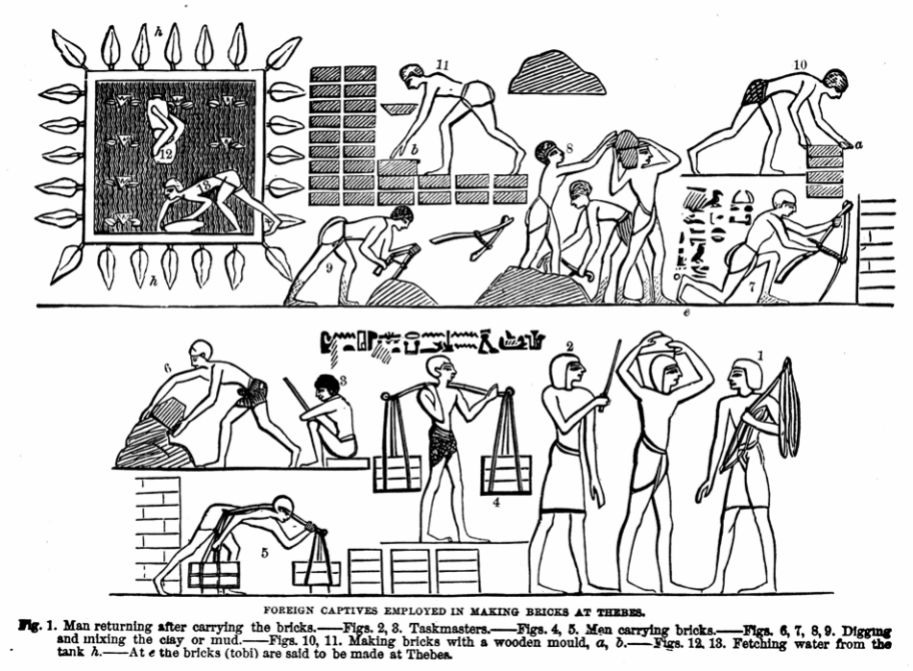
13, 14. The nature of their toil is here more fully described. Hard bondage — Rather, hard labour in clay and bricks, and all (kind of) service in the field. They were not made house-servants, or employed as artisans in any kind of skilled labour, but were set at the coarse work of brick-making for the great public buildings, canal digging, raising water from the river for irrigation, which is specially toilsome in Egypt, and similar rough outdoor labours. This remark applies only to this time of special oppression. Josephus says that they built the pyramids; but the great pyramids are made of stone, and were standing when Joseph went down into Egypt. A vast amount of brick was required for the walls of cities, fortresses, temple-courts, and private as well as public buildings. They were made of the Nile mud mixed with straw, and of clay without straw, baked in the sun, and their manufacture was a government monopoly. Immense piles of these bricks — the ruins of ancient works, many of them stamped with the hieroglyphs of the Pharaohs — are now found in the land of Goshen. The opposite engraving represents a painting at Thebes, in the tomb of an officer of Thothmes III., of the eighteenth dynasty, and delineates all the processes of Egyptian brick-making, foreign captives being the labourers, directed by Egyptian task-masters.
It is a noteworthy fact, that, in an inscription of the twenty-second year of Amosis, alien labourers of some pastoral nation, like the Israelites, are described as carrying blocks of limestone from the Rufu quarries to Memphis. This, like the opposite picture, shows that events precisely like those narrated in the text were, according to the best chronology, transpiring in Egypt at the time when the Israelites were there.
And they made their lives bitter with hard bondage, in morter, and in brick, and in all manner of service in the field: all their service, wherein they made them serve, was with rigor.
Adam Clarke on Exodus 1:14
Editorial note: Source collation note — paragraph 2: “with hard bondage] בעבדה קשה baabodah kashah, with grievous”. source PDF page 9: “servitude. With hard bondage קשה בעבדה baabodah kashah, with grievous”. Compared with CLA_EXO.PDF PDF p. 9. The source-font or layout comparison does not securely establish every letter, mark or local sequence in these passages. The flagged language readings or layout are retained; the original source pages should be consulted for these specific readings. Additional-source investigation: an automated comparison of surrounding English text located possible corresponding passages in OCR from separately digitized printed volumes. The linked scan pages are research locators; their images have not been collated for this note's flagged readings. OCR agreement does not verify Greek or Hebrew letters, diacritics, word order, or table layout. The flagged readings or layout remain uncertain. CLA_EXO.PDF, PDF page 9; Additional printed-scan page locator (OCR context only; flagged reading unverified).
Verse 14. They made their lives bitter] So that they became weary of life, through the severity of their servitude.
With hard bondage] בעבדה קשה baabodah kashah, with grievous servitude. This was the general character of their life in Egypt; it was a life of the most painful servitude, oppressive enough in itself, but made much more so by the cruel manner of their treatment while performing their tasks.
In mortar, and in brick] First, in digging the clay, kneading, and preparing it, and secondly, forming it into bricks, drying them in the sun, &c.
Service in the field] Carrying these materials to the places where they were to be formed into buildings, and serving the builders while employed in those public works. Josephus says “The Egyptians contrived a variety of ways to afflict the Israelites; for they enjoined them to cut a great number of channels for the river, and to build walls for their cities and ramparts, that they might restrain the river, and hinder its waters from stagnating upon its overrunning its own banks; they set them also to build pyramids, (πυραμιδας τε ανοικοδομουντες,) and wore them out, and forced them to learn all sorts of mechanic arts, and to accustom themselves to hard labour.”-Antiq., lib. ii., cap. ix., sec. 1. Philo bears nearly the same testimony, p. 86, Edit. Mangey.
Joseph Benson on Exodus 1:14
Verse 14. In mortar and brick — It has been supposed by many, that, besides the treasure-cities, mentioned verse 11, and other similar works, the Israelites were employed in raising those enormous piles, termed pyramids, which remain to this day, and probably will remain to the end of the world; “monuments, not so much of the greatness and wisdom, as of the folly, caprice, exorbitant power, and cruel tyranny of the monarchs who projected them. It cannot indeed be denied, that the skill wherewith they were planned equals the vastness of the labour with which they were completed; but then it is evident they never could be useful in any degree adequate to the toil and expense with which they were erected. The supposition, however, is entirely groundless; for the Israelites were employed in making brick; while it is well known the pyramids were built of hewn stone.” — Scott. “The great pyramid,” says Herodotus, “was covered with polished stones, perfectly well joined, the smallest of which was thirty feet long. It was built in the form of steps, on each of which were placed wooden machines to raise the stones from one to another.” Diodorus adds, that “the stories were of very different workmanship, and of eternal duration. It is preserved to our days (the middle of the Augustan age) without being in the least injured. The marble was brought from the quarries of Arabia.” Pliny bears the same testimony: “It is formed of stone brought from the quarries of Arabia.” — Encycl. Brit. So that, it seems evident, the Israelites, who were employed in brick and mortar, had no hand in erecting the pyramids. All manner of service in the field — In cultivating the ground, and, according to Josephus, in cutting canals and trenches, to convey to different parts of the country the waters of the Nile, to raise up mounds, lest the waters overflowing should stagnate, and in other laborious services.
Cited across the library (1 reference)
- DictionaryWatson’s Dictionary: Law
And the king of Egypt spake to the Hebrew midwives, of which the name of the one was Shiphrah, and the name of the other Puah:
John Wesley on Exodus 1:15
V. 15. And the king spake to the Hebrew midwives-The two chief of them. They are called Hebrew midwives, probably not because they were themselves Hebrews; for sure Pharaoh could never expect they should be so barbarous to those of their own nation, but because they were generally made use of by the Hebrews, and being Egyptians he hoped to prevail with them.
Adam Clarke on Exodus 1:15
Verse 15. Hebrew midwives] Shiphrah and Puah, who are here mentioned, were probably certain chiefs, under whom all the rest acted, and by whom they were instructed in the obstetric art. Aben Ezra supposes there could not have been fewer than five hundred midwives among the Hebrew women at this time, but that very few were requisite see proved on Exodus 1:19. See Clark on “Exodus 1:19”.
Joseph Benson on Exodus 1:15
Verse 15. The king spake to the Hebrew midwives — The two chief of them. They are called Hebrew midwives, probably not because they were themselves Hebrews; for sure Pharaoh could never expect they should be so barbarous to those of their own nation; but because they were generally made use of among the Hebrews, and being Egyptians, he hoped to prevail with them.
Daniel Whedon on Exodus 1:15–16
15, 16. A second and far more cruel edict now went forth. Herodotus shows (vol. 2:84) that medical theory and practice were highly perfected in Egypt, medical specialties being carefully cultivated; and the monuments show that the women were accoucheurs. Shiphrah and Puah were superintendents of the midwives, and are here designated the midwives, as Pharaoh’s chief butler and baker are called the butler and baker in Genesis 11:1. This orderly superintendence of all industries is abundantly illustrated on the Theban tombs. When ye… see them upon the stools — When ye look upon the birth, (Targ. Onk.) At the very moment of birth they were to destroy the child, if a male, as they could easily do even before the mother had seen it. This edict was probably aimed specially at the leading families of Israel, for such only would be likely to employ a professional midwife. See Concluding Notes. (2.)
And he said, When ye do the office of a midwife to the Hebrew women, and see them upon the stools; if it be a son, then ye shall kill him: but if it be a daughter, then she shall live.
John Wesley on Exodus 1:16
V. 16. The stools-Seats used on that occasion.
Adam Clarke on Exodus 1:16
Editorial note: Source collation note — paragraph 1: “16. upon the stools] על האבנים al haobnayim. this is”. source PDF page 10: “16. Upon the stools האבנים על al haobnayim This is”. Compared with CLA_EXO.PDF PDF p. 10. The source-font or layout comparison does not securely establish every letter, mark or local sequence in these passages. The flagged language readings or layout are retained; the original source pages should be consulted for these specific readings. Additional-source investigation: an automated comparison of surrounding English text located possible corresponding passages in OCR from separately digitized printed volumes. The linked scan pages are research locators; their images have not been collated for this note's flagged readings. OCR agreement does not verify Greek or Hebrew letters, diacritics, word order, or table layout. The flagged readings or layout remain uncertain. CLA_EXO.PDF, PDF page 10; Additional printed-scan page locator (OCR context only; flagged reading unverified).
Verse 16. Upon the stools] על האבנים al haobnayim. This is a difficult word, and occurs nowhere else in the Hebrew Bible but in Jeremiah 18:3, where we translate it the potter’s wheels. As אכי signifies a stone, the obnayim has been supposed to signify a stone trough, in which they received and washed the infant as soon as born. Jarchi, in his book of Hebrew roots, gives a very different interpretation of it; he derives it from בן ben, a son, or בנים banim, children; his words must not be literally translated, but this is the sense: “When ye do the office of a midwife to the Hebrew women, and ye see that the birth is broken forth, if it be a son, then ye shall kill him.” Jonathan ben Uzziel gives us a curious reason for the command given by Pharaoh to the Egyptian women: “Pharaoh slept, and saw in his sleep a balance, and behold the whole land of Egypt stood in one scale, and a lamb in the other; and the scale in which the lamb was outweighed that in which was the land of Egypt. Immediately he sent and called all the chief magicians, and told them his dream. And Janes and Jimbres, (see 2 Timothy 3:8.) who were chief of the magicians, opened their mouths and said to Pharaoh, ‘A child is shortly to be born in the congregation of the Israelites, whose hand shall destroy the whole land of Egypt.’ Therefore Pharaoh spake to the midwives, &c.”
Joseph Benson on Exodus 1:16–19
Verses 16-19. The stools — Seats used on that occasion. But the midwives feared God — Dreaded his wrath more than Pharaoh’s, and therefore saved the men-children alive. The Hebrew women are lively — We have no reason to doubt the truth of this; it is plain they were now under an extraordinary blessing of increase, which may well be supposed to have had this effect, that the women had quick and easy labour, and the mothers and children being both lively, they seldom needed the help of midwives: this these midwives took notice of, and concluding it to be the finger of God, were thereby imboldened to disobey the king, and with this justify themselves before Pharaoh when he called them to an account for it.
Cited across the library (1 reference)
But the midwives feared God, and did not as the king of Egypt commanded them, but saved the men children alive.
John Wesley on Exodus 1:17
V. 17. But the midwives feared God-Dreaded his wrath more than Pharaoh’s, and therefore saved the men-children alive.
Adam Clarke on Exodus 1:17
Verse 17. The midwives feared God] Because they knew that God had forbidden murder of every kind; for though the law was not yet given, Exodus 20:13, being Hebrews they must have known that God had from the beginning declared, Whosoever sheddeth man’s blood, by man shall his blood be shed, Genesis 9:6. Therefore they saved the male children of all to whose assistance they were called. See Clarke’s note on “Exodus 1:19”.
Daniel Whedon on Exodus 1:17–19
17-19. But the midwives feared — Feared the (one only) God rather than Pharaoh, and would not execute his murderous mandate. Their excuse was plausible, for childbirth is usually easy with women of the pastoral class, especially in the East. Burckhardt and Tischendorf relate that the Bedouin mother seeks a spot by a spring or stream, and bears and dresses her infant without aid. She even sometimes alights from her camel to bear her child, which she washes in the sand and then resumes her place.
And the king of Egypt called for the midwives, and said unto them, Why have ye done this thing, and have saved the men children alive?
And the midwives said unto Pharaoh, Because the Hebrew women are not as the Egyptian women; for they are lively, and are delivered ere the midwives come in unto them.
John Wesley on Exodus 1:19
V. 19. I see no reason we have to doubt the truth of this; it is plain they were now under an extraordinary blessing of increase, which may well be supposed to have this effect, that the women had quick and easy labour, and the mothers and children being both lively, they seldom needed the help of midwives; this these midwives took notice of, and concluding it to be the finger of God, were thereby emboldened to disobey the king, and with this justify themselves before Pharaoh, when he called them to an account for it.
Adam Clarke on Exodus 1:19
Verse 19. The Hebrew women are not as the Egyptian women] This is a simple statement of what general experience shows to be a fact, viz., that women, who during the whole of their pregnancy are accustomed to hard labour, especially in the open air, have comparatively little pain in parturition. At this time the whole Hebrew nation, men and women, were in a state of slavery, and were obliged to work in mortar and brick, and all manner of service IN THE FIELD, Exodus 1:14, and this at once accounts for the ease and speediness of their travail. With the strictest truth the midwives might say, The Hebrew women are not as the Egyptian women: the latter fare delicately, are not inured to labour, and are kept shut up at home, therefore they have hard, difficult, and dangerous labours; but the Hebrew women are lively, חיות chayoth, are strong, hale, and vigorous, and therefore are delivered ere the midwives come in unto them. In such cases we may naturally conclude that the midwives were very seldom even sent for. And this is probably the reason why we find but two mentioned; as in such a state of society there could be but very little employment for persons of that profession, as a mother, an aunt, or any female acquaintance or neighbour, could readily afford all the assistance necessary in such cases. Commentators, pressed with imaginary difficulties, have sought for examples of easy parturition in Æthiopia, Persia, and India, as parallels to the case before us; but they might have spared themselves the trouble, because the case is common in all parts of the globe where the women labour hard, and especially in the open air. I have known several instances of the kind myself among the labouring poor. I shall mention one: I saw a poor woman in the open field at hard labour; she stayed away in the afternoon, but she returned the next morning to her work with her infant child, having in the interim been safely delivered! She continued at her daily work, having apparently suffered no inconvenience! I have entered more particularly into this subject because, through want of proper information, (perhaps from a worse motive,) certain persons have spoken very unguardedly against this inspired record: “The Hebrew midwives told palpable lies, and God commends them for it; thus we may do evil that good may come of it, and sanctify the means by the end.” Now I contend that there was neither lie direct nor even prevarication in the case. The midwives boldly state to Pharaoh a fact, (had it not been so, he had a thousand means of ascertaining the truth,) and they state it in such a way as to bring conviction to his mind on the subject of his oppressive cruelty on the one hand, and the mercy of Jehovah on the other. As if they had said, “The very oppression under which, through thy cruelty, the Israelites groan, their God has turned to their advantage; they are not only fruitful, but they bring forth with comparatively no trouble; we have scarcely any employment among them.” Here then is a fact, boldly announced in the face of danger; and we see that God was pleased with this frankness of the midwives, and he blessed them for it.
Joseph Sutcliffe on Exodus 1:19
Ver. 19. Are lively. This no doubt was often true, and the king believed it. These midwives had the character of confessors of righteousness, because they risked their lives for their religion, and their people. Women engaged in some laborious employment have a great advantage over those of softer habits of life, at the time of parturition, because of their superior hardiness and strength. This edict, it would seem, was too cruel to be of long continuance.
Cited across the library (1 reference)
- DictionaryWatson’s Dictionary: Child Birth
Therefore God dealt well with the midwives: and the people multiplied, and waxed very mighty.
John Wesley on Exodus 1:20
V. 20. Therefore God dealt well with them-That is, built them up in families, and blessed their children.
Adam Clarke on Exodus 1:20
Verse 20. Therefore God dealt well with the midwives: and the people multiplied, and waxed very mighty.] This shows an especial providence and blessing of God; for though in all cases where females are kept to hard labour they have comparatively easy and safe travail, yet in a state of slavery the increase is generally very small, as the children die for want of proper nursing, the women, through their labour, being obliged to neglect their offspring; so that in the slave countries the stock is obliged to be recruited by foreign imports: yet in the case above it was not so; there was not one barren among their tribes, and even their women, though constantly obliged to perform their daily tasks, were neither rendered unfruitful by it, nor taken off by premature death through the violence and continuance of their labour, when even in the delicate situation mentioned above.
Joseph Benson on Exodus 1:20–21
Verses 20, 21. God dealt well with the midwives — he made them houses — He blessed them in kind: for as they kept up Israel’s houses or families, so God, in recompense, built them up into families, blessed their children, and made them prosperous. But a late learned writer interprets the passage as follows: Pharaoh, resolving effectually to prevent the increase of the Israelites, built houses for them, that so they might no longer have it in their power to lodge their women in child-bed out of the way to save their children, by removing them from place to place, as they had before done when they lived in the fields in tents, which was their ancient way of living. But the other seems the true interpretation.
Daniel Whedon on Exodus 1:20
20. God dealt well with the mid-wives — Augustine well says: “Not their falsehood, but their mercy, kindness, and fear of God, were rewarded. For the sake of the good, God forgave the evil.” It was well that the fear of God kept them from murder; it had been better if it had also kept them from falsehood.
And it came to pass, because the midwives feared God, that he made them houses.
Adam Clarke on Exodus 1:21
Verse 21. He made them houses.] Dr. Shuckford thinks that there is something wrong both in the punctuation and translation of this place, and reads the passage thus, adding the 21st to the 20th verse: “And they multiplied and waxed mighty; and this happened (ויהי vayehi) because the midwives feared God; and he (Pharaoh) made (להם lahem, masc.) them (the Israelites) houses; and commanded all his people, saying, Every son that is born, &c.” The doctor supposes that previously to this time the Israelites had no fixed dwellings, but lived in tents, and therefore had a better opportunity of concealing their children; but now Pharaoh built them houses, and obliged them to dwell in them, and caused the Egyptians to watch over them, that all the male children might be destroyed, which could not have been easily effected had the Israelites continued to live in their usual scattered manner in tents. That the houses in question were not made for the midwives, but for the Israelites in general, the Hebrew text seems pretty plainly to indicate, for the pronoun להם lahem, to them, is the masculine gender; had the midwives been meant, the feminine pronoun להן laken would have been used. Others contend that by making them houses, not only the midwives are intended, but also that the words mark an increase of their families, and that the objection taken from the masculine pronoun is of no weight, because these pronouns are often interchanged; see 1 Kings 22:17, where להם lahem is written, and in the parallel place, 2 Chronicles 18:16, להן lahen is used. So בהם bahem, in 1 Chronicles 10:7, is written בהן bahen, 1 Samuel 31:7, and in several other places. There is no doubt that God did bless the midwives, his approbation of their conduct is strictly marked; and there can be no doubt of his prospering the Israelites, for it is particularly said that the people multiplied and waxed very mighty. But the words most probably refer to the Israelites, whose houses or families were built up by an extraordinary increase of children, notwithstanding the cruel policy of the Egyptian king. Vain is the counsel of man when opposed to the determinations of God! All the means used for the destruction of this people became in his hand instruments of their prosperity and increase. How true is the saying, If God be for us, who can be against us?
Joseph Sutcliffe on Exodus 1:21
Ver. 21. Made them houses. Their fortitude in resisting the king’s bloody decrees, so exalted their character, that they were married into the first families of Levi; or the Lord blessed them with a vast posterity in their houses.
Daniel Whedon on Exodus 1:21
21. Made them houses — Built up their families, increased their posterity, in reward for their preservation of the posterity of Israel. This, in the Hebrew idiom, is to “build a house.” Comp. 2 Samuel 7:11, 27.
And Pharaoh charged all his people, saying, Every son that is born ye shall cast into the river, and every daughter ye shall save alive.
Adam Clarke on Exodus 1:22
Verse 22. Ye shall cast into the river] As the Nile, which is here intended, was a sacred river among the Egyptians, it is not unlikely that Pharaoh intended the young Hebrews as an offering to his god, having two objects in view: 1. To increase the fertility of the country by thus procuring, as he might suppose, a proper and sufficient annual inundation; and 2. To prevent an increase of population among the Israelites, and in process of time procure their entire extermination.
It is conjectured, with a great show of probability, that the edict mentioned in this verse was not made till after the birth of Aaron, and that it was revoked soon after the birth of Moses; as, if it had subsisted in its rigour during the eighty-six years which elapsed between this and the deliverance of the Israelites, it is not at all likely that their males would have amounted to six hundred thousand, and those all effective men.
IN the general preface to this work reference has been made to ORIGEN’S method of interpreting the Scriptures, and some specimens promised. On the plain account of a simple matter of fact, related in the preceding chapter, this very eminent man, in his 2d Homily on Exodus, imposes an interpretation of which the following is the substance.
“Pharaoh, king of Egypt, represents the devil; the male and female children of the Hebrews represent the animal and rational faculties of the soul. Pharaoh, the devil, wishes to destroy all the males, i.e., the seeds of rationality and spiritual science through which the soul tends to and seeks heavenly things; but he wishes to preserve the females alive, i.e., all those animal propensities of man, through which he becomes carnal and devilish.
Hence,” says he, “when you see a man living in luxury, banquetings, pleasures, and sensual gratifications, know that there the king of Egypt has slain all the males, and preserved all the females alive. The midwives represent the Old and New Testaments: the one is called Sephora, which signifies a sparrow, and means that sort of instruction by which the soul is led to soar aloft, and contemplate heavenly things; the other is called Phua, which signifies ruddy or bashful, and points out the Gospel, which is ruddy with the blood of Christ, spreading the doctrine of his passion over the earth. By these, as midwives, the souls that are born into the Church, are healed, for the reading of the Scriptures corrects and heals what is amiss in the mind. Pharaoh, the devil, wishes to corrupt those midwives, that all the males-the spiritual propensities, may be destroyed; and this he endeavours to do by bringing in heresies and corrupt opinions. But the foundation of God standeth sure. The midwives feared God, therefore he builded them houses. If this be taken literally, it has little or no meaning, and is of no importance; but it points out that the midwives-the law and the Gospel, by teaching the fear of God, build the houses of the Church, and fill the whole earth with houses of prayer. Therefore these midwives, because they feared God, and taught the fear of God, did not fulfil the command of the king of Egypt-they did not kill the males, and I dare confidently affirm that they did not preserve the females alive; for they do not teach vicious doctrines in the Church, nor preach up luxury, nor foster sin, which are what Pharaoh wishes in keeping the females alive; for by these virtue alone is cultivated and nourished. By Pharaoh’s daughter I suppose the Church to be intended, which is gathered from among the Gentiles; and although she has an impious and iniquitous father, yet the prophet says unto her, Hearken, O daughter, and consider, incline thine ear; forget also thine own people, and thy father’s house, so shall the king greatly desire thy beauty, Psalm 45:10, 11. This therefore is she who is come to the waters to bathe, i.e., to the baptismal font, that she may be washed from the sins which she has contracted in her father’s house. Immediately she receives bowels of commiseration, and pities the infant; that is, the Church, coming from among the Gentiles, finds Moses-the law, lying in the pool, cast out, and exposed by his own people in an ark of bulrushes, daubed over with pitch-deformed and obscured by the carnal and absurd glosses of the Jews, who are ignorant of its spiritual sense; and while it continues with them is as a helpless and destitute infant; but as soon as it enters the doors of the Christian Church it becomes strong and vigorous; and thus Moses-the law, grows up, and becomes, through means of the Christian Church, more respectable even in the eyes of the Jews themselves, according to his own prophecy: I will move them to jealousy with those which are not a people; I will provoke them to anger with a foolish nation, Deuteronomy 32:21. Thus taught by the Christian Church, the synagogue forsakes idolatry; for when it sees the Gentiles worshipping the true God, it is ashamed of its idols, and worships them no more. In like manner, though we have had Pharaoh for our father-though the prince of this world has begotten us by wicked works, yet when we come unto the waters of baptism we take unto us Moses-the law of God, in its true and spiritual meaning; what is low or weak in it we leave, what is strong and perfect we take and place in the royal palace of our heart. Then we have Moses grown up-we no longer consider the law as little or mean; all is magnificent, excellent, elegant, for all is spiritually understood. Let us beseech the Lord Jesus Christ that he may reveal himself to us more and more and show us how great and sublime Moses is; for he by his Holy Spirit reveals these things to whomsoever he will. To him be glory and dominion for ever and ever! Amen.
Neither the praise of piety nor the merit of ingenuity can be denied to this eminent man in such interpretations as these. But who at the same time does not see that if such a mode of exposition were to be allowed, the trumpet could no longer give a certain sound? Every passage and fact might then be obliged to say something, any thing, every thing, or nothing, according to the fancy, peculiar creed, or caprice of the interpreter. I have given this large specimen from one of the ancients, merely to save the moderns, from whose works on the sacred writings I could produce many specimens equally singular and more absurd. Reader, it is possible to trifle with the testimonies of God, and all the while speak serious things; but if all be not done according to the pattern shown in the mount, much evil may be produced, and many stumbling blocks thrown in the way of others, which may turn them totally out of the way of understanding; and then what a dreadful account must such interpreters have to give to that God who has pronounced a curse, not only on those who take away from his word, but also on those who add to it.
Joseph Sutcliffe on Exodus 1:22
Ver. 22. Every son that is born ye shall cast into the river, that the land might not be polluted with blood. Elijah took the prophets of Baal to the brook and slew them. In many parts of Africa the blacks preserve this custom, and in the West Indies many instances of this kind have occurred.
Daniel Whedon on Exodus 1:22
22. Every son… ye shall cast into the river — The Nile. This third and most sweeping edict is now promulgated, by which all Pharaoh’s subjects are commanded to become executioners of the Hebrew children. The command was so inhuman, and so contrary to the interests of the Egyptians themselves, that it is not likely that it was ever enforced for any length of time; but it gave legal opportunity to any who desired to destroy the children of Hebrew families who seemed for any reason specially dangerous. Hence the fears of the mother of Moses. This massacre has, moreover, historic parallels. When the servile class in Sparta became formidable from numbers, the Spartan youth were sent out with daggers to murder a sufficient number to remove apprehension. Diodorus relates that before the time of Psammetichus — that is, all through the Old Testament period — simple jealousy often led the Egyptian kings to put foreigners to death. And this cruel edict opened the schools and the palace of the City of the Sun to the saviour of Israel! And how we glance from the massacre of Goshen to that of Beth-lehem; from the bulrush ark to the manger; from prostrate Ra to Satan falling like lightning from heaven; from the saviour of a nation to the Saviour of a world!
CONCLUDING NOTES.
Chronology of the Exodus. (1.) The period of the Israelitish sojourn in Egypt is expressly declared in Exodus 12:40 to have been 430 years. This harmonizes with the prediction made to Abraham, Genesis 15:13: “Thy seed shall be a stranger in a land that is not theirs, and shall serve them; and they shall afflict them 400 years;” which language is also quoted by Stephen in his discourse in Acts 7:6. But the Samaritan and Septuagint text of Exodus 12:40, give a different reading, which makes the 430 years cover the whole “sojourn” of the three patriarchs, Abraham, Isaac, and Jacob, in Canaan, as well as that of the Israelites in Egypt, extending thus from the arrival of Abraham in Haran to the Exode. This would make the Egyptian sojourn only two hundred and fifteen years. Paul follows this Sept. chronology in Galatians 3:17. We have, then, what are called a long and a short chronology of the Exodus. The short period is adopted in our chronology, (Usher’s) which sets the Exode at B.C. 1491, two hundred and fifteen years after Jacob went down into Egypt. As yet we have not data for deciding with certainty between the two periods, but the census of the Israelites at the Exode is usually deemed to favour four rather than two centuries of Egyptian sojourn. To balance up authorities on this matter gives little light, and the question would seem to have been doubtful in the time of Josephus, since he expressly commits himself to both sides in the same treatise. Compare Antiq., 2:15 with Exodus 2:9. See notes on Exodus 12:40. Egyptian chronology is at present so wholly unsettled that it is rash to dogmatize, and wise to wait patiently till more light comes from the monuments. The most famous Egyptologists differ from each other by centuries in regard to the date of the Exodus. As mentioned above, Usher’s date, B.C. 1491, stands in our English Bible; Poole fixes it at 1652, (Smith’s Bib. Dict., art. Chronology;) Rawlinson at 1650, (Ancient Hist., p. 61;) Wilkinson at first made Thothmes III. the Pharaoh of the Exode, about 1460, (Anc. Egypt, vol. i, pages 76-81, English Edition,) but has since decided for Pthahmen, (Meneptah I.,) of the nineteenth dynasty, who came to the throne about B.C. 1250, (Rawl., Her. App. to book ii, chap. viii;) and so Brugsch, (Hist. de l’Egypt, 1:156,) who makes Rameses II., the father of Pthahmen, to be the Pharaoh of Exodus 1. This is the view of Stanley and many others. Lepsius and Bunsen make the Exode to have taken place under the nineteenth dynasty, and Bunsen fixes about 1320 as its date. Ewald, Winer, and Knobel identify the Pharaoh of Exodus i, with Amosis of the eighteenth dynasty, as in our note. This view is learnedly defended by Canon Cook in the Speaker’s Commentary.
The whole story of the Hyksos, or Shepherd Kings, though so generally accepted, rests solely on the confused and contradictory account of the priest Manetho, who lived more than a thousand years after the alleged events, and fragments of whose work have been handed to us by Josephus and Syncellus, and hopelessly confused with fragments from another Manetho of uncertain date and authority. No trace of the Hyksos is found in the monuments so far, in Herodotus, Diodorus, or the books of Moses. Hengstenberg, Havernik, and many others, consider the whole story as a confused Egyptian legend of the Exode. Blackie, in his Homer, well sets forth this view. (Homer and the Iliad, 1:36.)
(2.) חאבנים, (verse 16.) The word occurs in only one other place, Jeremiah 18:3, where it is rendered the (two) wheels, (of the potter,) in the margin, frames or seats. Five different interpretations are suggested, not noticing proposed alterations of the text, as by Furst, etc.
1. Gesenius, in Heb. Lex., makes it the midwife’s chair, on which she sat before the woman in labour.
2. Gesenius elsewhere makes it the bath tub or trough (badewanne) in which the child was washed. So De Wette.
3. Smith’s Dict. quotes Lane’s Modern Egyptians to show that it means the chair used in aiding delivery, showing that the modern Egyptians have the same custom, and such a chair is said to be represented on the monuments of the eighteenth dynasty. Auf dem Geburts-stuhle, Van Ess. But neither of these interpretations explain the dual form.
4. Ewald interprets the word adverbially as meaning instantly, like the German, flugs; English, “on the fly.”
5. Fagius (Crit. Sacr.) follows the interpretation of J. Kimchi and others, who refer the word to the vagina, the labia uteri. Thus La Haye, (Bib. Max.,) who renders cum in ostiis vulvae prolem videritis. So Keil and Knobel, who seem to settle the question.
Cited across the library (1 reference)
Closing reflections and analysis
Joseph Sutcliffe
REFLECTIONS.
This short chapter comprises a considerable number of years, during which the Hebrews increased in number, increased in wickedness, and almost lost their religion. They worshipped the gods, and revered the abominations of Egypt. Joshua 24:14. Ezekiel 20:8. Circumcision, the grand seal of their covenant fell into total disuse, Joshua 5.; and having partially adopted the idolatry of their oppressors, they made little scruple of intermarrying with the daughters of the Egyptians. Leviticus 24:10. Exodus 12:38. Hence the Lord permitted the sorest calamities to befal his people. Hence also ministers, and the heads of houses may learn, that among a numerous people, rigour of discipline must be preserved. If the reins are once abandoned to passion and the populace, a nation is in full route to become an object of divine visitation.
We may farther observe, that the first strokes of God’s afflictions are to sanctify rather than destroy. Israel in bondage cried unto the Lord: and it is very remarkable that God never brought a man, or a people to distinction and honour, but he began, or very early accompanied his work by affliction. The oppression of the Israelites had a most salutary effect, in weaning their affections from Egypt, and preparing them for the hardships of the desert. Let us then be supported under all our troubles, by a firm persuasion, that soon or late it shall appear that they were intended for our good.
Pharaoh and his court, who decreed the destruction of the male infants, show us that when wicked men are assailed with fears and menaced with danger, they are apt to substitute policy for prudence and cruelty for justice; and in that case, they are sure to fall into the pit they dig for another, as the history before us amply proves. Ah, how many dreadful portraits have we in sacred and profane history of the character of man. To what an extent of wickedness may he not rapidly attain? And who can be preserved, that does not properly believe in God, doing all things in his sight.
In the midwives who feared God, and risked their lives for righteousness, persons may learn how to conduct themselves in the crisis of temptation and trouble. When a man is poor, and persecuted, and friendless, what has he left but his God? And if he, in those circumstances, forfeit the divine favour, he is ruined indeed. Joseph, abandoned in prison, and long forgotten of the butler, had nothing left but his piety; and it proved a hundredfold reward in this life, and in the world to come life everlasting. Let us learn therefore to reject the wisdom of the flesh, and to cherish the wisdom from above, which is pure, peaceable, full of mercy and of good fruit.
John Wesley
NOTES ON THE SECOND BOOK
OF MOSES CALLED EXODUS.
Moses having in the first book of his history preserved the records of the church, while it existed in private families, comes, in the second book, to give us an account of its growth into a great nation. The beginning of the former book shews us how God formed the world for himself, the beginning of this shews us how he formed Israel for himself. There we have the creation of the world in history, here the redemption of the world in type. The Greek translators called this book Exodus, which signifies a going out, because it begins with the story of the going out of the children of Israel from Egypt. This book gives us, I. The accomplishment of the promise made before to Abraham, to chap. xix. and then, II. The establishment of the ordinances which were afterwards observed by Israel: thence to the end. Moses in this book begins, like Caesar, to write his own commentaries; and gives us the history of those things which he was himself an eye and ear witness of. There are more types of Christ in this book than perhaps in any other book of the Old Testament. The way of man’s reconciliation to God, and coming into covenant and communion with him by a Mediator, is here variously represented; and it is of great use to us for the illustration of the New Testament.
CHAPTER 1.
We have here,
I. God’s kindness to Israel, in multiplying them exceedingly, ver. 1-7. II. The Egyptians wickedness to them; 1. Oppressing and enslaving them, ver. 8-14. 2. Murdering their children, ver. 15-22.
Adam Clarke
CHAPTER 1
The names and number of the children of Israel that went down into Egypt, 1-5. Joseph and all his brethren of that generation die, 6. The great increase of their posterity, 7. The cruel policy of the king of Egypt to destroy them, 8-11. They increase greatly, notwithstanding their affliction, 12. Account of their hard bondage, 13, 14. Pharaoh’s command to the Hebrew midwives to kill all the male children, 15,16. The midwives disobey the king’s command, and, on being questioned, vindicate themselves, 17-19. God is pleased with their conduct, blesses them, and increases the people, 20, 21. Pharaoh gives a general command to the Egyptians to drown all the male children of the Hebrews, 22.
NOTES ON CHAP. 1
Joseph Benson
CHAPTER 1.
A.M. 2298. — B.C. 1706.
We have here,
(1,) God’s kindness to Israel, in multiplying them exceedingly, 1-7. (2,) The Egyptians’ wickedness to them; 1, Oppressing and enslaving them, 8-14. 2, Murdering their children, 15-22.
NOTES ON CHAPTER 1.
Joseph Sutcliffe
CHAPTER 1.
Daniel Whedon
BIRTH OF THE NATION. — Exodus 1:1-15:21.
I. PREPARATORY PERIOD.
Increase and Oppression of Israel, Chaps. 1, 2.
CHAPTER 1.
INTRODUCTORY.
(1.) Through the book of generations (Genesis) the fabric of Divine Revelation has risen like a pyramid in ten successive stages, broad as the creation at the bottom, and narrowing at the summit to a single family, which becomes lost from view in the darkness of Egyptian heathenism. The spiritual history of this family is now resumed, in order to develop facts and principles of universal interest and significance. JEHOVAH’S NAME is to be set in Israel, that, through the life and literature of that nation, the glory of that NAME may be diffused over all lands and ages. The narrative, after the manner so often noticed in Genesis, at the commencement doubles back upon itself for a new departure, and gives a brief review of the grand divisions of the nation; it then proceeds to relate the fulfilment of the promises to the patriarchs in the vast fruitfulness of the descendants of Israel. The connexion is thus close and logical with the Book of Generations, to which it is grammatically joined by the simple connective particle. The account of the origin of the world, of the race, of the chosen family, and the record of the successive calls of the patriarchs, having prepared the way, the writer proceeds to describe Jehovah as taking up his abode with men. Various ancient records and traditions, proverbs and songs, have been woven together in this work, but the unity of the composition shows that it proceeds from a single hand.
(2.) A very few lines shed upon the centuries of the Egyptian sojourn all the light that the world has received. The sacred writer did not aim to furnish a full history of Israel, but to develop the fulfilment of God’s plans, and hence he hastens over whole ages to the time of the accomplishment of the patriarchal promises. The work thus differs essentially from all secular histories. It is not a history of Israel, but of God in Israel. The immense increase of Israel in Egypt, whether the time of their sojourn were two or four centuries, precludes the idea of a severe continuous servitude. They were cruelly oppressed only during the last part of their stay. They were by no means a nation of degraded slaves, for they had their elders and scribes, brave warriors, skilled artisans, firm and sober family traditions, and inspiring songs. They had become entangled in Egyptian idolatry, but they had not forgotten the God of their fathers. From Joshua 5:5 we find that the covenant seal of circumcision was set upon the people generation after generation; while a name like Jochebed — meaning, whose glory is Jehovah — shows that at least in the tribe of Levi the covenant Name was revered.
There was a stern, sharp antagonism between the Egyptian religion, with its magnificent temples, its colossal idols, and its pompous ritual, and the simple spiritual worship of the Hebrew patriarchs; and this antagonism developed more and more in successive generations, and culminated in the conflict wherein Jehovah triumphed over the gods of Egypt. Moses did not create, but localized, spiritual forces that had been gathering for generations. When Israel was fully ripe for the revelation, the I AM spoke from the burning bramble.