Section 3: Abbrs, Parts of Speech, Articles
This transcription includes editorial corrections or unresolved source readings. The full record and source references are available below.
Editorial notes and transcription record · 20 notes
Editorial note: Transcription correction in the passage beginning “19. It forms the Genitive in υος, οος, ους the Dative, ui`, oi`, οῖ. Examples of the Fourth Declension.”: the independent 1872 printing, vol. XIV, printed p. 85 (physical PDF page 94), establishes these repairs: “ui`, oi`” → “υϊ, οϊ”. The repair follows the historical print; it does not modernize the grammar or certify other forms and table columns in the passage. Source type on physical PDF page 127; Independent 1872 printing, vol. XIV, printed p. 85 (PDF page 94).
Editorial note: Transcription correction in the passage beginning “βότρ-uv, υος ui` υν υ”: the independent 1872 printing, vol. XIV, printed p. 85 (physical PDF page 94), establishes these repairs: “βότρ-uv, υος ui` υν υ” → “βότρ-υς, υος υϊ υν υ”. The repair follows the historical print; it does not modernize the grammar or certify other forms and table columns in the passage. Source type on physical PDF page 122; Independent 1872 printing, vol. XIV, printed p. 85 (PDF page 94).
Editorial note: Transcription correction in the passage beginning “aijd-ὼς”: the independent 1872 printing, vol. XIV, printed p. 85 (physical PDF page 94), establishes these repairs: “aijd-ὼς” → “αἰδ-ὼς”. The repair follows the historical print; it does not modernize the grammar or certify other forms and table columns in the passage. Source type on physical PDF page 122; Independent 1872 printing, vol. XIV, printed p. 85 (PDF page 94).
Editorial note: Transcription correction in the passage beginning “21. It forms the Genitive in εος, ους, or i`ov the Dative in ei`, ει, or ii`, ι. Examples of the Fifth Declension.”: the independent 1872 printing, vol. XIV, printed p. 86 (physical PDF page 95), establishes these repairs: “i`ov” → “ϊος”; “ei`” → “εϊ”; “ii`” → “ιϊ”. The repair follows the historical print; it does not modernize the grammar or certify other forms and table columns in the passage. Source type on physical PDF page 128; Independent 1872 printing, vol. XIV, printed p. 86 (PDF page 95).
Editorial note: Transcription correction in the passage beginning “basil-εὺς έος ei`, εῖ έα εῦ”: the independent 1872 printing, vol. XIV, printed p. 86 (physical PDF page 95), establishes these repairs: “basil-” → “βασιλ-”; “ei`” → “εϊ”. The repair follows the historical print; it does not modernize the grammar or certify other forms and table columns in the passage. Source type on physical PDF page 122; Independent 1872 printing, vol. XIV, printed p. 86 (PDF page 95).
Editorial note: Transcription correction in the passage beginning “πρέσβ-uv εος ei`, ει υν υ”: the independent 1872 printing, vol. XIV, printed p. 86 (physical PDF page 95), establishes these repairs: “πρέσβ-uv” → “πρέσβ-υς”; “ei`” → “εϊ”. The repair follows the historical print; it does not modernize the grammar or certify other forms and table columns in the passage. Source type on physical PDF page 122; Independent 1872 printing, vol. XIV, printed p. 86 (PDF page 95).
Editorial note: Transcription correction in the passage beginning “ὀφ-iv ιος ii`, ι ι ι”: the independent 1872 printing, vol. XIV, printed p. 86 (physical PDF page 95), establishes these repairs: “ὀφ-iv” → “ὄφ-ις”; “ii`” → “ιϊ”. Only the nominative and the uncontracted dative font codes are repaired; the supplied row's remaining case endings are retained. Source type on physical PDF page 122; Independent 1872 printing, vol. XIV, printed p. 86 (PDF page 95).
Editorial note: Transcription correction in the passage beginning “ἀσ-u εος ei`, ι υ υ”: the independent 1872 printing, vol. XIV, printed p. 86 (physical PDF page 95), establishes these repairs: “ἀσ-u” → “ἄστ-υ”; “ei`” → “εϊ”. The historical sigma–tau ligature is expanded to its two letters in ἄστυ; other case endings in the supplied row are retained. Source type on physical PDF page 122; Independent 1872 printing, vol. XIV, printed p. 86 (PDF page 95).
Editorial note: Transcription correction in the passage beginning “basil-έες, εῖς έων eo~si εας, εῖς”: the independent 1872 printing, vol. XIV, printed p. 86 (physical PDF page 95), establishes these repairs: “basil-” → “βασιλ-”; “eo~si” → “εῦσι”. The repair follows the historical print; it does not modernize the grammar or certify other forms and table columns in the passage. Source type on physical PDF page 122; Independent 1872 printing, vol. XIV, printed p. 86 (PDF page 95).
Editorial note: Transcription correction in the passage beginning “35. Ι becomes poetically εσι or εσσι as, ἐπει` ἐπέεσσι.”: the independent 1872 printing, vol. XIV, printed p. 87 (physical PDF page 96), establishes these repairs: “ἐπει`” → “ἐπεϊ”. The repair follows the historical print; it does not modernize the grammar or certify other forms and table columns in the passage. Source type on physical PDF page 129; Independent 1872 printing, vol. XIV, printed p. 87 (PDF page 96).
Editorial note: Transcription correction in the passage beginning “44. Neuters in αρ make ατος in the Genitive; as, ἀλειαρ, ἀλειφαρ, δέλεαρ, ἐδαρ, ἦπαρ, κάρηαρ, κτέαρ, ὀνειαρ, οὐθαρ, πεῖραρ, σέαρ, φρέαρ Gen. ἀλείατος, etc. Add ”: the independent 1872 printing, vol. XIV, printed p. 88 (physical PDF page 97), establishes these repairs: “Dii`>” → “Διΐ”. Other words and accents in this long list are not certified by this bounded repair. Source type on physical PDF page 131; Independent 1872 printing, vol. XIV, printed p. 88 (PDF page 97).
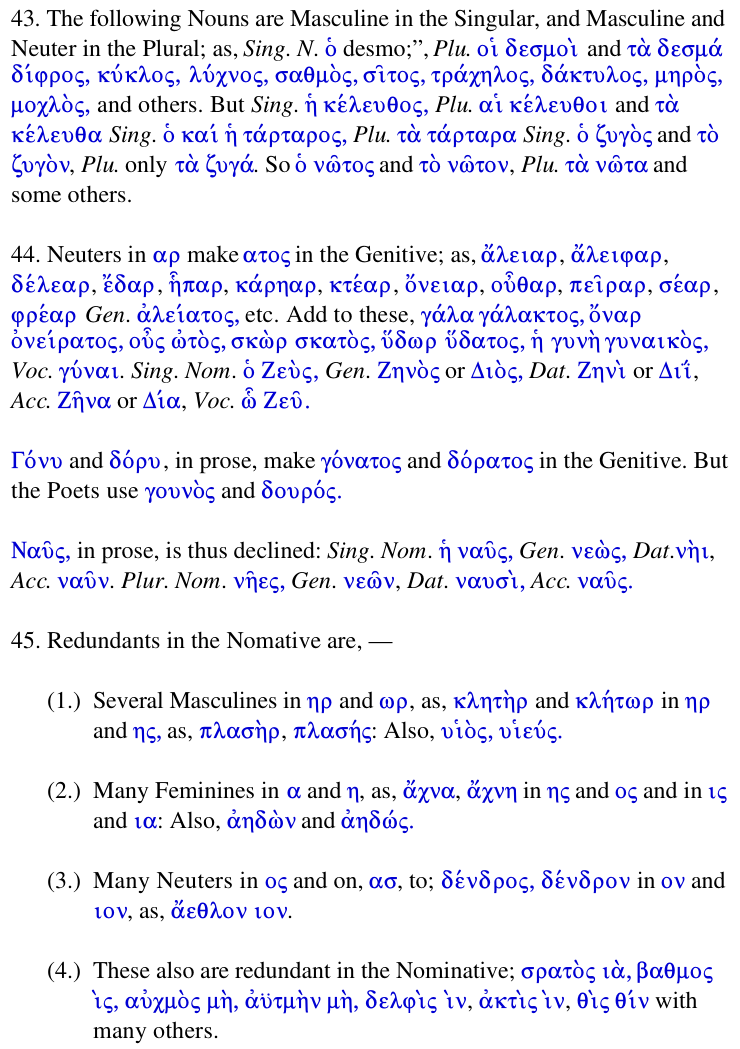
Editorial note: Transcription correction in the passage beginning “(4.) These also are redundant in the Nominative; σρατὸς ιὰ, βαθμος ὶς, αὐχμὸς μὴ, aju`τμὴν μὴ, δελφὶς ὶν, ἀκτὶς ὶν, θὶς θίν with many others.”: the independent 1872 printing, vol. XIV, printed p. 88 (physical PDF page 97), establishes these repairs: “aju`τμὴν” → “ἀϋτμὴν”. The repair follows the historical print; it does not modernize the grammar or certify other forms and table columns in the passage. Source type on physical PDF page 131; Independent 1872 printing, vol. XIV, printed p. 88 (PDF page 97).
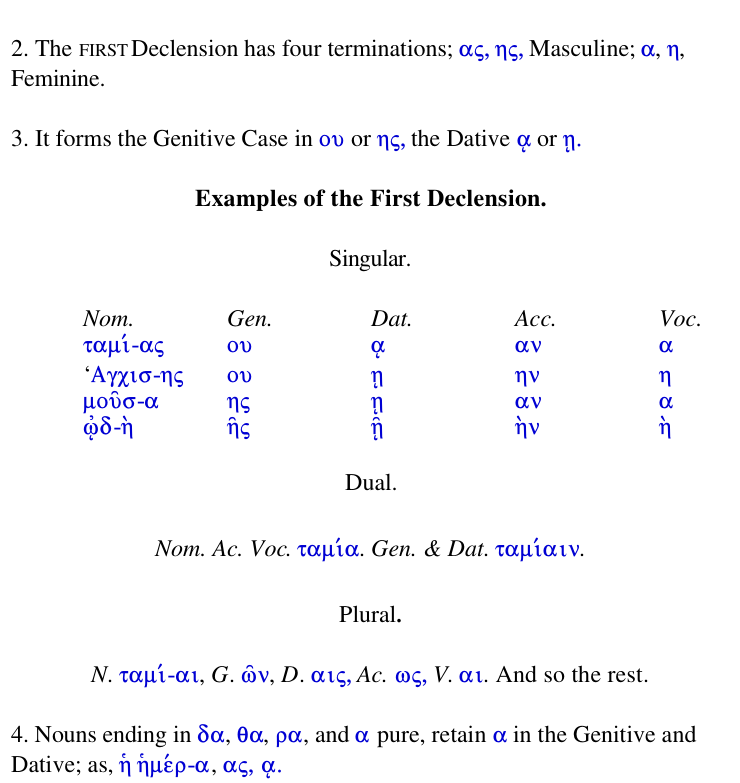
Editorial note: Source-reading note (WES_WW14.PDF, physical page 124): the Greek/Hebrew forms and their layout near “the dative a or h examples of the first declension singular nom gen dat acc voc tami av ou a an a agcishv ou h hn h mou sa hv h an a wj dh h” are not fully established by the transcription. The linked source image preserves the original type for comparison. The original type remains the reference for unresolved letters, accents, points, and layout. Additional-source investigation: an independently typeset 1872 printing of Wesley's Works, vol. XIV, has been located. Its Greek and Hebrew grammar tables provide a second witness, but the available comparison does not securely establish every flagged letter, accent, vowel point, or column boundary in this passage. Any bounded repairs established in this section are identified in separate transcription-correction notes; consult both scans for the remaining unresolved details. Source type and layout, physical PDF page 124; Independent 1872 printing of Wesley's Works, vol. XIV.
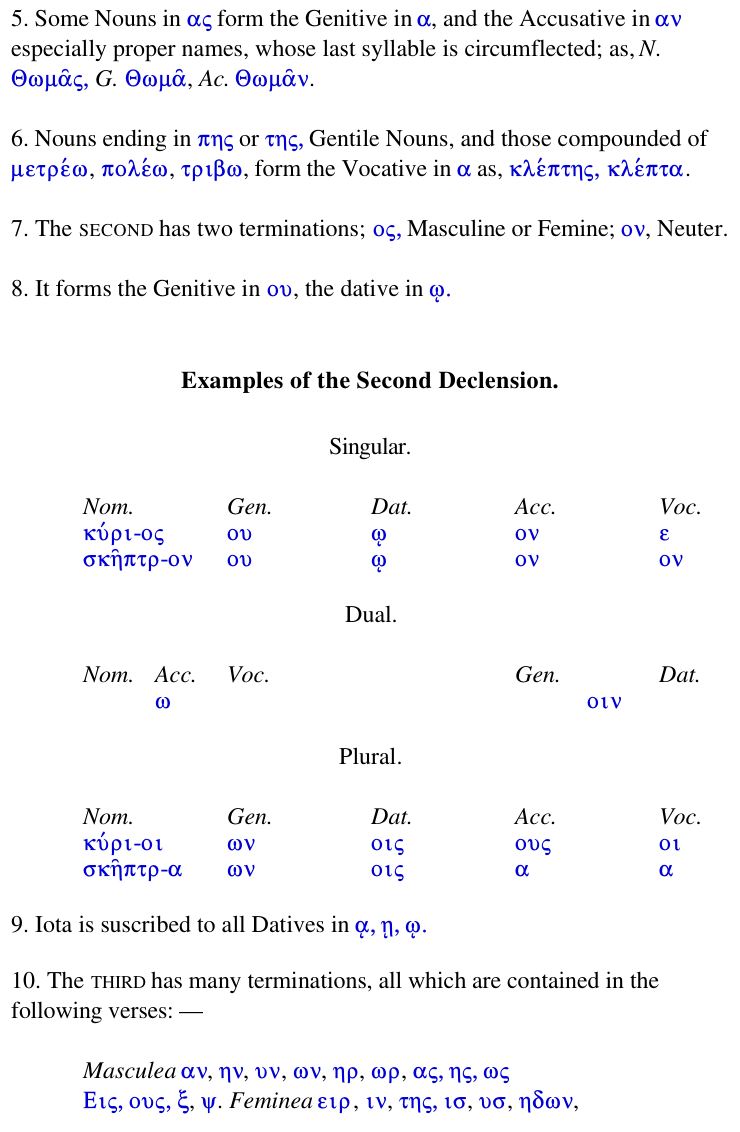
Editorial note: Source-reading note (WES_WW14.PDF, physical page 125): the Greek/Hebrew forms and their layout near “ou the dative in w examples of the second declension singular nom gen dat acc voc ku riov ou w on e skh ptron ou w on on dual nom acc voc ge”; “on on dual nom acc voc gen dat w oin plural nom gen dat acc voc ku rioi wn oiv ouv oi skh ptra wn oiv a a 9 iota is suscribed to all datives” are not fully established by the transcription. The linked source image preserves the original type for comparison. The original type remains the reference for unresolved letters, accents, points, and layout. Additional-source investigation: an independently typeset 1872 printing of Wesley's Works, vol. XIV, has been located. Its Greek and Hebrew grammar tables provide a second witness, but the available comparison does not securely establish every flagged letter, accent, vowel point, or column boundary in this passage. Any bounded repairs established in this section are identified in separate transcription-correction notes; consult both scans for the remaining unresolved details. Source type and layout, physical PDF page 125; Independent 1872 printing of Wesley's Works, vol. XIV.
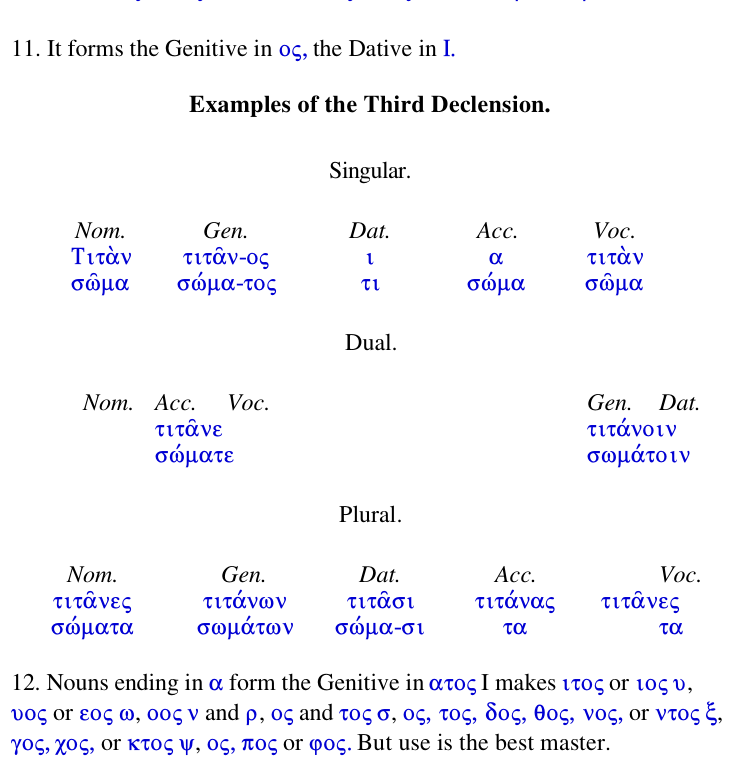
Editorial note: Source-reading note (WES_WW14.PDF, physical page 126): the Greek/Hebrew forms and their layout near “ov the dative in i examples of the third declension singular nom gen dat acc voc tita n tita nov i a tita n sw ma sw matov ti sw ma sw ma du” are not fully established by the transcription. The linked source image preserves the original type for comparison. The original type remains the reference for unresolved letters, accents, points, and layout. Additional-source investigation: an independently typeset 1872 printing of Wesley's Works, vol. XIV, has been located. Its Greek and Hebrew grammar tables provide a second witness, but the available comparison does not securely establish every flagged letter, accent, vowel point, or column boundary in this passage. Any bounded repairs established in this section are identified in separate transcription-correction notes; consult both scans for the remaining unresolved details. Source type and layout, physical PDF page 126; Independent 1872 printing of Wesley's Works, vol. XIV.
Editorial note: Source-reading note (WES_WW14.PDF, physical page 127): the Greek/Hebrew forms and their layout near “feminine as ijlu v and w and wv always feminine 19 it forms the genitive in uov oov ouv the dative ui oi oi examples of the fourth declensio”; “the dative ui oi oi examples of the fourth declension singular nom gen dat acc voc bo truv uov ui un u dual nom acc voc gen dat bo true botr”; “dual nom acc voc gen dat bo true botru oin plural nom gen dat acc voc bo truev truv botru wn bo trusi uav uv uev uv singular lecw oov ou v o” are not fully established by the transcription. The linked source image preserves the original type for comparison. The original type remains the reference for unresolved letters, accents, points, and layout. Additional-source investigation: an independently typeset 1872 printing of Wesley's Works, vol. XIV, has been located. Its Greek and Hebrew grammar tables provide a second witness, but the available comparison does not securely establish every flagged letter, accent, vowel point, or column boundary in this passage. Any bounded repairs established in this section are identified in separate transcription-correction notes; consult both scans for the remaining unresolved details. Source type and layout, physical PDF page 127; Independent 1872 printing of Wesley's Works, vol. XIV.
Editorial note: Source-reading note (WES_WW14.PDF, physical page 128): the Greek/Hebrew forms and their layout near “21 it forms the genitive in eov ouv or i ov the dative in ei ei or ii i examples of the fifth declension”; “21 it forms the genitive in eov ouv or i ov the dative in ei ei or ii i examples of the fifth declension singular nom gen dat acc voc swkra ”; “ei ei or ii i examples of the fifth declension singular nom gen dat acc voc swkra thv eov ouv ei ei ea h ev tei cov eov ouv ei ei ov ov basi”; “i i i a su eov ei i u u dual nom acc voc gen dat swkra tee h e oin oi n tei cea h loin oi n the rest are regular plural nom voc gen dat acc ” are not fully established by the transcription. The linked source image preserves the original type for comparison. The original type remains the reference for unresolved letters, accents, points, and layout. Additional-source investigation: an independently typeset 1872 printing of Wesley's Works, vol. XIV, has been located. Its Greek and Hebrew grammar tables provide a second witness, but the available comparison does not securely establish every flagged letter, accent, vowel point, or column boundary in this passage. Any bounded repairs established in this section are identified in separate transcription-correction notes; consult both scans for the remaining unresolved details. Source type and layout, physical PDF page 128; Independent 1872 printing of Wesley's Works, vol. XIV.
Editorial note: Source-reading note (WES_WW14.PDF, physical page 129): the Greek/Hebrew forms and their layout near “si le onti le ousi 34 r becomes rasi in nouns that have a syncope as patri patra si only gavh r gavh rsi 35 i becomes poetically esi or essi” are not fully established by the transcription. The linked source image preserves the original type for comparison. The original type remains the reference for unresolved letters, accents, points, and layout. Additional-source investigation: an independently typeset 1872 printing of Wesley's Works, vol. XIV, has been located. Its Greek and Hebrew grammar tables provide a second witness, but the available comparison does not securely establish every flagged letter, accent, vowel point, or column boundary in this passage. Any bounded repairs established in this section are identified in separate transcription-correction notes; consult both scans for the remaining unresolved details. Source type and layout, physical PDF page 129; Independent 1872 printing of Wesley's Works, vol. XIV.
Editorial note: Source-reading note (WES_WW14.PDF, physical page 131): the Greek/Hebrew forms and their layout near “nw tov and to nw ton plu ta nw ta and some others 44 neuters in ar make atov in the genitive as a leiar a leifar de lear e dar h par ka rhar”; “in on and ion as a eqlon ion 4 these also are redundant in the nominative srato v ia baqmov i v aujcmo v mh aju tmh n mh delfi v i n ajkti v” are not fully established by the transcription. The linked source image preserves the original type for comparison. The original type remains the reference for unresolved letters, accents, points, and layout. Additional-source investigation: an independently typeset 1872 printing of Wesley's Works, vol. XIV, has been located. Its Greek and Hebrew grammar tables provide a second witness, but the available comparison does not securely establish every flagged letter, accent, vowel point, or column boundary in this passage. Any bounded repairs established in this section are identified in separate transcription-correction notes; consult both scans for the remaining unresolved details. Source type and layout, physical PDF page 131; Independent 1872 printing of Wesley's Works, vol. XIV.
Editorial note: Title comparison: “Abbrs” abbreviates “ABBREVIATIONS”. The source prints “SECTION III. OF ABBREVIATIONS, PARTS OF SPEECH, AND ARTICLES”; all three subjects are present. Source: WES_WW14.PDF, physical PDF page 123.
SECTION III.
OF ABBREVIATIONS, PARTS OF SPEECH, AND ARTICLES.
1. GREEK words are not always writ at length but subject to abbreviation. [The early additions included a series of abbreviations written in a shorthand practiced in the author’s era. Being out of use today and being both difficult to decipher from the original volume and more or less incomprehensible to the modern reader, they are not included in this edition. — Edit.]
2. There are eight sorts of words, five of which are declinable; Article, Noun, Pronoun, Verb, Participle: Three indeclinable; Adverb, Conjunction, Preposition.
3. There are three Numbers; the Singular, Dual, and Plural.
4. The Singular speaketh but of one; as, μοῦσα, a song: The Dual speaketh properly of two; as, μούσα, two songs. The Plural speaketh of many; as, μοῦσαι, songs.
5. The Article prefixed to most Substantives is declined thus: — Singular. Dual. Plural.
N. G. D. Ac. N. & A. G. & D. N. G. D. Ac.
M. ὁ τοῦ τῷ τὸν τὼ τοῖν οἱ τῶν τοῖς τοὺς
F. ἡ τῆς τῇ τὴν τὰ ταῖν αι — ταῖς τὰς
N. τὸ τοῦ τῷ τὸ τὼ τοῖν τὰ — τοῖς τὰ
6. There is no Ablative Case in Greek.
SECTION IV.
OF SUBSTANTIVE NOUNS.
1. THERE are five Declensions; three of Simple, and two of contracted Nouns.
2. The FIRST Declension has four terminations; ας, ης, Masculine; α, η, Feminine.
3. It forms the Genitive Case in ου or ης, the Dative ᾳ or ῃ. Examples of the First Declension.
Singular.
Nom. Gen. Dat. Acc. Voc.
ταμί-ας ου ᾳ αν α
‘Αγχισ-ης ου ῃ ην η
μοῦσ-a ης ῃ αν α
ᾠδ-h< ῆς ῇ ὴν ὴ
Dual.
Nom. Ac. Voc. ταμία. Gen. & Dat. ταμίαιν.
Plural.
N. ταμί-αι, G. ῶν, D. αις, Ac. ως, V. αι. And so the rest.
4. Nouns ending in δα, θα, ρα, and α pure, retain α in the Genitive and Dative; as, ἡ ἡμέρ-α, ας, ᾳ.
5. Some Nouns in ας form the Genitive in α, and the Accusative in αν especially proper names, whose last syllable is circumflected; as, N. Θωμᾶς, G. Θωμᾶ, Ac. Θωμᾶν.
6. Nouns ending in πης or της, Gentile Nouns, and those compounded of μετρέω, πολέω, τριβω, form the Vocative in α as, κλέπτης, κλέπτα.
7. The SECOND has two terminations; ος, Masculine or Femine; ον, Neuter.
8. It forms the Genitive in ου, the dative in ῳ.
Examples of the Second Declension.
Singular.
Nom. Gen. Dat. Acc. Voc.
κύρι-ov ου ῳ ον ε
σκῆπτρ-on ου ῳ ον ον
Dual.
Nom. Acc. Voc. Gen. Dat.
ω οιν
Plural.
Nom. Gen. Dat. Acc. Voc.
κύρι-oi ων οις ους οι
σκῆπτρ-a ων οις α α
9. Iota is suscribed to all Datives in ᾳ, ῃ, ῳ.
10. The THIRD has many terminations, all which are contained in the following verses: —
Masculea αν, ην, υν, ων, ηρ, ωρ, ας, ης, ως
Εις, ους, ξ, ψ. Feminea ειρ, ιν, της, ισ, υσ, ηδων,
Sic ας, αδος Sunt Neutra ας, ατος Vocalis, αρ aut ορ.
11. It forms the Genitive in ος, the Dative in Ι.
Examples of the Third Declension.
Singular.
Nom. Gen. Dat. Acc. Voc.
Τιτὰν τιτᾶν-ov ι α τιτὰν
σῶμα σώμα-tov τι σώμα σῶμα
Dual.
Nom. Acc. Voc. Gen. Dat.
τιτᾶνε τιτάνοιν
σώματε σωμάτοιν
Plural.
Nom. Gen. Dat. Acc. Voc.
τιτᾶνες τιτάνων τιτᾶσι τιτάνας τιτᾶνες
σώματα σωμάτων σώμα-si τα τα
12. Nouns ending in α form the Genitive in ατος I makes ιτος or ιος υ, υος or εος ω, οος ν and ρ, ος and τος σ, ος, τος, δος, θος, νος, or ντος ξ, γος, χος, or κτος ψ, ος, πος or φος. But use is the best master.
13. Sometimes ω in the Nominative is changed into ο in Genitive, and η into ε as, ὁ πρίων, πρίονος ὁ αἰθὴρ, αἰθέρος.
14. Some Nouns ending in ηρ lose ε in the Genitive and Dative Singular; πατὴρ, μήτηρ, γαςήρ G. πατρὸς, D. πατρὶ, A. πατέρα.
15. But Δημήτηρ and θυγάτηρ lose ε in all the oblique cases.
16. ’Ανὴρ takes δ for ε cut off; as, G. ἀνδρὸς, D. ἀνδρί.
17. Add these, ἀρὴν, ἀρνός and κύων, κυνός.
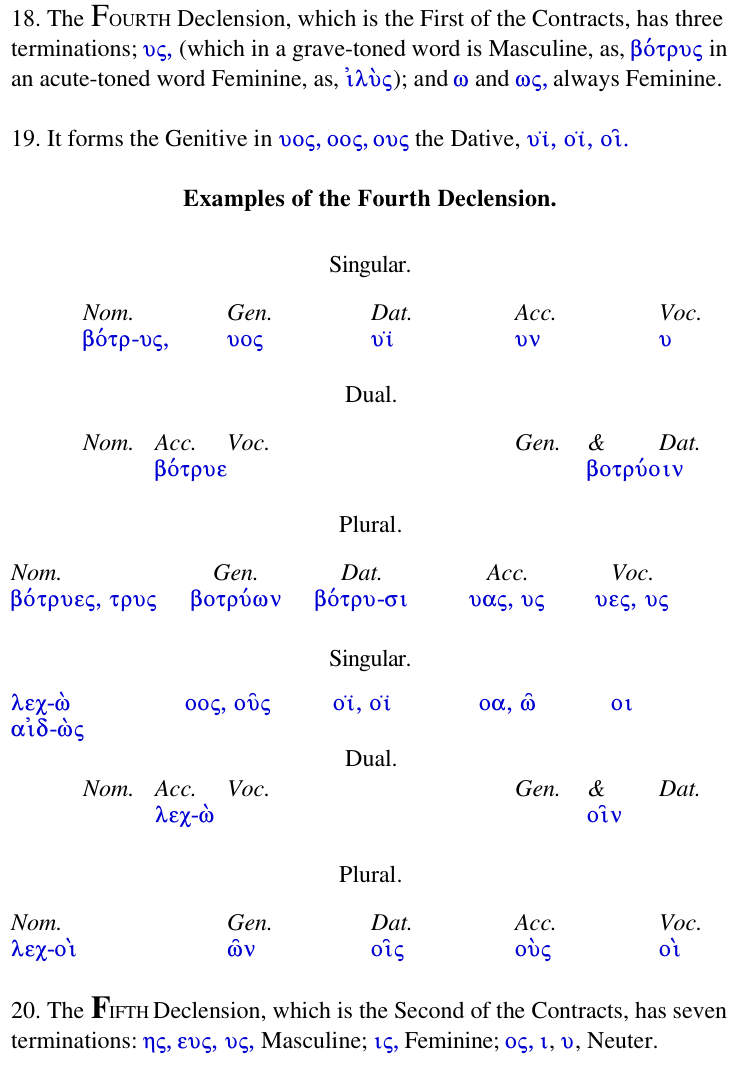
18. The FOURTH Declension, which is the First of the Contracts, has three terminations; υς, (which in a grave-toned word is Masculine, as, βότρυς in an acute-toned word Feminine, as, ἰλὺς); and ω and ως, always Feminine.
19. It forms the Genitive in υος, οος, ους the Dative, υϊ, οϊ, οῖ. Examples of the Fourth Declension.
Singular.
Nom. Gen. Dat. Acc. Voc.
βότρ-υς, υος υϊ υν υ
Dual.
Nom. Acc. Voc. Gen. & Dat.
βότρυε βοτρύοιν
Plural.
Nom. Gen. Dat. Acc. Voc.
βότρυες, τρυς βοτρύων βότρυ-σι υας, υς υες, υς
Singular.
λεχ-ὼ οος, οῦς oi`, oi` οα, ῶ οι
αἰδ-ὼς
Dual.
Nom. Acc. Voc. Gen. & Dat.
λεχ-ὼ οῖν
Plural.
Nom. Gen. Dat. Acc. Voc.
λεχ-οὶ ῶν οῖς οὺς οὶ
20. The FIFTH Declension, which is the Second of the Contracts, has seven terminations: ης, ευς, υς, Masculine; ις, Feminine; ος, ι, υ, Neuter.
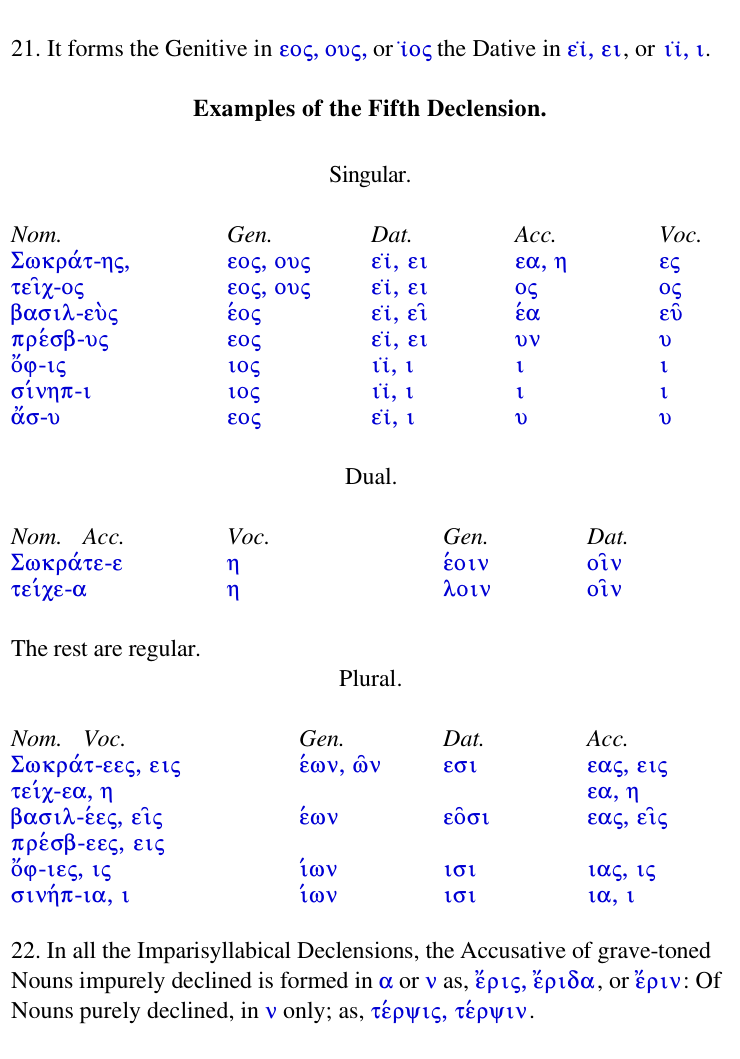
21. It forms the Genitive in εος, ους, or ϊος the Dative in εϊ, ει, or ιϊ, ι. Examples of the Fifth Declension.
Singular.
Nom. Gen. Dat. Acc. Voc.
Σωκράτ-hv, εος, ους ei`, ει εα, η ες
τεῖχ-ov εος, ους ei`, ει ος ος
βασιλ-εὺς έος εϊ, εῖ έα εῦ
πρέσβ-υς εος εϊ, ει υν υ
ὄφ-ις ιος ιϊ, ι ι ι
σίνηπ-i ιος ii`, ι ι ι
ἄστ-υ εος εϊ, ι υ υ
Dual.
Nom. Acc. Voc. Gen. Dat.
Σωκράτε-e η έοιν οῖν
τείχε-a η λοιν οῖν
The rest are regular.
Plural.
Nom. Voc. Gen. Dat. Acc.
Σωκράτ-eev, εις έων, ῶν εσι εας, εις
τείχ-ea, η εα, η
βασιλ-έες, εῖς έων εῦσι εας, εῖς
πρέσβ-eev, εις
ὀφ-iev, ις ίων ισι ιας, ις
σινήπ-ia, ι ίων ισι ια, ι
22. In all the Imparisyllabical Declensions, the Accusative of grave-toned Nouns impurely declined is formed in α or ν as, ἐρις, ἐριδα, or ἐριν: Of Nouns purely declined, in ν only; as, τέρψις, τέρψιν.
23. The Vocative is generally like the Nominative.
24. But Nouns ending in ης εος, ωρ ορος, ων ονος, ηρ ηρος, and Adjectives in ην ενος, shorten the long vowel; as, Σωκράτης, Σώκρατες: Also, σωτὴρ, σώτερ.
25. Nouns forming the Genitive in ντος drop τος as λέων, λέοντος, λεόν. Εις εντος drop σ and τος as, πλακόεις πλακόεντος, πλακόει and πλακόεν.
26. Ας ανος forms the Vocative in αν so μέλας μέλανος, μέλαν.
27. Grave-toned Nouns in ις or υς, and even acuted Adjectives drop σ so τέρψις τέρψι, ὀξὺς ὀξύ.
28. So does a dipthong; as, βασιλεὺς βασιλεῦ. Except ποῦς, ὀδοὺς, κτείς.
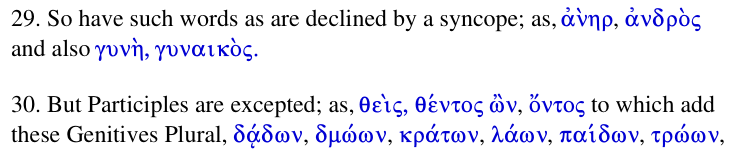
29. Sometimes ξ is dropped; as, ἀναξ ἀνα.
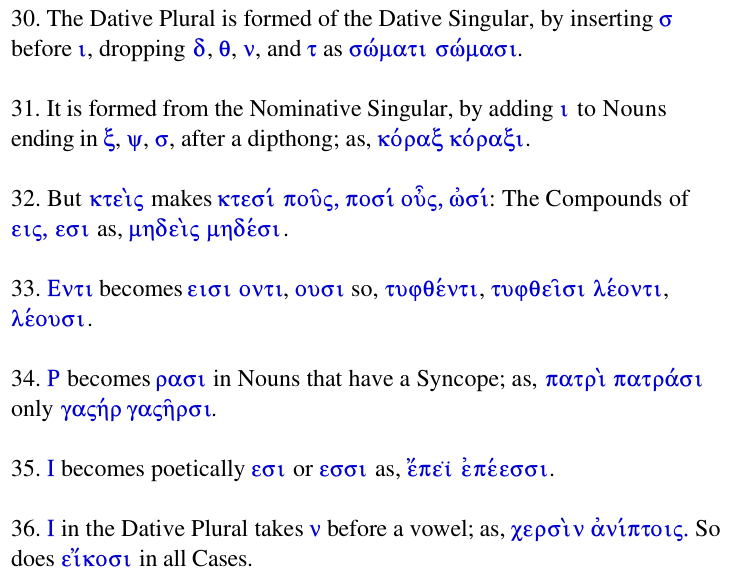
30. The Dative Plural is formed of the Dative Singular, by inserting σ before ι, dropping δ, θ, ν, and τ as σώματι σώμασι.
31. It is formed from the Nominative Singular, by adding ι to Nouns ending in ξ, ψ, σ, after a dipthong; as, κόραξ κόραξι.
32. But κτεὶς makes κτεσί ποῦς, ποσί οὐς, ὠσί: The Compounds of εις, εσι as, μηδεὶς μηδέσι.
33. Εντι becomes εισι οντι, ουσι so, τυφθέντι, τυφθεῖσι λέοντι, λέουσι.
34. Ρ becomes ρασι in Nouns that have a Syncope; as, πατρὶ πατράσι only γαςήρ γαςῆρσι.
35. Ι becomes poetically εσι or εσσι as, ἐπεϊ ἐπέεσσι.
36. Ι in the Dative Plural takes ν before a vowel; as, χερσὶν ἀνίπτοις. So does εἰκοσι in all Cases.
37. HETEROCLITE Nouns, which differ from the common way of declining, are either Defective, Varient, or Redundant.
38. Nouns are defective either in Number or in Case.
39. All Proper Names, and those Nouns which are Singular only by signification, as the names of vices, metals, fruits of the earth, liquors, and the ages of men, want Dual and Plural; as, ἡ φιλοσοφία, γῆρας, γάλα, χρυσός. Yet read, οἱ ἀέρες, from ἀήρ αἱ γαῖ, from γῆ τὰ πυρὰ, from pu’r.
40. These want the Singular and Dual, namely, the feasts of the gods; as, τὰ Κρόνια: Some names of cities; as, αι ’Αθῆναι. So do ’Αχαιοὶ, Εὐμενίδες, Ἐφοροι, τὰ ἐπιτίμια, τὰ ὀνείρατα, τὰ κτέρεα.
41. Nouns defective in Case are, —
(1.) Aptots: as the Names of Letters, ἀλφα, βῆτα foreign Names as Δαβιδ words expressing the natural voice of creatures, as the κοὰξ of frogs κοι; of young pigs; Nouns cut off by Apocope, as δῶ for δῶμα, or increased by Paragoge, as, σρατόφι for σρατός and Numbers, from four to an hundred. Add these Neuters; δάος, δέμας, ἐέλδωρ, ἠδος, ἠτορ, κωςας or κῶς, μῆχος or μῆχαρ, νῶκαρ, σεβας, σκίναρ, τέκμαρ and τέκμωρ, ὑπαρ, χρέως or χρείως, χρεών.
(2.) Monoptots: as, ἡ δὼς, αί κατακλῶθες, ὠ τὰν, and others.
(3.) Dipots: as, ἀμφὼ, ἀμφοῖν οἱ φθοῖες, τοὺς φθοῖας.
(4.) Tripots: as, N. μάρτυς, A. μάρτυν, D. μάρτυσι and G. ἀλλήλων, D. ἀλλήλοις, αις, οις, A. ἀλλήλους, ας, α.
42. Nouns vary either in Gender or in Case.
43. The following Nouns are Masculine in the Singular, and Masculine and Neuter in the Plural; as, Sing. N. ὁ desmo;”, Plu. οἱ δεσμοὶ and τὰ δεσμά δίφρος, κύκλος, λύχνος, σαθμὸς, σῖτος, τράχηλος, δάκτυλος, μηρὸς, μοχλὸς, and others. But Sing. ἡ κέλευθος, Plu. αἱ κέλευθοι and τὰ κέλευθα Sing. ὁ καί ἡ τάρταρος, Plu. τὰ τάρταρα Sing. ὁ ζυγὸς and τὸ ζυγὸν, Plu. only τὰ ζυγά. So ὁ νῶτος and τὸ νῶτον, Plu. τὰ νῶτα and some others.
44. Neuters in αρ make ατος in the Genitive; as, ἀλειαρ, ἀλειφαρ, δέλεαρ, ἐδαρ, ἦπαρ, κάρηαρ, κτέαρ, ὀνειαρ, οὐθαρ, πεῖραρ, σέαρ, φρέαρ Gen. ἀλείατος, etc. Add to these, γάλα γάλακτος, ὀναρ ὀνείρατος, οὐς ὠτὸς, σκὼρ σκατὸς, ὑδωρ ὑδατος, ἡ γυνὴ γυναικὸς, Voc. γύναι. Sing. Nom. ὁ Ζεὺς, Gen. Ζηνὸς or Διὸς, Dat. Ζηνὶ or Διΐ, Acc. Ζῆνα or Δία, Voc. ὦ Ζεῦ.
Γόνυ and δόρυ, in prose, make γόνατος and δόρατος in the Genitive. But the Poets use γουνὸς and δουρός.
Ναῦς, in prose, is thus declined: Sing. Nom. ἡ ναῦς, Gen. νεὼς, Dat.νὴι, Acc. ναῦν. Plur. Nom. νῆες, Gen. νεῶν, Dat. ναυσὶ, Acc. ναῦς.
45. Redundants in the Nomative are, —
(1.) Several Masculines in ηρ and ωρ, as, κλητὴρ and κλήτωρ in ηρ and ης, as, πλασὴρ, πλασής: Also, υἱὸς, υἱεύς.
(2.) Many Feminines in α and η, as, ἀχνα, ἀχνη in ης and ος and in ις and ια: Also, ἀηδὼν and ἀηδώς.
(3.) Many Neuters in ος and on, ασ, to; δένδρος, δένδρον in ον and ιον, as, ἀεθλον ιον.
(4.) These also are redundant in the Nominative; σρατὸς ιὰ, βαθμος ὶς, αὐχμὸς μὴ, ἀϋτμὴν μὴ, δελφὶς ὶν, ἀκτὶς ὶν, θὶς θίν with many others.
46. Several Nouns ending in ους, ως, ις, and ης, are redundant in the Genitive; as, Nom. νοῦς, Gen. οῦ and οός. Μίως, Gen. ω and ωος ὁ γέλως, ωτος and ω. ἡ τίγρις, Gen. ιδος and ιος ἡ θέμις, ιδος and ισος ὁ δάρης, Gen. ου and ητος with some others.