Section 7: Auxiliary Verbs
This transcription includes editorial corrections or unresolved source readings. The full record and source references are available below.
Editorial notes and transcription record · 4 notes
Editorial note: Transcription correction in the passage beginning “Imperf. & Perf. S. ¥Hn, ἠς, ἠ or ἠν”: the independent 1872 printing, vol. XIV, printed p. 99 (physical PDF page 108), establishes these repairs: “¥Hn” → “Ἦν”. The repair follows the historical print; it does not modernize the grammar or certify other forms and table columns in the passage. Source type on physical PDF page 145; Independent 1872 printing, vol. XIV, printed p. 99 (PDF page 108).
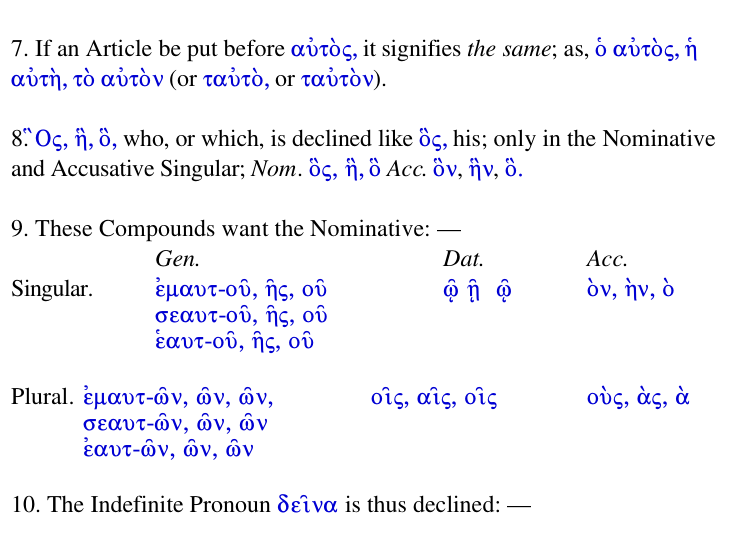
Editorial note: Transcription correction in the passage beginning “Future. S. ’Es-οίμην, οιο, οιτο”: the independent 1872 printing, vol. XIV, printed p. 99 (physical PDF page 108), establishes these repairs: “’Es-” → “Ἐσ-”. The repair follows the historical print; it does not modernize the grammar or certify other forms and table columns in the passage. Source type on physical PDF page 145; Independent 1872 printing, vol. XIV, printed p. 99 (PDF page 108).
Editorial note: Source-reading note (WES_WW14.PDF, physical page 147): the Greek/Hebrew forms and their layout near “imperf perf s hn h v h or h n d h ton h thn p h men h te h san preterpluperf s hmhn h so h to d h meqon h sqon h sqhn p h meqa h sqe h nto f”; “e sesqon p ejso meqa e sesqe e sontai imperative mood present s c isqi or e so e sw d e son e swn p e se e swsan optative mood ei qe pres pe” are not fully established by the transcription. The linked source image preserves the original type for comparison. The original type remains the reference for unresolved letters, accents, points, and layout. Additional-source investigation: an independently typeset 1872 printing of Wesley's Works, vol. XIV, has been located. Its Greek and Hebrew grammar tables provide a second witness, but the available comparison does not securely establish every flagged letter, accent, vowel point, or column boundary in this passage. Any bounded repairs established in this section are identified in separate transcription-correction notes; consult both scans for the remaining unresolved details. Source type and layout, physical PDF page 147; Independent 1872 printing of Wesley's Works, vol. XIV.
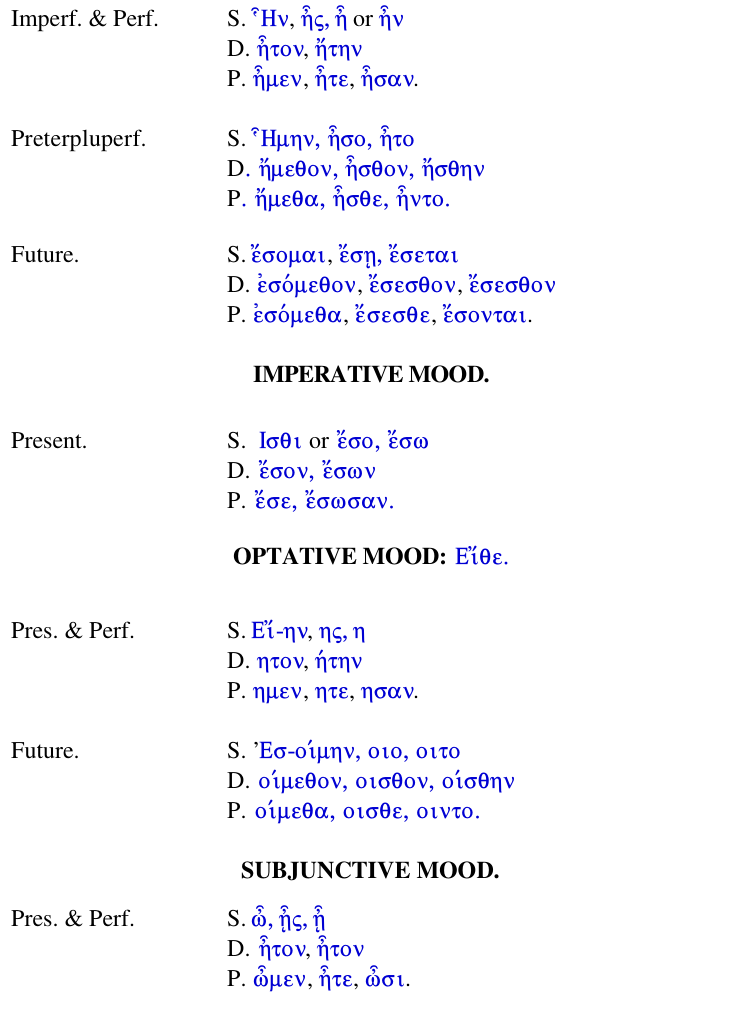
Editorial note: Source-reading note (WES_WW14.PDF, physical page 148): the Greek/Hebrew forms and their layout near “infinitive mood pres perf ei nai fut e sesqai participles present n w n ou sa o n fut n ejso menov h on g o ntov ou shv o ntov g ou hv ou et” are not fully established by the transcription. The linked source image preserves the original type for comparison. The original type remains the reference for unresolved letters, accents, points, and layout. Additional-source investigation: an independently typeset 1872 printing of Wesley's Works, vol. XIV, has been located. Its Greek and Hebrew grammar tables provide a second witness, but the available comparison does not securely establish every flagged letter, accent, vowel point, or column boundary in this passage. Any bounded repairs established in this section are identified in separate transcription-correction notes; consult both scans for the remaining unresolved details. Source type and layout, physical PDF page 148; Independent 1872 printing of Wesley's Works, vol. XIV.
SECTION VII.
OF AUXILIARY VERBS.
1. THERE are five Moods; the Indicative, the Imperative, the Optative, the Subjunctive, and the Infinitive.
2. There are nine Tenses; the Present, the Imperfect, the First Future, the First Indefinite, the Preterperfect, the Preterpluperfect, the Paulo-post-Future, (which is only used in the Passive Voice, and expresses a thing that is quickly to be,) the Second Future, and the Second Indefinite.
3. The Indefinite tenses are so called because of the various times to which they refer; for they are often used indifferently either for the Imperfect, Perfect, or Pluperfect; though mostly for the Perfect.
4. But they are sometimes used for the Present, and also for the Future; especially in Imperatives and Subjunctives.
5. There is but one Auxiliary Verb, which is εἰμὶ, I am.
6. It is conjugated thus: —
Present, Εἰμὶ Future, ἐσομαι Perfect, ἠν
INDICATIVE MOOD.
Present. Singular. Εἰμὶ, εἰς or εἰ, ἐςί
Dual. ἐσὸν, ἐσόν
Plural. ἐσμὲν, ἐσὲ, εἰσί.
Imperf. & Perf. S. Ἦν, ἠς, ἠ or ἠν
D. ἠτον, ἠτην
P. ἠμεν, ἠτε, ἠσαν.
Preterpluperf. S. ¥Hmhn, ἠσο, ἠτο
D. ἠμεθον, ἠσθον, ἠσθην
P. ἠμεθα, ἠσθε, ἠντο.
Future. S. ἐσομαι, ἐσῃ, ἐσεται
D. ἐσόμεθον, ἐσεσθον, ἐσεσθον
P. ἐσόμεθα, ἐσεσθε, ἐσονται.
IMPERATIVE MOOD.
Present. S. ÇIsqi or ἐσο, ἐσω
D. ἐσον, ἐσων
P. ἐσε, ἐσωσαν.
OPTATIVE MOOD: Εἰθε.
Pres. & Perf. S. Εἰ-ην, ης, η
D. ητον, ήτην
P. ημεν, ητε, ησαν.
Future. S. Ἐσ-οίμην, οιο, οιτο
D. οίμεθον, οισθον, οίσθην
P. οίμεθα, οισθε, οιντο.
SUBJUNCTIVE MOOD.
Pres. & Perf. S. ὠ, ᾐς, ᾐ
D. ἠτον, ἠτον
P. ὠμεν, ἠτε, ὠσι.
Future. S. Ἐσ-ωμαι, ῃ, ηται
D. ώμεθον, ησθον, ησθον
P. ώμεθα, ησθε, ωνται.
INFINITIVE MOOD.
Pres. & Perf. Εἰναι Fut. ἐσεσθαι.
PARTICIPLES.
Present. N. ω}ν, οὐσα, ο}ν, Fut. N. ἐσόμεν-ος, η, ον, G. ὀντος, οὐσης, ὀντος. G. ου, ης, ου, etc.