Chapter introductions
And Hiram king of Tyre sent his servants unto Solomon; for he had heard that they had anointed him king in the room of his father: for Hiram was ever a lover of David.
Adam Clarke on 1 Kings 5:1
Verse 1. Hiram king of Tyre] It must have been at the beginning of Solomon’s reign that these ambassadors were sent; and some suppose that the Hiram mentioned here is different from him who was the friend of David; but there seems no very solid reason for this supposition. As Hiram had intimate alliance with David, and built his palace, 2 Samuel 5:11, he wished to maintain the same good understanding with his son, of whose wisdom he had no doubt heard the most advantageous accounts; and he loved the son because he always loved the father, for Hiram was ever a lover of David.
Joseph Benson on 1 Kings 5:1
Verse 1. Hiram sent his servants unto Solomon — Namely, as soon as he heard of his succession in the throne, as the following words show, he sent to congratulate him, as the manner of princes is. For Hiram was ever a lover of David — And therefore was desirous to continue in friendship with his son. This Hiram was probably the son of him who sent David timber and artificers to build his palace. Josephus assures us, that in his time, the letters which passed between him and Solomon were preserved in the archives of Tyre.
Joseph Sutcliffe on 1 Kings 5:1
Verse 1. Tyre, situate on a strong island, was anciently called Zor or Zur, Thevenot supposes from Syria. The Arabs still call it Sor.
Daniel Whedon on 1 Kings 5:1–12
NEGOTIATIONS WITH HIRAM, 1-12.
1. Hiram king of Tyre — Whether this Hiram was the same king of Tyre who supplied David with cedars and carpenters to build his royal palace, (see 2 Samuel 5:11,) some have presumed to doubt. But the positive statement of this verse, that Hiram was ever a lover of David, and the words of Solomon’s message, (2 Chronicles 2:3,) “As thou didst deal with David my father, and didst send him cedars to build him a house,” seem clearly to put it beyond all question that the same Hiram who furnished David materials for his palace assisted Solomon in the building of the temple. No one would ever have thought otherwise had not Menander of Ephesus, according to Josephus, (Jos. against Apion, 1, 18,) affirmed that Hiram reigned thirty-four years; and this seems not long enough to meet the demands of the scriptural narrative. According to 1 Kings 9:10, he was still living in the twentieth year of Solomon’s reign, and this would leave only fourteen years in which to have had his intercourse with David. Accordingly David, who reigned in all but forty years, and seven of these at Hebron, must have reigned nineteen years at Jerusalem before he began to build his royal palace there, a supposition altogether improbable. In view, therefore, of the consistency and positive statements of the scriptural narrative, we conclude that Menander’s chronology is wrong, and that Hiram’s reign must have extended over a large portion of that of both David and Solomon. His servants — Ambassadors.
And Solomon sent to Hiram, saying,
Adam Clarke on 1 Kings 5:2
Verse 2. Solomon sent to Hiram] Made an interchange of ambassadors and friendly greetings. Josephus tells us that the correspondence between Hiram and Solomon was preserved in the archives of the Tyrians even in his time. But this, like many other assertions of the same author, is worthy of little credit.
Thou knowest how that David my father could not build an house unto the name of the LORD his God for the wars which were about him on every side, until the LORD put them under the soles of his feet.
Joseph Benson on 1 Kings 5:3–5
Verses 3-5. A house unto the name of the Lord — For his worship and service. For the wars which were about him on every side — Which diverted his cares and thoughts to other things, and occasioned God’s denying him the honour of that work. Until the Lord put them under the soles of his feet — That is, made them subject to him, that he could trample upon them at his pleasure. Compare Psalm 8:6; 1 Corinthians 15:27. I purpose to build a house unto the name of the Lord — That shall be called by his name, namely, the house of Jehovah; and be appropriated to his honour and glory.
Daniel Whedon on 1 Kings 5:3
3. My father could not build — There was a moral incapacity in David on account of his many wars, or, as expressed in 1 Chronicles 22:8, because he had shed so much blood in the sight of the Lord. He that builds the Lord’s house must not be a noted shedder of blood. Solomon assumes that Hiram knew this.
But now the LORD my God hath given me rest on every side, so that there is neither adversary nor evil occurrent.
Adam Clarke on 1 Kings 5:4
Editorial note: Source collation note — paragraph 1: “there is neither adversary] עין שׂשׂן eyn satan, there is”. source PDF page 35: “There is neither adversary שׂשׂן עין eyn satan, there is”. Compared with CLA_1KI.PDF PDF p. 35. The source-font or layout comparison does not securely establish every letter, mark or local sequence in these passages. The flagged language readings or layout are retained; the original source pages should be consulted for these specific readings. Additional-source investigation: an automated comparison of surrounding English text located possible corresponding passages in OCR from separately digitized printed volumes. The linked scan pages are research locators; their images have not been collated for this note's flagged readings. OCR agreement does not verify Greek or Hebrew letters, diacritics, word order, or table layout. The flagged readings or layout remain uncertain. CLA_1KI.PDF, PDF page 35; Additional printed-scan page locator (OCR context only; flagged reading unverified).
Verse 4. There is neither adversary] עין שׂשׂן eyn satan, there is no satan-no opposer, nor any kind of evil; all is peace and quiet, both without and within. God has given me this quiet that I may build his temple. Deus nobis haec otia fecit.
Daniel Whedon on 1 Kings 5:4
4. Neither adversary nor evil occurrent — No adversary like the Philistines or Moabites, who were formerly anxious to reduce Israel to a state of subjection; no evil incident like the rebellion of Absalom, or the curse of famine or plague.
Cited across the library (1 reference)
And, behold, I purpose to build an house unto the name of the LORD my God, as the LORD spake unto David my father, saying, Thy son, whom I will set upon thy throne in thy room, he shall build an house unto my name.
Adam Clarke on 1 Kings 5:5
Verse 5. A house unto the name of the Lord] The name of God is God himself. I purpose to build a house to that infinite and eternal Being called Jehovah.
Daniel Whedon on 1 Kings 5:5
5. As the Lord spake unto David — See 2 Samuel 7:12, 13, and the notes there.
Now therefore command thou that they hew me cedar trees out of Lebanon; and my servants shall be with thy servants: and unto thee will I give hire for thy servants according to all that thou shalt appoint: for thou knowest that there is not among us any that can skill to hew timber like unto the Sidonians.
John Wesley on 1 Kings 5:6
V. 6. They-That is, thy servants. And this assistance which these Gentiles gave to the building of Solomon’s temple, was a type of the calling of the Gentiles, and that they should be instrumental in building and constituting Christ’s spiritual temple. Cedar-trees-Which for their soundness, and strength, and fragrancy, and durableness, were most proper for his design. Of these David had procured some, but not a sufficient number. Lebanon-Which was in Solomon’s jurisdiction: and therefore he doth not desire that Hiram would give him the cedars, because they were his own already; but only that his servants might hew them for him; which the ingenious Tyrians well understood. With thy servants-Either to be employed therein as they shall direct; or to receive the cedars, from their hands, and transmit them to me. Hire-Pay them for their labour and art. Sidonians-Or Tyrians: for these places and people being near, are promiscuously used one for another.
Adam Clarke on 1 Kings 5:6
Verse 6. Any that can skill to hew timber] An obsolete and barbarous expression for any that know how to cut timber. They had neither sawyers, carpenters, joiners, nor builders among them, equal to the Sidonians. Sidon was a part of the territories of Hiram, and its inhabitants appear to have been the most expert workmen. It requires more skill to fell and prepare timber than is generally supposed. Vitruvius gives some rules relative to this, lib. ii., cap. 9, the sum of which is this: 1. Trees should be felled in autumn, or in the winter, and in the wane of the moon; for in this season the trees recover their vigour and solidity, which was dispersed among their leaves, and exhausted by their fruit, in spring and summer; they will then be free from a certain moisture, very apt to engender worms and rot them, which in autumn and winter is consumed and dried up. 2. Trees should not be cut down at once; they should be cut carefully round towards the pith, that the sap may drop down and distil away, and thus left till thoroughly dry, and then cut down entirely. 3. When fully dried, a tree should not be exposed to the south sun, high winds, and rain; and should be smeared over with cow-dung to prevent its splitting. 4. It should never be drawn through the dew, but be removed in the afternoon. 5. It is not fit for floors, doors, or windows, till it has been felled three years. Perhaps these directions attended to, would prevent the dry rot. And we see from them that there is considerable skill required to hew timber, and in this the Sidonians excelled. We do every thing in a hurry, and our building is good for nothing.
Joseph Benson on 1 Kings 5:6
Verse 6. Now therefore command thou, that they — That is, thy servants, who are skilful in such work; hew me cedar-trees — Which, for their soundness, and strength, and fragrancy, and durable-ness, were most proper for his design. Of these David had procured some, but not a sufficient number. Out of Lebanon — Which was in Solomon’s jurisdiction; and therefore he doth not desire that Hiram would give him the cedars, because they were his own already, but only that his servants might hew them for him, which the ingenious Tyrians well understood: My servants shall be with thy servants — Either to be employed as they shall direct, or to receive the cedars from their hands, and transmit them to me. And unto thee will I give hire for thy servants — Pay them for their labour and art. Sidonians — Or Tyrians; for these places and people, being near each other, are promiscuously used one for another. This assistance, which these Gentiles gave to the building of Solomon’s temple, was a type of the calling of the Gentiles, and that they should be instrumental in building and constituting Christ’s spiritual temple.
Daniel Whedon on 1 Kings 5:6
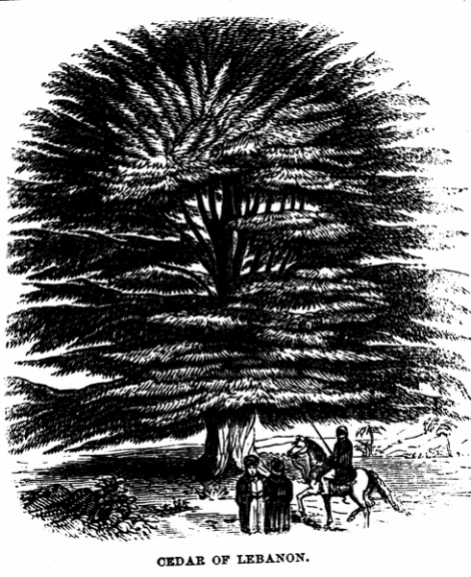
6. Cedar trees out of Lebanon — The cedars of Lebanon are the most celebrated of all the trees of Scripture, the monarchs of the vegetable kingdom. The prophets refer to them as emblems of greatness, majesty, and splendour. Ezekiel, in his prophecy, (chap 31,) presents us with a most graphic description of their grandeur and beauty when he makes them representatives of the Assyrian power and glory. The wood was used for beams, pillars, boards, masts of ships, and carved images. Not only did David and Solomon import it for their building purposes, but the kings of Assyria and Persia, and perhaps of other nations, did the same. This extensive use of the cedar of Lebanon makes it clear that in ancient times this mountain must have been largely covered with forests of this timber. At present only one considerable group, embosomed in a magnificent recess among the loftiest heights of the mountain, and which is generally known, has been often visited and described by travellers. Other groves, however, have been found in other less frequented parts of the mountain. The modern cedar of Lebanon is usually from fifty to eighty feet high, and often covers with its branches, when standing alone, a space the diameter of which is greater than the height of the tree. It is an evergreen, and its leaves are produced in tufts. Its branches, disposed in layers, spread out horizontally, and form, as they approach the top, a thick pyramidal head. All this corresponds closely with Ezekiel’s description, Ezekiel 31:3. The profane writers represent the cedar wood as specially noted for its durability, and the cedar roof of the great temple of Diana at Ephesus is said to have lasted four hundred years. Hew timber like unto the Sidonians — “The Sidonians,” writes Strabo, who lived about the time of Christ, “are said by historians to excel in various kinds of art, as the words of Homer also imply. Besides, they cultivate science and study astronomy and arithmetic. It is thought that geometry was introduced into Greece from Egypt, and astronomy and arithmetic from Phenicia. At present the best opportunities are afforded in these cities for acquiring a knowledge of these and of all other branches of philosophy.” On Zidon, or Sidon, see at Genesis 10:19, Joshua 11:8. כרת, here rendered to hew, means rather to cut down, or to fell. Merely for the felling and treatment of the timber great skill was required. According to Vitruvius, a contemporary of Julius Caesar, and author of a celebrated treatise on architecture, timber must be cut in the autumn or in the winter, when it is free from a moisture which is apt to make it rot, and it should be cut in such a manner as to allow the sap to distil away. It should never be exposed to a hot sun, high winds, or rain, nor drawn through the dew; and it should be in like manner guarded for three years before being used in building. Probably these and other similar precautions gave the Sidonians their fame for skill in felling timber.
Cited across the library (3 references)
And it came to pass, when Hiram heard the words of Solomon, that he rejoiced greatly, and said, Blessed be the LORD this day, which hath given unto David a wise son over this great people.
John Wesley on 1 Kings 5:7
V. 7. Rejoiced-Being a faithful friend to David and his house, and tho’ it is not probable he was a sincere proselyte, yet he had sufficient information concerning the nature and excellency of the God of Israel, and had honourable thoughts of him.
Adam Clarke on 1 Kings 5:7
Verse 7. Blessed be the Lord this day] From this, and indeed from every part of Hiram’s conduct, it is evident that he was a worshipper of the true God; unless, as was the case with many of the heathens, he supposed that every country had its own god, and every god his own country, and he thanked the God of Israel that he had given so wise a prince to govern those whom he considered his friends and allies: but the first opinion seems to be the most correct.
Joseph Benson on 1 Kings 5:7–8
Verses 7, 8. He rejoiced greatly — Being a faithful friend to David and his house; and though it is not probable he was a sincere proselyte, yet he had received much information concerning the nature and excellence of the God of Israel, and had honourable thoughts of him. And Hiram sent to Solomon — A letter, 2 Chronicles 2:11. Timber of fir — The word which we translate fir, others think signifies pine, or cypress; but their conjecture is the most reasonable, who think it was a kind of cedar, and therefore comprehended under that name, verse 6, where Solomon desires of him only that his servants might hew him cedar-trees.
Daniel Whedon on 1 Kings 5:7
7. Hiram heard… and said, Blessed be the Lord — How far this implies that the king of Tyre was a worshipper of the true God is quite uncertain. His expressions of reverence for Jehovah, as Creator of heaven and earth, are still stronger in the parallel passage 2 Chronicles 2:11. He evidently acknowledged Jehovah and worshipped him as God, but, like the Samaritans of a later age, (2 Kings 17:33,) he may have feared the Lord and at the same time have worshipped the various gods of the heathen. In so far, however, as Hiram, a heathen king, was brought to a knowledge of the God of Israel, and worshipped him, and helped to build his holy temple, so far these things may be typical of events in Messiah’s day. The Greater than Solomon, in the building of his spiritual temple builds not with Jews alone. It is significant that the only time Jesus travelled on his works of mercy beyond the limits of the land of Israel was to the coasts of Tyre and Sidon. Mark 7:24. His human ministry was not to be among the Gentiles; but by this one miracle in the regions beyond Israel he would indicate his purpose to gather elect and precious stones from all nations, and build them up together for a habitation of God through the Spirit.
And Hiram sent to Solomon, saying, I have considered the things which thou sentest to me for: and I will do all thy desire concerning timber of cedar, and concerning timber of fir.
Daniel Whedon on 1 Kings 5:8
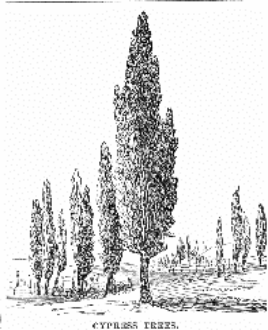
8. Timber of cedar, and… of fir — The fir tree is often mentioned in connection with the cedar. It was a lofty, ornamental tree that grew on Lebanon, (2 Kings 19:23; Isaiah 60:13,) and was used in making ships, (Ezekiel 27:5,) spears, (Nahum 2:3,) and musical instruments, (2 Samuel 6:5.) The Hebrew name is berosh, (ברוש,) and may also designate the cypress or the pine. In 2 Chronicles 2:8, almug trees are mentioned besides cedar and fir, clearly showing that Lebanon was noted for other kinds of celebrated wood besides the cedar. But the almug trees furnished by Hiram were of a quality inferior to those which Solomon subsequently obtained from Ophir. See on 1 Kings 10:12.
Cited across the library (1 reference)
- DictionaryWatson’s Dictionary: Fir Tree
My servants shall bring them down from Lebanon unto the sea: and I will convey them by sea in floats unto the place that thou shalt appoint me, and will cause them to be discharged there, and thou shalt receive them: and thou shalt accomplish my desire, in giving food for my household.
John Wesley on 1 Kings 5:9
V. 9. The sea-The mid-land sea. Floats-Or, rafts. It is thought the timber were tied together in the water, as now is usual, and so by the help of boats or ships, conveyed to the appointed place, which was at no great distance. Household-My family and court, which most properly is called his house.
Adam Clarke on 1 Kings 5:9
Verse 9. Shall bring them down from Lebanon unto the sea] As the river Adonis was in the vicinity of the forest of Lebanon, and emptied itself into the Mediterranean sea, near Biblos, Hiram could transport the timber all squared, and not only cut to scantling, but cut so as to occupy the place it was intended for in the building, without any farther need of axe or saw. It might be readily sent down the coast on rafts and landed at Joppa, or Jamnia, just opposite to Jerusalem, at the distance of about twenty-five miles. See 2 Chronicles 2:16. The carriage could not be great, as the timber was all fitted for the building where it was hewn down. The materials had only to be put together when they arrived at Jerusalem. See 1 Kings 6:7.
Joseph Benson on 1 Kings 5:9
Verse 9. From Lebanon unto the sea — The Mediterranean sea, on which his city stood. I will convey them — in floats — Or rafts. It is thought the pieces of timber were tied together in the water, as now is usual, and so, by the help of boats or ships, conveyed to the appointed place, which was at no great distance. Unto the place thou shalt appoint me — Which was Joppa, a famous seaport in the country of Israel, 2 Chronicles 2:16. Will cause them to be discharged there — Hebrew, dispersed, or dissolved; which implies that they were tied together. In giving food for my household — My family and court; which, most properly, is called his household. Though they had plenty of money, being great merchants, yet they wanted corn and other provisions: and in after times, it appears, they were supported by provisions from Judea, Acts 12:20.
Daniel Whedon on 1 Kings 5:9
9. By sea in floats — The timber was cut on the western sides of Lebanon, and thence conveyed, probably by beasts of burden, to the Mediterranean Sea; there it was bound together in rafts, and floated along the coast to Joppa, and thence conveyed again overland to Jerusalem. 2 Chronicles 2:16. The timber was probably hewn out and prepared for use in the mountain, thus facilitating transportation. Food for my household — Provisions for the royal court of Tyre. Compare Solomon’s provision, 1 Kings 4:22, 23.
Cited across the library (1 reference)
So Hiram gave Solomon cedar trees and fir trees according to all his desire.
Joseph Benson on 1 Kings 5:10–11
Verses 10, 11. So Hiram gave Solomon cedar-trees — That is, he agreed to give him all that he desired; but the trees were not yet cut down and prepared. Twenty thousand measures of wheat — Each measure spoken of here is supposed to contain six hundred and forty-eight pounds weight, so that the weight of the wheat yearly given to Hiram was two millions one hundred and sixty thousand pounds. Twenty measures of pure oil — In the parallel place, 2 Chronicles 2:10. it is twenty thousand baths of oil, which has the sanction of many of the versions, and seems the most probable reading in this place; and so in verse 16, instead of three hundred, it is six hundred in the Chronicles; a variation which it is not easy to reconcile without supposing an error, most probably in this place, as the Seventy give their authority to the reading in the Chronicles. But it is thought by some that the place in Chronicles speaks of what was given to the workmen, who had other things, there mentioned, besides, to support them in their labour; but that this place speaks of what was given for the use of Hiram’s family. Thus gave Solomon to Hiram year by year — Either for sustenance to the workmen during the years wherein they were employed in cutting down or hewing of timber, or for the yearly support of the king’s house during the said time. Thus, by the wise disposal of Providence, one country has need of another, and is benefited by an other, that there may be a mutual correspondence and dependence, to the glory of God our common parent.
And Solomon gave Hiram twenty thousand measures of wheat for food to his household, and twenty measures of pure oil: thus gave Solomon to Hiram year by year.
John Wesley on 1 Kings 5:11
V. 11. Measures-Heb. twenty cors pure oil; but in 2 Chronicles 2:10, it is twenty thousand baths of oil. To which there is added twenty thousand measures of barley, and twenty thousand baths of wine. Either therefore, first, he speaks of several things. Or, secondly, he speaks there of what Solomon offered: for it runs thus, I will give; and here of what Hiram accepted. Or, thirdly, the barley, and wine, and twenty thousand baths of common oil, mentioned 2 Chronicles 2:10, must be added to the twenty thousand measures of wheat, and the twenty measures of pure oil here expressed, and the whole sum is to be made up from both places; that book of Chronicles being written to supply and compleat the histories of the books of Samuel, and of the Kings. Gave Hiram-Either, first, for sustenance to the workmen, during the years wherein they were employed in the cutting down and hewing of timber. Or, for the yearly support of the king’s house, during the said time. Thus by the wise disposal of providence, one country has need of another, and is benefited by another, that there may be a mutual correspondence and dependence, to the glory of God our common Parent.
Adam Clarke on 1 Kings 5:11
Verse 11. And Solomon gave Hiram, &c.] The information in this verse of the annual stipend paid to Hiram, is deficient, and must be supplied out of 2 Chronicles 2:10. Here twenty thousand measures of wheat, and twenty measures of pure oil, is all that is promised: there, twenty thousand measures of beaten wheat, twenty thousand measures of barley, twenty thousand baths of wine, and twenty thousand baths of oil, is the stipulation; unless we suppose the first to be for Hiram’s own family, the latter for his workmen. Instead of twenty measures of oil, the Syriac, Arabic, and Septuagint, have twenty thousand measures, as in Chronicles. In 2 Chron., instead of cors of oil, it is baths. The bath was a measure much less than the cor.
Daniel Whedon on 1 Kings 5:11
Editorial note: The supplied edition prints “Acts 12:26” here (WHD_CO04.PDF, physical PDF page 69). The surrounding discussion of Tyre and Sidon depending on the king's country for food corresponds to Acts 12:20 in the King James Version. The origin of the printed numbering is not established here; the historical wording is retained. WHD_CO04.PDF, PDF page 69.
11. Twenty thousand measures of wheat — Or twenty thousand cors, about 222,000 bushels. Pure oil — Or beaten oil, the purest and finest kind, such as came from the olives by mere pounding and not by pressing. This was for Hiram’s household; but besides this, according to 2 Chronicles 2:10, he furnished Hiram’s servants, the hewers, 20,000 cors of beaten wheat, 20,000 cors of barley, 20,000 baths of wine, and 20,000 baths of oil; the last evidently common oil, not the beaten. Hence there is no discrepancy between these passages, for they refer to different things. The land of Israel abounded in grain and oil, while in this respect Phenicia was poor. Compare Acts 12:26.
And the LORD gave Solomon wisdom, as he promised him: and there was peace between Hiram and Solomon; and they two made a league together.
And king Solomon raised a levy out of all Israel; and the levy was thirty thousand men.
John Wesley on 1 Kings 5:13
V. 13. The levy-Which were to be employed in the most honourable and easy parts of the work relating to the temple; and these were Israelites; but those fifteen hundred thousand mentioned ver. 15, were strangers. If it seem strange, that so many thousands should be employed about so small a building as the temple was; it must be considered,
1. that the temple, all its parts being considered, was far larger than men imagine;
2. that it is probable, they were employed by turns, as the thirty thousand were, ver. 14, else they had been oppressed with hard and uninterrupted labours.
3. that the timber and stone hewed and carried by them, was designed, not only for the temple, but also for Solomon’s own houses, and buildings; because we read of no other levy of men, nor of any care and pains taken after the building of the temple, for the procurement, or preparation of materials for his own houses, or his other buildings; nay, that this very levy of men was made and employed for the building of the Lord’s house, and Solomon’s house, and Millo, and the wall of Jerusalem, and Hazor, and Megiddo, and Gezer, is expressed 1 Kings 9:15.
Adam Clarke on 1 Kings 5:13
Verse 13. The levy was thirty thousand men.] We find from the following verse that only ten thousand were employed at once, and those only for one month at a time; and having rested two months, they again resumed their labour. These were the persons over whom Adoniram was superintendent, and were all Israelites.
Joseph Benson on 1 Kings 5:13
Verse 13. Solomon raised a levy — Which were to be employed in the most honourable and easy parts of the work relating to the temple, in the manner expressed verse 14; and these were Israelites; but those one hundred and fifty thousand mentioned verse 15 were strangers. if it seem strange that so many thousands should be employed about so small a building as the temple was, it must be considered, 1st, That the temple, all its parts being considered, was far larger than men imagine: 2d, That it is probable they were employed by turns, as the thirty thousand were, (verse 13,) else they had been oppressed with hard and uninterrupted labours: 3d, That the timber and stone hewed and carried by them were designed, not only for the temple, but also for Solomon’s own houses and buildings; because we read of no other levy of men, nor of any care and pains taken, after the building of the temple, for the procurement or preparation of materials for his own houses, or his other buildings; nay, that this very levy of men was made and employed for the building of the Lord’s house, and Solomon’s house, and Millo, and the wall of Jerusalem, and Hazor, and Megiddo, and Gezer, is expressed chap. 9:15.
Daniel Whedon on 1 Kings 5:13–18
THE LABORERS AT LEBANON, 13-18.
13. Levy — See note on 1 Kings 4:6, and 2 Samuel 20:24.
Cited across the library (1 reference)
- DictionaryWatson’s Dictionary: Tribute
And he sent them to Lebanon, ten thousand a month by courses: a month they were in Lebanon, and two months at home: and Adoniram was over the levy.
Daniel Whedon on 1 Kings 5:14
14. Ten thousand a month by courses — Solomon carefully observed the law (Leviticus 25:39-46) in not making bondmen of his own people, but of the strangers of the land. Compare 1 Kings 9:21, 22. The Israelitish labourers in Lebanon were allowed two months in three to be at home.
And Solomon had threescore and ten thousand that bare burdens, and fourscore thousand hewers in the mountains;
Adam Clarke on 1 Kings 5:15
Verse 15. Threescore and ten thousand that bare burdens] These were all strangers, or proselytes, dwelling among the Israelites; as we learn from the parallel place, 2 Chronicles 2:17, 18.
Joseph Benson on 1 Kings 5:15–16
Verses 15, 16. That bare burdens — Namely, porters, carters, seamen, and such like. Fourscore thousand hewers in the mountains — That is, hewers of stone, for timber was hewed by Hiram’s servants in Lebanon. Officers over the work three thousand three hundred — Whereof three thousand were set over the one hundred and fifty thousand mentioned verse 15, each of these over fifty of them, and the odd three hundred were set over these three thousand; each of them to have the oversight of ten, to take an account of the work from them. But in 2 Chronicles 2:18, these overseers are said to be three thousand six hundred. The three hundred added in 2 Chronicles 2. might be a reserve to supply the places of the other three thousand; yea, or of the three thousand six hundred, as any of them should be taken off from the work by death, or sickness, or weakness, or any necessary occasion; which was a prudent provision, and not unusual in like cases. And so there were three thousand six hundred commissioned for the work, but only three thousand three hundred employed at one time; and therefore both computations fairly stand together.
Joseph Sutcliffe on 1 Kings 5:15
Ver. 15. Threescore and ten thousand. If we add the thirty thousand, and the eighty thousand, then the whole of the workmen were a hundred and ninety thousand. When a flourishing nation has little foreign trade, it is wise to employ the people in great and useful public works. Such was the wisdom of the Egyptians and the Greeks. The best writers on the structure of the temple are Villapandus, Ribberamus, Montanus, and our Dr. Lightfoot. The writing, that is, the drawing, or general plan of the temple, David affirms that he received it from the Lord. 1 Chronicles 28:19. The proportions however are analogous to those of the tabernacle; the main difference lies in the magnitude.
Daniel Whedon on 1 Kings 5:15
15. Threescore and ten thousand — These, and the others mentioned in this verse and the following, were not Israelites, but foreigners dwelling in the land. The whole number, according to 2 Chronicles 2:17, was 153,600. Of these 70,000 bare burdens, 80,000 were hewers, and the remaining 3,600 were overseers of the others’ work, thus making one overseer to about every forty men.
Beside the chief of Solomon's officers which were over the work, three thousand and three hundred, which ruled over the people that wrought in the work.
John Wesley on 1 Kings 5:16
V. 16. Three thousand &c.-Whereof three thousand were set over the fifteen hundred thousand, expressed ver. 15, each of these, over fifty of them, and the odd three hundred were set over these three thousand, each of these to have the oversight of ten of them, to take an account of the work for them. But in 2 Chronicles 2:18, these overseers are said to be thirty-six hundred. The three thousand added in 2 Chronicles 2:2, might be a reserve, to supply the places of the other three thousand: yea, or of the thirty-three hundred, as any of them should be taken off from the work by death, or sickness, or weakness, or necessary occasions; which was a prudent provision, and not unusual in like cases. And so there were thirty-six hundred commissioned for the work, but only thirty-three hundred employed at one time; and therefore both computations fairly stand together.
Adam Clarke on 1 Kings 5:16
Verse 16. Besides-three thousand and three hundred which ruled over the people] In the parallel place, 2 Chronicles 2:18, it is three thousand six hundred. The Septuagint has here the same number.
Daniel Whedon on 1 Kings 5:16
16. Besides the chief of Solomon’s officers — Which numbered in all 550, (chap. 9:23,) of which, however, 250 seem to have been Israelites, (2 Chronicles 8:9, 10,) and the other 300 foreigners. These last, added to the 3,300 mentioned in this verse, make up the 3,600 of 2 Chronicles 2:18.
And the king commanded, and they brought great stones, costly stones, and hewed stones, to lay the foundation of the house.
John Wesley on 1 Kings 5:17
V. 17. Great and costly-Marble and porphyry, or other stones of great size and value. The foundation-Where they could not afterward be seen: and therefore that this was done, is mentioned only as a point of magnificence, except it was intended for a type, or mystical signification of the preciousness of Christ, who is the foundation of the true temple, the church of God.
Adam Clarke on 1 Kings 5:17
Verse 17. Great stones] Stones of very large dimensions. Costly stones] Stones that cost much labour and time to cut them out of the rock.
Hewed stones] Everywhere squared and polished.
Joseph Benson on 1 Kings 5:17
Verse 17. Costly stones — Marble and porphyry, or other stones of great size and value. To lay the foundation of the house — Where they could not afterward be seen; and therefore that this was done, is mentioned only as a point of magnificence, except it was intended for a type or mystical signification of the preciousness of Christ, who is the foundation of the true temple, and the church of God. “It should seem,” says Henry, “that Solomon was himself present at the founding of the temple, and that the first stone, as has been usual in famous buildings, was laid with great solemnity. Solomon commanded, and they brought costly stones — For a foundation; though, being out of sight, worse might have served. Christ, who is laid for a foundation, is an elect and precious stone, (Isaiah 28.,) and the foundations of the church are said to be laid with sapphires, Isaiah 54:11. and Revelation 21:19. Sincerity obligeth us to lay our foundation firm, and to bestow most pains on that part of our religion which lies out of the sight, of men.”
Daniel Whedon on 1 Kings 5:17
17. And they brought — ויסעו, they quarried out, great stones. The reference is to the digging of the stones from the quarry, not to their transportation. Great stones, costly stones, hewed stones — Literally, They quarried out great stones, costly stones, to lay the foundation of the house of hewn stones. That is, the great costly stones were dug out for the purpose of being hewn or squared, that the foundation might be laid with stones thus squared, and not with rough stones. Josephus says: “The king laid the foundation of the temple very deep in the ground, and the materials were strong stones, and such as would resist the force of time. These were to unite themselves with the earth, and become a basis and sure foundation to sustain with ease those vast superstructures and precious ornaments whose own weight was to be not less than the weight of those other high and heavy buildings which the king designed to be very ornamental and magnificent.” Great stones are found in the walls of modern Jerusalem which measure from seventeen to over thirty feet in length, and vary in thickness from four to six and a half feet. They are doubtless some remains of the ancient temple. Dr. Robinson, who measured many of them, remarks that it is not only their great size, but also “the manner in which they are hewn, that gives them a peculiar character. In common parlance they are said to be bevelled; which means that after the whole face has first been hewn and squared, a narrow strip along the edge is cut down a quarter or half an inch lower than the rest of the surface. The face of the wall of such stones has the appearance of many panels.”
And Solomon's builders and Hiram's builders did hew them, and the stonesquarers: so they prepared timber and stones to build the house.
John Wesley on 1 Kings 5:18
V. 18. Stone-squarers-Heb. the Giblites, the inhabitants of Gebel, a place near Zidon, famous for artificers and architects, Joshua 13:5. These are here mentioned apart, distinct from the rest of Hiram’s builders, as the most eminent of them.
Adam Clarke on 1 Kings 5:18
Verse 18. And the stone-squarers] Instead of stone-squarers the margin very properly reads Giblites, הגבלים haggiblim; and refers to Ezekiel 27:9, where we find the inhabitants of Gebal celebrated for their knowledge in ship-building. Some suppose that these Giblites were the inhabitants of Biblos, at the foot of Mount Libanus, northward of Sidon, on the coast of the Mediterranean Sea; famous for its wines; and now called Gaeta. Both Ptolemy and Stephanus Byzantinus speak of a town called Gebala, to the east of Tyre: but this was different from Gebal, or Biblos. It seems more natural to understand this of a people than of stone-squarers, though most of the versions have adopted this idea which we follow in the text.
Joseph Benson on 1 Kings 5:18
Verse 18. Solomon’s builders and Hiram’s did hew them — It seemed Solomon’s servants learned of Hiram’s, or, at least, were directed by them to assist in the work. And the stone-squarers — Hebrew, the Giblites, the inhabitants of Gebal, a place near Zidon, mentioned Psalm 83:7; Ezekiel 27:9, famous for artificers and architects, Joshua 13:5. These are here distinguished from the rest of Hiram’s builders, as the most eminent of them. So they prepared timber and stones to build the house — Made all ready, not only to lay the foundation, but to raise the superstructure.
Joseph Sutcliffe on 1 Kings 5:18
Ver. 18. They prepared timber and stones. Septuagint, “They were three years in preparing timber and stones.”
Daniel Whedon on 1 Kings 5:18
18. The stonesquarers — Rather, as in the margin, the Giblites, whose city, Gebal, lay on the seacoast, and whose land lay in the vicinity of Lebanon. See on Joshua 13:5. According to Ezekiel 27:9, they were skilled in ship building. In one of the ravines of Lebanon, which opens at the port of the ancient Gebal, Tristram discovered extensive cedar groves; and observes that the Giblites probably cut and launched at their own port cedars from this very valley, which would be far more accessible to them than those on the distant inland moraines and snow-covered heights.
Cited across the library (1 reference)
Closing reflections and analysis
Joseph Sutcliffe
REFLECTIONS.
Solomon, divinely appointed to the throne, began his reign with all the ardour common to youths of extraordinary endowments. He proceeded with the improvements of his empire in every view; but his grand object was to finish the preparations for the temple, and then proceed with the work without delay. In this age the nations are employed in building shipping, and in the extension of commerce, sources of greater wealth than temples, which were regarded as permanent monuments of national genius, affluence, and industry. And when the darkness of gentile superstition was vanquished by the superior lustre and divine excellence of christianity, the spirit of the nations was turned to the erection of churches, not inferior in architectural magnificence to many of the temples.
Hiram sent an embassy to congratulate Solomon on his accession to the throne. This was dictated by the wisdom and politeness of early nations; and it tended to promote harmony, peace, and good understanding among them. But here, the good understanding and covenant between the two kings, tended also to supply Solomon with the best artists to build the temple, to fortify his cities, and elevate his magnificent palaces. So when God has a great work to do, he brings forth out of his treasures the requisite means and resources.
Tyre being the mart of the east, it had attracted the best artificers of Egypt and of Greece; and now they join with Israel and consecrate their skill in raising a temple to the Lord of hosts. This cannot but remind us of our blessed Lord, who after laying the foundation of his spiritual church, presently found among the converted gentiles some of the ablest ministers of his kingdom. One has remarked that the christian fathers came into the church loaded with Egyptian gold. So it was with Tertullian, Basil, Chrysostom, and a multitude more; and though many of them brought dross with the gold, it is really difficult for a man wholly to divest himself of early habits, and the prejudices of education. Solomon having received his plan from God, it could admit of no deviations, or imaginary improvements: so in the doctrine and discipline of Christ we must hold fast the form of sound words, and walk by the same rule. The foundation being laid, let every minister take heed how he builds thereon. The massy stones and the cedar beams were all prepared before they arrived at Jerusalem, which saved much in the carriage, and avoided confusion in the place of the building. Let the christian world from hence learn, that whatever sweating it may cause to fell the proud cedar of Lebanon, or to dig the rude stone from the earth, the work must proceed. Difficulties must all be surmounted. The early work of conversion is indeed often noisy, and it costs many a hard stroke before the flinty stone will yield; but after awhile the sinner may receive a high polish of grace, and ultimately fill for ever a glorious place in the spiritual temple. If I may not be a pillar in the house of my God, nor a corner stone, nor a cedar beam, let me nevertheless be the humblest stone in that mansion, that I may dwell in thy presence for evermore.
If the workmen spent three years in preparing timber and stones according to the plan, it is high time for every sinner to think of his salvation; and not to delude himself with the idle dream that all this work can be done by a single sigh, or a deceitful prayer in the hour of death. That gross ignorance, that proud and seared conscience, those vicious habits must receive some of the hardest strokes of the Spirit, before a sinner so hardened and aged can see the kingdom of heaven.
John Wesley
CHAPTER 5.
Hiram congratulates Solomon on his accession, and agrees to furnish him with workmen and timber for the temple, ver. 1-9. The work is well done, and the workmen paid, ver. 10-18.
Adam Clarke
CHAPTER 5
Hiram, king of Tyre, sends to congratulate Solomon on his accession to the kingdom, 1. Solomon consults him on building a temple for the Lord, and requests his assistance, 2-6. Hiram is pleased and specifies the assistance which he will afford, 7-9. He sends cedars and fir trees, 10. The return made by Solomon, 11. They form a league, 12. Solomon makes a levy of men in Israel to prepare wood and stones, 13-18.
NOTES ON CHAP. 5
Joseph Benson
CHAPTER 5.
A.M. 2990. — B.C. 1014.
Hiram congratulates Solomon on his accession, and agrees to furnish him with workmen and timber for the temple, 1-9. The work is well done, and the workmen paid, 10-18.
NOTES ON CHAPTER 5.
Joseph Sutcliffe
CHAPTER 5.
Daniel Whedon
CHAPTER 5.
In this chapter we have an account of Solomon’s preparations for building the temple, and the three following chapters describe the building and dedication of that celebrated edifice. It was the mighty work which, above all others, shed a glory over the reign of Solomon. The temple was to be the central seat of national worship and religious interest, and was designed thenceforth to mould the religious life and knowledge of the Hebrew race, and to stand a type and symbol of the Christian Church — that great spiritual temple of which Jesus Christ is the chief corner-stone. This great work was not a sudden device of Solomon. It had been planned by David, to whom its first idea had come like an inspiration from the Almighty. 2 Samuel 7:2. He would not have the ark dwelling in curtains, while he himself occupied a house of cedar. And though not permitted to build, in his day, a worthy dwelling for the mighty God of Jacob, he nevertheless prepared by Divine counsel its pattern, and carefully committed it to his son Solomon. 1 Chronicles 28:11, 12, 19. Compare the notes on 2 Samuel 7:1-17. He also prepared the place for its erection on Ornan’s threshingfloor, where he had seen the angel of the Lord. 2 Chronicles 3:1; 2 Samuel 24:17.
In the next two chapters, and their parallels in Chronicles, we learn the most that is known of this celebrated structure, built so long ago, and long ago destroyed. “There is no building of the ancient world which has excited so much attention since the time of its destruction as the temple which Solomon built at Jerusalem. and its successor as rebuilt by Herod. Its spoils were considered worthy of forming the principal illustration of one of the most beautiful of Roman triumphal arches; and Justinian’s highest architectural ambition was, that he might surpass it. Throughout the middle ages it influenced to a considerable degree the forms of Christian churches, and its peculiarities were the watchwords and rallying points of all associations of builders. Since the revival of learning in the sixteenth century its arrangements have employed the pens of many learned antiquarians, and architects of several countries have taxed their science in trying to reproduce its forms.
But it is not only to Christians that the temple of Solomon is so interesting; the whole Mohammedan world look to it as the foundation of all architectural knowledge, and the Jews still recall its glories, and sigh over their loss with a constant tenacity, unmatched by that of any other people to any other building of the ancient world.” — FERGUSSON, in Smith’s Dictionary.