Chapter introductions
And the LORD spake unto Moses, saying,
Joseph Benson on Exodus 14:1–2
Verses 1, 2. The Lord spake — Or rather had spoken, before they came to Succoth, Exodus 12:37. For what was there briefly and generally expressed, is here more largely and particularly declared, together with the occasion of it, which was God’s command. Speak unto the children of Israel — They were got to the edge of the wilderness, Exodus 13:20, and one stage or two would have brought them to Horeb, the place appointed for their serving God; but, instead of going forward, they are ordered to turn short off on the right hand from Canaan, and to march toward the Red sea. When they were at Etham, there was no sea in their way to obstruct their passage; but God himself orders them into straits, which might give them an assurance, that when his purposes were served, he would bring them out of those straits. Before Pi-hahiroth — Or, the straits of Hiroth, two great mountains, between which they marched. Migdol and Baal-zephon were cities of Egypt, and probably garrisoned.
Cited across the library (1 reference)
- DictionaryWatson’s Dictionary: Red Sea
Speak unto the children of Israel, that they turn and encamp before Pihahiroth, between Migdol and the sea, over against Baalzephon: before it shall ye encamp by the sea.
John Wesley on Exodus 14:2
V. 2. They were got to the edge of the wilderness, Exodus 13:20, and one stage or two would have brought them to Horeb, the place appointed for their serving God, but instead of going forward, they are ordered to turn short off, on the right-hand from Canaan, and to march towards the Red-sea. When they were at Etham, there was no sea in their way to obstruct their passage; but God himself orders them into straits, which might give them an assurance, that when his purposes were served, he would bring them out of those straits. Before Pi-hahiroth-Or the straits of Hiroth, two great mountains, between which they marched. Migdol and Baal-zephon were cities of Egypt and probably garrison’d.
Adam Clarke on Exodus 14:2
Editorial note: Source collation note — paragraph 1: “2. encamp before pihahiroth] פי ההירת pi hachiroth, the mouth”; “bay. over against baalzephon, בעל צפן baal tsephon, the lord”. source PDF page 162: “2. Encamp before Pi-hahiroth ההירת פי pi hachiroth the mouth,”; “bay. Over against Baal-zephon צפן בעל baal tsephon the lord”. Compared with CLA_EXO.PDF PDF p. 162. The source-font or layout comparison does not securely establish every letter, mark or local sequence in these passages. The flagged language readings or layout are retained; the original source pages should be consulted for these specific readings. Additional-source investigation: an automated comparison of surrounding English text located possible corresponding passages in OCR from separately digitized printed volumes. The linked scan pages are research locators; their images have not been collated for this note's flagged readings. OCR agreement does not verify Greek or Hebrew letters, diacritics, word order, or table layout. The flagged readings or layout remain uncertain. CLA_EXO.PDF, PDF page 162; Additional printed-scan page locator (OCR context only; flagged reading unverified).
Verse 2. Encamp before Pi-hahiroth] פי ההירת pi hachiroth, the mouth, strait, or bay of Chiroth. Between Migdol, מגדל migdol, the tower, probably a fortress that served to defend the bay. Over against Baal-zephon, בעל צפן baal tsephon, the lord or master of the watch, probably an idol temple, where a continual guard, watch, or light was kept up for the defence of one part of the haven, or as a guide to ships. Dr. Shaw thinks that chiroth may denote the valley which extended itself from the wilderness of Etham to the Red Sea, and that the part in which the Israelites encamped was called Pi-hachiroth, i.e., the mouth or bay of Chiroth. See his Travels, p. 310, and his account at the end of Exodus.
Joseph Sutcliffe on Exodus 14:2
Verse 2. Before Pi-hahiroth. The Lord led the people into the straits between the hills, in order that Pharaoh and his hosts might be overwhelmed in the sea; and that Israel might see his salvation, and find a quiet passage in the desert.
Daniel Whedon on Exodus 14:2–3
2, 3. That they turn and encamp before Pi-hahiroth — The Hebrews were now at Etham, near the head of the Gulf, whence the direct route to Palestine would be northeast, by way of the plain of Philistia, and the route to Mount Sinai southeast, along the eastern shore of the Gulf; but instead of taking either of these direct routes to their destination, they turned southwest into the great plain west of the modern Suez, came down the west shore of the Gulf, and encamped north and east of Mount Attakah. Thus the Sea was in front and Mount Attakah on the right flank, and partially in the rear. When, then, the Egyptians came upon them from the northwest, either by the Bubastis or Belteis road, they seemed to be completely entrapped, especially if Pharaoh sent a small detachment around Mount Attakah to block the defile and thus cut off all retreat on the south. (See map of Goshen.) Pi-hahiroth… Migdol… Baal-zephon — These were all known places in the time of Moses, all traces of which seem to have been lost in the changes of these thousands of years, although the names are all suggestive of the localities. Migdol, tower, implies that this was a fortified spot, perhaps on one of the summits of Attakah; Baal-zephon (צפה, to watch) was probably a frontier watch-tower, and the name Pi-hahiroth, if, as generally supposed, an Egyptian word meaning the “place of reeds,” seems to have been a coast fortress or station. They are entangled — Probably the word is better rendered by bewildered. (Gesenius, De Wette, Knobel.) Their “turn” into this trap between the mountain and the sea seemed to arise from confusion and perplexity when they found themselves “on the edge” of the terrible desert. The wilderness hath shut them in — Literally, closed upon them, like a trap.
Cited across the library (3 references)
- WorksClarke's Commentary - Ancillary Data — B
- DictionaryWatson’s Dictionary: Migdol
- DictionaryWatson’s Dictionary: Red Sea
For Pharaoh will say of the children of Israel, They are entangled in the land, the wilderness hath shut them in.
John Wesley on Exodus 14:3
V. 3. They are entangled-Inclosed with mountains, and garrisons, and deserts.
Adam Clarke on Exodus 14:3
Verse 3. They are entangled in the land] God himself brought them into straits from which no human power or art could extricate them. Consider their situation when once brought out of the open country, where alone they had room either to fight or fly. Now they had the Red Sea before them, Pharaoh and his host behind them, and on their right and left hand fortresses of the Egyptians to prevent their escape; nor had they one boat or transport prepared for their passage! If they be now saved, the arm of the Lord must be seen, and the vanity and nullity of the Egyptian idols be demonstrated. By bringing them into such a situation he took from them all hope of human help, and gave their adversaries every advantage against them, so that they themselves said, They are entangled in the land, the wilderness hath shut them in.
Joseph Benson on Exodus 14:3–4
Verses 3, 4. Pharaoh will say they are entangled — He will presume that you are hemmed in between the rocks and the sea. I will harden Pharaoh’s heart — See note on Exodus 4:21, and 7:13, 14. The meaning is, that Pharaoh would take occasion, from the apparently distressed situation the Israelites were now in, enclosed with mountains, deserts, and Egyptian garrisons, to harden his heart. He would even be so desperate as to attempt to follow and bring them back again into their former state of bondage. I will be honoured upon Pharaoh — By the manifestation of my power and justice.
And I will harden Pharaoh’s heart, that he shall follow after them; and I will be honored upon Pharaoh, and upon all his host; that the Egyptians may know that I am the LORD. And they did so.
Adam Clarke on Exodus 14:4
Verse 4. I will harden Pharaoh’s heart] After relenting and giving them permission to depart, he now changes his mind and determines to prevent them; and without any farther restraining grace, God permits him to rush on to his final ruin, for the cup of his iniquity was now full.
Cited across the library (1 reference)
- DictionaryWatson’s Dictionary: Red Sea
And it was told the king of Egypt that the people fled: and the heart of Pharaoh and of his servants was turned against the people, and they said, Why have we done this, that we have let Israel go from serving us?
John Wesley on Exodus 14:5
V. 5. And it was told the king that the people fled-He either forgot, or would not own that they had departed with his consent; and therefore was willing it should be represented to him as a revolt from their allegiance.
Adam Clarke on Exodus 14:5
Verse 5. And it was told the king-that the people fled] Of their departure he could not be ignorant, because himself had given them liberty to depart: but the word fled here may be understood as implying that they had utterly left Egypt without any intention to return, which is probably what he did not expect, for he had only given them permission to go three days’ journey into the wilderness, in order to sacrifice to Jehovah; but from the circumstances of their departure, and the property they had got from the Egyptians, it was taken for granted that they had no design to return; and this was in all likelihood the consideration that weighed most with this avaricious king, and determined him to pursue, and either recover the spoil or bring them back, or both. Thus the heart of Pharaoh and his servants was turned against the people, and they said, Why have we let Israel go from serving us? Here was the grand incentive to pursuit; their service was profitable to the state, and they were determined not to give it up.
Joseph Benson on Exodus 14:5
Verse 5. It was told the king that the people fled — As they had been ordered by the Lord to turn a different way from that which led directly to mount Horeb, it is probable that, as soon as Pharaoh heard of it, he concluded they had no intention of going thither, but were escaping out of Egypt. He either forgot, or would not own, that they had departed with his consent; and therefore was willing it should be represented to him as a revolt from their allegiance. Why have we done this? — They, who never truly repented of their sins, now heartily repent of their only good action.
Daniel Whedon on Exodus 14:5
5. Why have we done this? — What (is) this (that) we have done? The panic having subsided, Pharaoh’s hard heart rises in rage and revenge. The pride and obstinacy of Pharaoh may appear incredible, but this representation of his character is in perfect harmony with the pictures of the Egyptian kings, as they have themselves left them upon the walls of their tombs. The magnificent engravings in the great works of Lepsius and of the artists of Napoleon spread before our eyes pictures of the conquests, coronations, and deifications of these Pharaohs, as they may now be seen in their rock-hewn tombs, from the Delta to the Cataracts — perpetual monuments of their haughty might and heaven-defying pride, as well as vast and enduring commentaries upon this narrative of Moses. (See Introduction to the History of the Plagues, 1.)
And he made ready his chariot, and took his people with him:
Daniel Whedon on Exodus 14:6
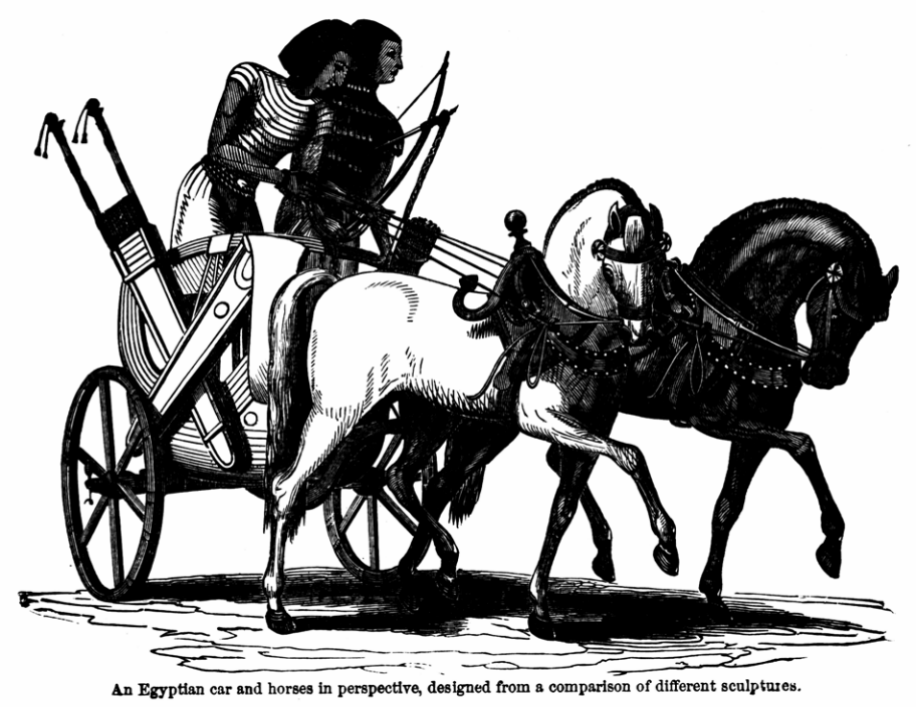
6. He made ready his chariot — Horses and chariots are first represented in the monuments of Amosis, (1520 B.C.,) although there is evidence of their use before that time. The chariot was two-wheeled, without back or seat, bottomed with a network of thongs, whose elasticity supplied the lack of springs: it was drawn by two horses, which were harnessed, without traces, to a pole fastened to a yoke resting upon the withers. The spear-case, bow-case, and quiver were fastened at the side, and it was manned by a driver and one or two warriors, who stood as they rode.
Cited across the library (1 reference)
- DictionaryWatson’s Dictionary: Armies
And he took six hundred chosen chariots, and all the chariots of Egypt, and captains over every one of them.
John Wesley on Exodus 14:7
V. 7. Captains over every one of them-Or rather over all of them; distributing the command of them to his several Captains.
Adam Clarke on Exodus 14:7
Verse 7. Six hundred chosen chariots, &c.] According to the most authentic accounts we have of war-chariots, they were frequently drawn by two or by four horses, and carried three persons: one was charioteer, whose business it was to guide the horses, but he seldom fought; the second chiefly defended the charioteer; and the third alone was properly the combatant. It appears that in this case Pharaoh had collected all the cavalry of Egypt; (see Exodus 14:17;) and though these might not have been very numerous, yet, humanly speaking, they might easily overcome the unarmed and encumbered Israelites, who could not be supposed to be able to make any resistance against cavalry and war-chariots.
Joseph Benson on Exodus 14:7
Verse 7. Six hundred chosen chariots — The strength of ancient Egypt, which is a plain country, consisted in cavalry and military chariots. Indeed, it appears from sundry passages of Scripture, that the eastern nations in general, in the early ages of the world, made great use of armed chariots in war. Captains over every one of them — Or rather over all of them, distributing the command of them to his several captains.
Joseph Sutcliffe on Exodus 14:7
Ver. 7. Six hundred chariots. A captain or valiant man was in each chariot, his armour bearer, a man of valour also, besides a man to guide the horses, who had a shield, and probably other weapons. The army of Pharaoh is estimated by Josephus at 50,000 horse, and 200,000 foot. All the host of Pharaoh was there, ver. 28. How bitter are the dregs of the cup to hardened men!
Daniel Whedon on Exodus 14:7
7. Six hundred — This was a picked chariot force, and Josephus adds, from traditional sources, that there were fifty thousand horsemen and two hundred thousand footmen. The word “all” is not to be taken absolutely, as if every chariot in Egypt was in the pursuit. See note on Exodus 9:6. Captains — Literally, third men, one of three, because the chariot was sometimes manned by three.
Cited across the library (1 reference)
- DictionaryWatson’s Dictionary: Chariots of War
And the LORD hardened the heart of Pharaoh king of Egypt, and he pursued after the children of Israel: and the children of Israel went out with an high hand.
John Wesley on Exodus 14:8
V. 8. With an high hand-Boldly, resolutely.
Joseph Benson on Exodus 14:8
Verse 8. With a high hand — Boldly and resolutely. It seems the latter part of the verse had better be rendered, even the children of Israel, going away with a high hand, or, in other words, in spite of him.
Daniel Whedon on Exodus 14:8
8. With a high hand — Openly and defiantly; but how their courage failed when they saw Pharaoh’s chariots!
Cited across the library (1 reference)
- DictionaryWatson’s Dictionary: Red Sea
But the Egyptians pursued after them, all the horses and chariots of Pharaoh, and his horsemen, and his army, and overtook them encamping by the sea, beside Pihahiroth, before Baalzephon.
John Wesley on Exodus 14:9
V. 9. Chariots and horsemen-It should seem he took no foot with him, because the king’s business required haste.
Joseph Benson on Exodus 14:9–10
Verses 9, 10. Chariots and horsemen — It seems he took no foot with him, because the king’s business required haste. The children of Israel cried out unto the Lord — Partly by petition, and partly by complaint and expostulation; probably, however, more from despair than trust in God, for they were sore afraid, and their fears were aggravated by the presence and outcries of their wives and children. They knew the strength of the enemy, and their own weakness; numerous indeed they were, but all foot, unarmed, undisciplined, dispirited by long servitude, and now pent up, so that they could not escape. On one hand was Pi-hahiroth, a range of craggy rocks unpassable; on the other hand were Migdol and Baal-zephon, forts upon the frontiers of Egypt; before them was the sea, behind them were the Egyptians; so that there was no way open for them but upward, and thence their deliverance came.
Daniel Whedon on Exodus 14:9
9. All the horses and chariots of Pharaoh — Rather, the chariot horses. Three kinds of troops are mentioned, cavalry, chariotry, and infantry.
And when Pharaoh drew nigh, the children of Israel lifted up their eyes, and, behold, the Egyptians marched after them; and they were sore afraid: and the children of Israel cried out unto the LORD.
John Wesley on Exodus 14:10
V. 10. They were sore afraid-They knew the strength of the enemy, and their own weakness; numerous indeed they were, but all foot, unarmed, undisciplined, dispirited, by long servitude, and now pent up, so that they could not escape. On one hand was Pi-hahiroth, a range of craggy rocks unpassable; on the other hand were Migdol and Baal-zephon, forts upon the frontiers of Egypt; before them was the sea, behind them were the Egyptians; so that there was no way open for them but upwards, and thence their deliverance came.
Adam Clarke on Exodus 14:10
Verse 10. The children of Israel cried out unto the Lord.] Had their prayer been accompanied with faith, we should not have found them in the next verses murmuring against Moses, or rather against the Lord, through whose goodness they were now brought from under that bondage from which they had often cried for deliverance. Calmet thinks that the most pious and judicious cried unto God, while the unthinking and irreligious murmured against Moses.
Daniel Whedon on Exodus 14:10–12
10-12. Cried out unto the Lord — In terror, but not in faith. Because there were no graves in Egypt — No graves at all; words that had a special pathos in the mouths of a people who had been bred in a land renowned for the vastness and grandeur of its sepulchres. The royal cemetery of Memphis stretched more than sixty miles along the Nile, and among its monuments now stands the loftiest and most massive work that man’s hand ever reared. The Theban tombs are magnificent palaces of the dead. To lie unburied after death was deemed in Egypt to be one of the greatest of calamities, and the Israelites had doubtless an Egyptian horror of having their bodies scattered over the desert. Better for us to serve the Egyptians — Cowardly despair. But it should be remembered they had been degraded by bondage, and the masters before whom they had cowered so long were full in sight with horses and chariots.
Cited across the library (1 reference)
And they said unto Moses, Because there were no graves in Egypt, hast thou taken us away to die in the wilderness? wherefore hast thou dealt thus with us, to carry us forth out of Egypt?
Cited across the library (1 reference)
Is not this the word that we did tell thee in Egypt, saying, Let us alone, that we may serve the Egyptians? For it had been better for us to serve the Egyptians, than that we should die in the wilderness.
Cited across the library (1 reference)
And Moses said unto the people, Fear ye not, stand still, and see the salvation of the LORD, which he will shew to you to day: for the Egyptians whom ye have seen to day, ye shall see them again no more for ever.
John Wesley on Exodus 14:13
V. 13. Moses answered not these fools according to their folly: Instead of chiding he comforts them, and with an admirable pretence of mind, not disheartened either by the threatenings of Egypt, or the tremblings of Israel, stills their murmuring, Fear ye not, It is our duty, when we cannot get out of our troubles, yet to get above our fears, so that they may only serve to quicken our prayers and endeavours, but may not prevail to silence our faith and hope. Stand still, and think not to save yourselves either by fighting or flying; wait God’s orders, and observe them; Compose yourselves, by an entire confidence in God, into a peaceful prospect of the great salvation God is now about to work for you. Hold your peace, you need not so much as give a shout against the enemy: the work shall be done without any concurrence of yours. In times of great difficulty, it is our wisdom to keep our spirits calm, quiet, and sedate, for then we are in the best frame both to do our own work, and to consider the work of God.
Adam Clarke on Exodus 14:13
Verse 13. Moses said-Fear ye not] This exhortation was not given to excite them to resist, for of that there was no hope; they were unarmed, they had no courage, and their minds were deplorably degraded. Stand still] Ye shall not be even workers together with God; only be quiet, and do not render yourselves wretched by your fears and your confusion. See the salvation of the Lord] Behold the deliverance which God will work, independently of all human help and means.
Ye shall see them again no more] Here was strong faith, but this was accompanied by the spirit of prophecy. God showed Moses what he would do, he believed, and therefore he spoke in the encouraging manner related above.
Joseph Benson on Exodus 14:13–14
Verses 13, 14. Moses said, Fear ye not, stand still — Hebrew, make yourselves to stand. Let not your hearts fail, or sink, or stagger, through unbelief: but with quiet minds look up to God. The Lord shall fight for you, and ye shall hold your peace — Ye shall contribute nothing to the victory, neither by your words nor by your deeds. A remarkable instance this of the composure of Moses’s mind, and the sedateness of his temper, and how well he deserved the character given him Numbers 12:3, of being one of the meekest of men. He did not answer these fools according to their folly: he does not chide, but comforts them; and with an admirable presence of mind, not in the least disconcerted or disheartened, either by the approach of Pharaoh, or the tremblings of Israel, he stills their murmurings, calmly exhorting them to take heart and trust in God. It is our duty when we cannot get out of our troubles, yet to get above our fears, so that they may only serve to quicken our prayers and endeavours, but may not prevail to silence our faith and hope.
Daniel Whedon on Exodus 14:13
13. Stand still, and see the salvation of the Lord — Moses rises to the height of the occasion; his faith is mighty, but he cannot see how salvation is to come.
The LORD shall fight for you, and ye shall hold your peace.
Adam Clarke on Exodus 14:14
Verse 14. The Lord shall fight for you] Ye shall have no part in the honour of the day; God alone shall bring you off, and defeat your foes. Ye shall hold your peace.] Your unbelieving fears and clamours shall be confounded, and ye shall see that by might none shall be able to prevail against the Lord, and that the feeblest shall take the prey when the power of Jehovah is exerted.
And the LORD said unto Moses, Wherefore criest thou unto me? speak unto the children of Israel, that they go forward:
John Wesley on Exodus 14:15
V. 15. Wherefore criest thou unto me-Moses though he was assured of a good issue, yet did not neglect prayer. We read not of one word he said in prayer, but he lifted up his heart to God, and God well understood, and took notice of. Moses’s silent prayer prevailed more with God, than Israel’s loud out-cries. But is God displeased with Moses for praying? No, he asks this question, Wherefore criest thou unto me? Wherefore shouldst thou press thy petition any farther, when it is already granted? Moses has something else to do besides praying, he is to command the hosts of Israel. Speak to them that they go forward-Some think Moses had prayed not so much for their deliverance, he was assured of that; as for the pardon of their murmurings, and God’s ordering them to go forward, was an intimation of the pardon. Moses bid them stand still and expect orders from God: and now orders are given. They thought they must have been directed either to the right hand, or to the left; no, saith God, speak to them to go forward, directly to the sea-side; as if there had lain a fleet of transport ships ready for them to embark in. Let the children of Israel go as far as they can upon dry ground, and then God will divide the sea. The same power could have congealed the waters for them to pass over, but infinite wisdom chose rather to divide the waters for them to pass through, for that way of salvation is always pitched upon which is most humbling.
Adam Clarke on Exodus 14:15
Verse 15. Wherefore criest thou unto me?] We hear not one word of Moses’ praying, and yet here the Lord asks him why he cries unto him? From which we may learn that the heart of Moses was deeply engaged with God, though it is probable he did not articulate one word; but the language of sighs, tears, and desires is equally intelligible to God with that of words. This consideration should be a strong encouragement to every feeble, discouraged mind: Thou canst not pray, but thou canst weep; if even tears are denied thee, (for there may be deep and genuine repentance, where the distress is so great as to stop up those channels of relief,) then thou canst sigh; and God, whose Spirit has thus convinced thee of sin, righteousness, and judgment, knows thy unutterable groanings, and reads the inexpressible wish of thy burdened soul, a wish of which himself is the author, and which he has breathed into thy heart with the purpose to satisfy it.
Joseph Benson on Exodus 14:15
Verse 15. Wherefore criest thou to me? — Moses, though he was assured of a good issue, yet did not neglect prayer. We read not of one word he said in prayer, but he lifted up his heart to God, and God well understood, and took notice of it. Moses’s silent prayer prevailed more with God than Israel’s loud outcries. But is God displeased with Moses for praying? No; he asks this question, Wherefore criest thou unto me? Wherefore shouldest thou press thy petition any further, when it is already granted? Moses has something else to do besides praying; he is to command the hosts of Israel. Speak to them that they go forward — Some think Moses had prayed not so much for their deliverance, he was assured of that, as for the pardon of their murmurings: and God’s ordering them to go forward was an intimation of the pardon. Moses bid them stand still and expect orders from God: and now orders are given. They thought they must have been directed either to the right hand or to the left; no, saith God, speak to them to go forward directly to the sea-side; as if there had lain a fleet of transport ships ready for them to embark in. Let the children of Israel go as far as they can upon dry ground, and then God will divide the sea. The same power could have congealed the waters for them to pass over, but infinite Wisdom chose rather to divide the waters for them to pass through, for that way of salvation is always pitched upon which is most humbling.
Daniel Whedon on Exodus 14:15
15. Wherefore (or what) criest thou unto me — No prayer is recorded, but this is the reply to the inward struggle — to the “groanings that cannot be uttered” — in which the soul of Moses then travailed with Israel’s birth. He is told that the answer to his prayer is ready, and that he has but to prepare to receive: — “Advance and accept deliverance!” Go forward — Decamp, break up and march. This seemed like madness, but it was God’s command.
But lift thou up thy rod, and stretch out thine hand over the sea, and divide it: and the children of Israel shall go on dry ground through the midst of the sea.
Adam Clarke on Exodus 14:16
Verse 16. Lift thou up thy rod] Neither Moses nor his rod could be any effective instrument in a work which could be accomplished only by the omnipotence of God; but it was necessary that he should appear in it, in order that he might have credit in the sight of the Israelites, and that they might see that God had chosen him to be the instrument of their deliverance.
Daniel Whedon on Exodus 14:16
16. Lift thou up thy rod… divide it — Prayer is thus said to effect what God effects in answer to prayer when it is inspired by him. The rod was but the symbol of the divine-human power.
And I, behold, I will harden the hearts of the Egyptians, and they shall follow them: and I will get me honor upon Pharaoh, and upon all his host, upon his chariots, and upon his horsemen.
Daniel Whedon on Exodus 14:17
17. I will get me honour — Namely, by their complete overthrow in, such manner that it shall be manifest to all that “the Lord is the man of war” who accomplishes this destruction. Chariots… horsemen. (See cut on p. 85.)
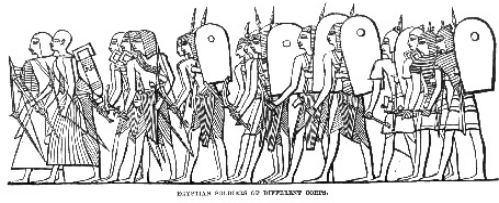
The cut on this page, from a Theban tomb, represents the different kinds of Egyptian infantry, with their arms.
And the Egyptians shall know that I am the LORD, when I have gotten me honor upon Pharaoh, upon his chariots, and upon his horsemen.
Adam Clarke on Exodus 14:18
Verse 18. Shall know that I am the Lord] Pharaoh had just recovered from the consternation and confusion with which the late plagues had overwhelmed him, and now he is emboldened to pursue after Israel; and God is determined to make his overthrow so signal by such an exertion of omnipotence, that he shall get himself honour by this miraculous act, and that the Egyptians shall know, i.e., acknowledge, that he is Jehovah, the omnipotent, self-existing, eternal God.
And the angel of God, which went before the camp of Israel, removed and went behind them; and the pillar of the cloud went from before their face, and stood behind them:
John Wesley on Exodus 14:19
V. 19. The angel of God-Whose ministry was made use of in the pillar of cloud and fire, went from before the camp of Israel, where they did not now need a guide; there was no danger of missing their way through the sea, and came behind them, where now they needed a guard, the Egyptians being just ready to seize the hindmost of them. There it was of use to the Israelites, not only to protect them, but to light them through the sea; and at the same time it confounded the Egyptians, so that they lost sight of their prey, just when they were ready to lay hands on it. The word and providence of God have a black and dark side towards sin and sinners, but a bright and pleasant side towards those that are Israelites indeed.
Adam Clarke on Exodus 14:19
Verse 19. The angel of God] It has been thought by some that the angel, i.e., messenger, of the Lord, and the pillar of cloud, mean here the same thing. An angel might assume the appearance of a cloud; and even a material cloud thus particularly appointed might be called an angel or messenger of the Lord, for such is the literal import of the word מלאך malach, an angel. It is however most probable that the Angel of the covenant, the Lord Jesus, appeared on this occasion in behalf of the people; for as this deliverance was to be an illustrious type of the deliverance of man from the power and guilt of sin by his incarnation and death, it might have been deemed necessary, in the judgment of Divine wisdom, that he should appear chief agent in this most important and momentous crisis. On the word angel, and Angel of the covenant, See Clarke’s notes on “Genesis 16:7”; “Genesis 18:13”; and “Exodus 3:2”.
Joseph Benson on Exodus 14:19
Verse 19. The angel of God — Whose ministry was made use of in the pillar of cloud and fire, went from before the camp of Israel, where they did not now need a guide, (there was no danger of missing their way through the sea,) and came behind them, where now they needed a guard, the Egyptians being just ready to seize the hindmost of them. There it was of use to the Israelites, not only to protect them, but to light them through the sea; and at the same time it confounded the Egyptians, so that they lost sight of their prey just when they were ready to lay hands on it. The word and providence of God have a black and dark side toward sin and sinners, but a bright and pleasant side toward those that are Israelites indeed.
Joseph Sutcliffe on Exodus 14:19
Ver. 19. The Angel of God. The Messiah, as in other places, showing a dark and frowning aspect on the Egyptians, and a cheering light of joy on the Hebrews.
Daniel Whedon on Exodus 14:19–20
19, 20. The Angel of God — That is, the manifestation of God in the pillar of cloud and fire. See Exodus 3:2, 6. The pillar gave light to Israel, so that they could see how to direct their march, while at the same time it hid their movements from the Egyptians, and, as it was spread between the armies, perhaps seemed to Pharaoh’s host simply like the natural darkness of the night.
Cited across the library (1 reference)
- DictionaryWatson’s Dictionary: Cloud
And it came between the camp of the Egyptians and the camp of Israel; and it was a cloud and darkness to them, but it gave light by night to these: so that the one came not near the other all the night.
Adam Clarke on Exodus 14:20
Verse 20. It was a cloud and darkness to them, &c.] That the Israelites might not be dismayed at the appearance of their enemies, and that these might not be able to discern the object of their pursuit, the pillar of cloud moved from the front to the rear of the Israelitish camp, so as perfectly to separate between them and the Egyptians. It appears also that this cloud had two sides, one dark and the other luminous: the luminous side gave light to the whole camp of Israel during the night of passage; and the dark side, turned towards the pursuing Egyptians, prevented them from receiving any benefit from that light. How easily can God make the same thing an instrument of destruction or salvation, as seems best to his godly wisdom! He alone can work by all agents, and produce any kind of effect even by the same instrument; for all things serve the purposes of his will.
And Moses stretched out his hand over the sea; and the LORD caused the sea to go back by a strong east wind all that night, and made the sea dry land, and the waters were divided.
John Wesley on Exodus 14:21
V. 21. We have here the history of that work of wonder which is so often mentioned both in the Old and New Testament. An instance of God’s almighty power in dividing the sea, and opening a passage through the waters. It was a bay, or gulf, or arm of the sea, two or three leagues over. The God of nature has not tied himself to its laws, but when he pleases dispenseth with them, and then the fire doth not burn, nor the water flow. They went through the sea to the opposite shore; they walked upon dry land in the midst of the sea; and the pillar of cloud being their rereward, the waters were a wall to them on their right hand, and on their left. Moses and Aaron it is likely ventured first, into this untrodden path, and then all Israel after them; and this march through the paths of the great waters would make their march afterwards through the wilderness less formidable. This march through the sea was in the night, and not a moon-shine night, for it was seven days after the full moon, so that they had no light but what they had from the pillar of fire. This made it the more awful, but where God leads us, he will light us; while we follow his conduct we shall not want his comforts.
Adam Clarke on Exodus 14:21
Verse 21. The Lord caused the sea to go back] That part of the sea over which the Israelites passed was, according to Mr. Bruce and other travellers, about four leagues across, and therefore might easily be crossed in one night. In the dividing of the sea two agents appear to be employed, though the effect produced can be attributed to neither. By stretching out the rod the waters were divided; by the blowing of the vehement, ardent, east wind, the bed of the sea was dried. It has been observed, that in the place where the Israelites are supposed to have passed, the water is about fourteen fathoms or twenty-eight yards deep: had the wind mentioned here been strong enough, naturally speaking, to have divided the waters, it must have blown in one narrow track, and continued blowing in the direction in which the Israelites passed; and a wind sufficient to have raised a mass of water twenty-eight yards deep and twelve miles in length, out of its bed, would necessarily have blown the whole six hundred thousand men away, and utterly destroyed them and their cattle. I therefore conclude that the east wind, which was ever remarked as a parching, burning wind, was used after the division of the waters, merely to dry the bottom, and render it passable. For an account of the hot drying winds in the east, See Clarke’s note on “Genesis 8:1”. God ever puts the highest honour on his instrument, Nature; and where it can act, he ever employs it. No natural agent could divide these waters, and cause them to stand as a wall upon the right hand and upon the left; therefore God did it by his own sovereign power. When the waters were thus divided, there was no need of a miracle to dry the bed of the sea and make it passable; therefore the strong desiccating east wind was brought, which soon accomplished this object. In this light I suppose the text should be understood.
Joseph Benson on Exodus 14:21–22
Verses 21, 22. And Moses stretched out his hand, &c. — We have here the history of that work of wonder which is so often mentioned both in the Old and New Testaments. An instance of God’s almighty power in dividing the sea, and opening a passage through the waters. It was a bay, or gulf, or arm of the sea, two or three leagues over. The God of nature has not tied himself to its laws, but when he pleases dispenseth with them, and then the fire doth not burn, nor the water flow. They went through the sea to the opposite shore; they walked upon dry land in the midst of the sea; and the pillar of cloud being their rearward, the waters were a wall to them on their right hand, and on their left — Moses and Aaron, it is likely, ventured first into this untrodden path, and then all Israel after them; and this march through the paths of the great waters would make their march afterward through the wilderness less formidable. This march through the sea was in the night, and not a moonshine night, for it was seven days after the full moon, so that they had no light but what they had from the pillar of fire. This made it the more awful; but where God leads us, he will light us; while we follow his conduct we shall not want his comforts.
Joseph Sutcliffe on Exodus 14:21
Ver. 21. The waters were divided, as the Jordan on another occasion; they stood on a heap. Psalm 78:13. It was not a driving back of the tongue of the sea, but a real division by Jehovah’s presence. The bottom of the sea became dry, and formed a wide opening like the wilderness.
Daniel Whedon on Exodus 14:21–22
21, 22. And the Lord caused the sea to go back by a strong east wind all that night — Here, as in the history of the plagues, natural causes are declared to have been supernaturally used. A northeast wind, which would be called “an east wind” in Hebrew, would tend to drive the water out of the narrow bay towards the southwest, and if transpiring at the time of an ebb tide, might be strong enough to blow the channel dry. If there were shoals or flats at the place of crossing, as there now are near Suez, and deeper water to the north, as there now is, a pathway might thus be made across the Gulf, leaving deep water above and below. It will be noticed that this was soon after the full moon of the vernal equinox, when there would be a very low ebb and a very high flood, and that the tide rises from five to seven feet opposite Suez, and from eight to nine feet when aided by strong winds, returning with unusual suddenness and power after the ebb. (See Introductory remarks.) The Hebrew and heathen traditions of this wonderful deliverance all make it probable that all these natural causes were employed to answer the prayer of Moses. In Moses’ song of triumph the waters are said to have been “gathered together” by the “blast of the nostrils” of Jehovah. He also sang, “Thou didst blow with thy wind, the sea covered them,” (Exodus 15:8, 10;) thus assigning the return as well as the division of the waters to the agency of the wind. So in many places God is said to have “dried up the waters of the Red Sea,” as if by wind. Joshua 2:10; Psalm 66:6; 106:9. [Different minds will assign different degrees of the supernatural to the transaction. But, (1.) The movements of Israel by divine orders were prescribed, and to these the blowings of the wind were precisely timed, measured, and even changed from east to west. (2.) The two armies were long in such proximity that Israel could have easily been destroyed had not Pharaoh been deterred and blinded by the “pillar.” (3.) The ordinary tidal action of the sea must have been better known to Pharaoh and his generals than to Israel. That the whole should have been so executed as to save all Israel and destroy all the Egyptians is… unaccountable on merely natural assumptions. See note on Joshua 10:12.]
The waters were a wall unto them on their right hand, and on their left — That is, they were a defense, not necessarily perpendicular cliffs, as they are often pictured. God could make the water stand in precipices if he should so choose, and such a conception is more impressive to the imagination; but it is certain that the language of the text may mean simply that the water was a protection on the right and on the left flanks of the hosts. Thus in Nahum, (Nahum 3:8,) No (Thebes) is said to have the sea (the broad Nile) for a rampart and wall; that is, a defense, a protection against enemies. It is true that in poetical passages the waters are said to have stood “as a heap;” Exodus 15:8; Psalm 78:13; but so they are also, in the same style, said to have been “congealed in the heart of the sea;” and the peaks of the trembling Horeb are said to have “skipped like rams,” and the “little hills like lambs.” Psalm 114:4. Of course these expressions are not to be literally and prosaically interpreted. Yet it will be noticed that upon our view the waters were heaped up by the wind, though we do not believe that they stood in parallel precipices. But see note on Joshua 3:13.
Cited across the library (4 references)
And the children of Israel went into the midst of the sea upon the dry ground: and the waters were a wall unto them on their right hand, and on their left.
Adam Clarke on Exodus 14:22
Verse 22. And the waters were a wall unto them on their right and on their left.] This verse demonstrates that the passage was miraculous. Some have supposed that the Israelites had passed through, favoured by an extraordinary ebb, which happened at that time to be produced by a strong wind, which happened just then to blow! Had this been the case, there could not have been waters standing on the right hand and on the left; much less could those waters, contrary to every law of fluids, have stood as a wall on either side while the Israelites passed through, and then happen to become obedient to the laws of gravitation when the Egyptians entered in! An infidel may deny the revelation in toto, and from such we expect nothing better; but to hear those who profess to believe this to be a Divine revelation endeavouring to prove that the passage of the Red Sea had nothing miraculous in it, is really intolerable. Such a mode of interpretation requires a miracle to make itself credible. Poor infidelity! how miserable and despicable are thy shifts!
And the Egyptians pursued, and went in after them to the midst of the sea, even all Pharaoh’s horses, his chariots, and his horsemen.
John Wesley on Exodus 14:23
V. 23. And the Egyptians went in after them into the midst of the sea-They thought, why might they not venture where Israel did? They were more advantageously provided with chariots and horses, while the Israelites were on foot.
Joseph Benson on Exodus 14:23
Verse 23. And the Egyptians went in after them into the midst of the sea — They thought, Why might they not venture where Israel did? They were more advantageously provided with chariots and horses, while the Israelites were on foot.
And it came to pass, that in the morning watch the LORD looked unto the host of the Egyptians through the pillar of fire and of the cloud, and troubled the host of the Egyptians,
John Wesley on Exodus 14:24
V. 24. The Lord-Called the angel before, looked-With indignation, upon the Egyptians, and troubled the Egyptians-With terrible winds and lightnings and thunders, Exodus 15:10, Psalm 77:18,19. Also with terror of mind.
Adam Clarke on Exodus 14:24
Editorial note: Source collation note — paragraph 3: “according to the hebrew, באשמרת הבקר beashmoreth habboker, the watch”. source PDF page 167: “according to the Hebrew, הבקר באשמרת beashmoreth habboker the watch”. Compared with CLA_EXO.PDF PDF p. 167. The source-font or layout comparison does not securely establish every letter, mark or local sequence in these passages. The flagged language readings or layout are retained; the original source pages should be consulted for these specific readings. Additional-source investigation: an automated comparison of surrounding English text located possible corresponding passages in OCR from separately digitized printed volumes. The linked scan pages are research locators; their images have not been collated for this note's flagged readings. OCR agreement does not verify Greek or Hebrew letters, diacritics, word order, or table layout. The flagged readings or layout remain uncertain. CLA_EXO.PDF, PDF page 167; Additional printed-scan page locator (OCR context only; flagged reading unverified).
Verse 24. The morning watch] A watch was the fourth part of the time from sun-setting to sun-rising; so called from soldiers keeping guard by night, who being changed four times during the night, the periods came to be called watches.-Dodd.
As here and in 1 Samuel 11:11 is mentioned the morning watch; so in Lamentations 2:19, the beginning of the watches; and in Judges 7:19, the middle watch is spoken of; in Luke 12:38, the second and third watch; and in Matthew 14:25, the fourth watch of the night; which in Mark 13:35 are named evening, midnight, cock-crowing, and day-dawning.-Ainsworth.
As the Israelites went out of Egypt at the vernal equinox, the morning watch, or, according to the Hebrew, באשמרת הבקר beashmoreth habboker, the watch of day-break, would answer to our four o’clock in the morning.-Calmet.
The Lord looked unto] This probably means that the cloud suddenly assumed a fiery appearance where it had been dark before; or they were appalled by violent thunders and lightning, which we are assured by the psalmist did actually take place, together with great inundations of rain, &c.: The clouds POURED OUT WATER; the skies sent out a SOUND: thine ARROWS also went abroad. The VOICE of thy THUNDER was in the heaven; the LIGHTNINGS LIGHTENED the world; the earth TREMBLED and SHOOK. Thy way is in the sea, and thy path in the great waters. Thou leddest thy people like a flock, by the hand of Moses and Aaron; Psalm 77:17-20. Such tempests as these would necessarily terrify the Egyptian horses, and produce general confusion. By their dashing hither and thither the wheels must be destroyed, and the chariots broken; and foot and horse must be mingled together in one universal ruin; see Exodus 14:25. During the time that this state of horror and confusion was at its summit the Israelites had safely passed over; and then Moses, at the command of God, (Exodus 14:26,) having stretched out his rod over the waters, the sea returned to its strength; (Exodus 14:27;) i.e., the waters by their natural gravity resumed their level, and the whole Egyptian host were completely overwhelmed, Exodus 14:28. But as to the Israelites, the waters had been a wall unto them on the right hand and on the left, Exodus 14:29. This the waters could not have been, unless they had been supernaturally supported; as their own gravity would necessarily have occasioned them to have kept their level, or, if raised beyond it, to have regained it if left to their natural law, to which they are ever subject, unless in cases of miraculous interference. Thus the enemies of the Lord perished; and that people who decreed that the male children of the Hebrews should be drowned, were themselves destroyed in the pit which they had destined for others. God’s ways are all equal; and he renders to every man according to his works.
Joseph Benson on Exodus 14:24
Verse 24. The Lord — Called the angel before; looked unto the host of the Egyptians — He looked upon them in anger, Psalm 104:32. He visited them with marks of his displeasure, and troubled the Egyptians with terrible winds, lightnings, and thunders, Exodus 15:10; Psalm 77:18, 19; also, with terror of mind. Through the pillar of fire and of the cloud — It seems not improbable but that, whereas the cloudy part of the pillar had been toward the Egyptians hitherto, it now turned the other side toward them, and confounded them with showing them their situation.
Daniel Whedon on Exodus 14:24
24. In the morning watch — In New Testament times, the Jews divided the night into four watches, but in the Old Testament history mention is made of three only: the first, or “beginning of the watches,” from sunset to ten P.M., (Lamentations 2:19;) the “middle watch,” from ten P.M. to two A.M., (Judges 7:10;) and the morning watch, from two A.M. to sunrise. It was, then, after two o’clock in the morning when the cloud, that had hung like a black curtain over and before the Egyptians, opened, and Jehovah “looked upon them” through his lightnings. Thus the Psalmist describes the scene. To appreciate its awfulness to the Egyptians we must remember that thunder and lightning are extremely rare in Egypt, and that the fearful grandeur of our thunderstorms is there wholly unknown. “The clouds streamed water, the skies lifted up their voice, yea, thine arrows (thunderbolts) flew. The voice of thy crash rolled round, (like a chariot in heaven;) lightnings illumined the world; trembled and shook the earth.” Psalm 77:17, 18.
Cited across the library (3 references)
- WorksClarke's Commentary - Ancillary Data — W
- DictionaryWatson’s Dictionary: Day
- DictionaryWatson’s Dictionary: Red Sea
And took off their chariot wheels, that they drave them heavily: so that the Egyptians said, Let us flee from the face of Israel; for the LORD fighteth for them against the Egyptians.
John Wesley on Exodus 14:25
V. 25. They had driven furiously, but now they drove heavily, and found themselves embarrassed at every step; the way grew deep, their hearts grew sad, their wheels dropt off, and the axle-trees failed. They had been flying upon the back of Israel as the hawk upon the dove; but now they cried, Let us flee from the face of Israel.
Joseph Benson on Exodus 14:25
Verse 25. They drave heavily — They had driven furiously, but they now found themselves embarrassed at every step; the way grew deep, their hearts grew sad, their wheels dropped off, and the axle-trees failed. They had been flying upon the back of Israel as the hawk on the dove; but now they cried, Let us flee from the face of Israel.
Joseph Sutcliffe on Exodus 14:25
Ver. 25. Took off the chariot wheels; that is, he entangled or overthrew their chariots.
Daniel Whedon on Exodus 14:25
25. Took off their chariot wheels — Their chariots were entangled with each other, bemired, broken, and overturned in the awful confusion that ensued from the pouring rains, blinding lightnings, and appalling thunders. Yet this was but a premonition of what awaited them when the sea returned to his strength.
And the LORD said unto Moses, Stretch out thine hand over the sea, that the waters may come again upon the Egyptians, upon their chariots, and upon their horsemen.
John Wesley on Exodus 14:26
V. 26. And the Lord said unto Moses, Stretch out thy hand over the sea-And give a signal to the waters to close again, as before upon the word of command they had opened to the right and the left. He did so, and immediately the waters returned to their place, and overwhelmed all the host of the Egyptians. Pharaoh and his servants, that had hardened one another in sin, now fell together, and not one escaped. An ancient tradition saith, That Pharaoh’s magicians Jannes and Jambres perished with the rest. Now God got him honour upon Pharaoh, a rebel to God, and a slave to his own barbarous passions; perfectly lost to humanity, virtue, and all true honour; here be lies buried in the deep, a perpetual monument of divine justice: here he went down to the pit, though he was the terror of the mighty in the land of the living.
Joseph Benson on Exodus 14:26
Verse 26. And the Lord said unto Moses, Stretch out thy hand over the sea — And give a signal to the waters to close again, as before upon the word of command they had opened to the right and the left. He did so, and immediately the waters returned to their place, and overwhelmed all the host of the Egyptians. Pharaoh and his servants, that had hardened one another in sin, now fell together, and not one escaped. An ancient tradition saith, that Pharaoh’s magicians, Jannes and Jambres, perished with the rest. Now God got him honour upon Pharaoh, a rebel to God, and a slave to his own barbarous passions; perfectly lost to humanity, virtue, and all true honour; here he lies buried in the deep, a perpetual monument of divine justice: here he went down to the pit, though he was the terror of the mighty in the land of the living.
And Moses stretched forth his hand over the sea, and the sea returned to his strength when the morning appeared; and the Egyptians fled against it; and the LORD overthrew the Egyptians in the midst of the sea.
Joseph Benson on Exodus 14:27
Verse 27. The sea returned to its strength — Its force had, as it were, been checked and held back by the reins of the divine power; but now full scope is given to its impetuous rage. The expression implies that the sea returned not leisurely, as in ordinary tides, but rushed upon them precipitately.
Daniel Whedon on Exodus 14:27
27. When the morning appeared — At the turning of the morning — approach of dawn. Then the entanglement of the bemired chariots and horses, the changing wind, which blew the blinding rain and spray directly into the faces of the Egyptians, now struggling towards their own shore, and the darkness, intensified by the lightnings, all conspired with the waters, suddenly returning in their overwhelming might, to make their destruction complete.
And the waters returned, and covered the chariots, and the horsemen, and all the host of Pharaoh that came into the sea after them; there remained not so much as one of them.
John Wesley on Exodus 14:28
V. 28. After them-That is, after the Israelites.
Adam Clarke on Exodus 14:28
Verse 28. There remained not so much as one of them.] Josephus says that the army of Pharaoh consisted of fifty thousand horse, and two hundred thousand foot, of whom not one remained to carry tidings of this most extraordinary catastrophe.
Cited across the library (1 reference)
But the children of Israel walked upon dry land in the midst of the sea; and the waters were a wall unto them on their right hand, and on their left.
Thus the LORD saved Israel that day out of the hand of the Egyptians; and Israel saw the Egyptians dead upon the sea shore.
John Wesley on Exodus 14:30
V. 30. And Israel saw the Egyptians dead upon the shore-The Egyptians were very curious in preserving the bodies of their great men, but here the utmost contempt is poured upon all the grandees of Egypt; see how they lie heaps upon heaps, as dung upon the face of the earth.
Adam Clarke on Exodus 14:30
Verse 30. Israel saw the Egyptians dead upon the seashore.] By the extraordinary agitation of the waters, no doubt multitudes of the dead Egyptians were cast on the shore, and by their spoils the Israelites were probably furnished with considerable riches, and especially clothing and arms; which latter were essentially necessary to them in their wars with the Amalekites, Basanites, and Amorites, &c., on their way to the promised land. If they did not get their arms in this way, we know not how they got them, as there is not the slightest reason to believe that they brought any with them out of Egypt.
Joseph Benson on Exodus 14:30
Verse 30. Israel saw the Egyptians dead upon the sea-shore — Rather, Israel upon (or from) the sea-shore saw the Egyptians dead — That is, saw their dead bodies floating upon the waters. It is likely, however, that the bodies of many of them were cast on shore, and became food to the beasts and birds of prey that frequent the wilderness, which may be the meaning of Psalm 74:14; and that the Israelites had the benefit of the spoil, especially of their arms, which they wanted. The Egyptians were very curious in preserving the bodies of their great men; but here the utmost contempt is poured upon the grandees of Egypt: see how they lie, heaps upon heaps, as dung upon the face of the earth!
Daniel Whedon on Exodus 14:30–31
30, 31. The Egyptians dead upon the sea shore — The western wind and the returning tide strewed the eastern shore with men and horses, chariots and armour. Josephus says: “On the next day Moses gathered together the weapons of the Egyptians which were brought to the camp of the Hebrews by the current of the sea and the force of the winds assisting it.” (Antiq., 2:16, 6.) Thus might the Israelites have obtained arms for the battles afterwards described with the desert tribes and the Canaanites. Thus the Lord saved Israel that day — Israel ever remembered this day and this event as the beginning of their national life. Reminiscences of the Red Sea deliverance are interwoven with all their literature, worship, and social life. Profane history has also preserved unmistakable traditions of this great event. Diodorus Siculus (iii, 39) relates that the inhabitants along the shore of the Sea have a tradition that it was once left dry by a great ebb tide, so that the bottom appeared. Artapanus relates (Euseb., Praep. Evang., 9:27) that the inhabitants of Memphis said that Moses led the hosts through the Red Sea during an ebb tide, while the inhabitants of Heliopolis said that Moses, when chased by the king, divided the Sea with his rod, but that when the Egyptians followed after them fire flashed upon them and the waters rolled back and destroyed them. In the language of Ewald, this is an event “whose historical certainty is well established, and its momentous results… are even to us distinctly visible.” (Hist. of Israel, 2:75.) It is not surprising that men who refuse to admit the supernatural anywhere attempt to explain the Red Sea deliverance as a fortuitous coincidence of natural events. Obstinate unbelief can resolve all answers to prayer into happy accidents. No amount of evidence can demonstrate the supernatural to him who lacks spiritual insight. No miracle can compel conviction like a mathematical demonstration, for the proof of divine activity is addressed to the moral and not to the intellectual man. The grandest miracle recorded in history, the resurrection of the Son of God, did not convince all who witnessed it, for “some doubted.” If unbelief were not always possible faith would not be a rewardable virtue, and it is this faith that sees with Israel that great work which Jehovah did upon the Egyptians.
And Israel saw that great work which the LORD did upon the Egyptians: and the people feared the LORD, and believed the LORD, and his servant Moses.
John Wesley on Exodus 14:31
V. 31. And Israel feared the Lord, and believed the Lord and his servant Moses-Now they were ashamed of their distrusts and murmurings; and in the mind they were in, they would never again despair of help from heaven; no not in the greatest straits! They would never again quarrel with Moses; nor talk of returning to Egypt. How well were it for us, if we were, always in as good a frame, as we are in sometimes!
Adam Clarke on Exodus 14:31
Verse 31. The people feared the Lord] They were convinced by the interference of Jehovah that his power was unlimited, and that he could do whatsoever he pleased, both in the way of judgment and in the way of mercy.
And believed the Lord, and his servant Moses.] They now clearly discerned that God had fulfilled all his promises; and that not one thing had failed of all the good which he had spoken concerning Israel. And they believed his servant Moses-they had now the fullest proof that he was Divinely appointed to work all these miracles, and to bring them out of Egypt into the promised land.
Thus God got himself honour upon Pharaoh and the Egyptians, and credit in the sight of Israel. After this overthrow of their king and his host, the Egyptians interrupted them no more in the journeyings, convinced of the omnipotence of their Protector: and how strange, that after such displays of the justice and mercy of Jehovah, the Israelites should ever have been deficient in faith, or have given place to murmuring!
1. THE events recorded in this chapter are truly astonishing; and they strongly mark what God can do, and what he will do, both against his enemies and in behalf of his followers. In vain are all the forces of Egypt united to destroy the Israelites: at the breath of God’s mouth they perish; and his feeble, discouraged, unarmed followers take the prey! With such a history before their eyes, is it not strange that sinners should run on frowardly in the path of transgression; and that those who are redeemed from the world, should ever doubt of the all-sufficiency and goodness of their God! Had we not already known the sequel of the Israelitish history, we should have been led to conclude that this people would have gone on their way rejoicing, trusting in God with their whole heart, and never leaning to their own understanding; but alas! we find that as soon as any new difficulty occurred, they murmured against God and their leaders, despised the pleasant land, and gave no credence to his word.
2. Their case is not a solitary one: most of those who are called Christians are not more remarkable for faith and patience. Every reverse will necessarily pain and discompose the people who are seeking their portion in this life. And it is a sure mark of a worldly mind, when we trust the God of Providence and grace no farther than we see the operations of his hand in our immediate supply; and murmur and repine when the hand of his bounty seems closed, and the influences of his Spirit restrained, though our unthankful and unholy carriage has been the cause of this change. Those alone who humble themselves under the mighty hand of God, shall be lifted up in due season. Reader, thou canst never be deceived in trusting thy all, the concerns of thy body and soul, to Him who divided the sea, saved the Hebrews, and destroyed the Egyptians.
Joseph Benson on Exodus 14:31
Verse 31. The people feared the Lord — This great work, which the Lord had done upon the Egyptians, was a means of begetting in them, for the present at least, awful thoughts of God, and devout affections toward him. And they believed the Lord and his servant Moses — Now they were ashamed of their distrusts and murmurings; and in the mind they were in, they would never again despair of help from heaven, no, not in the greatest straits! They would never again quarrel with Moses, nor talk of returning to Egypt. How well were it for us if we were always in as good a frame as we are in sometimes!
Closing reflections and analysis
Joseph Sutcliffe
REFLECTIONS.
In this chapter we see the Israelites saved, and the Egyptians destroyed; and consequently the whole land brought to the verge of ruin for its wicked counsel against the Lord’s people, and for rejecting the ministry and miracles of Moses. These things are written that all ages might fear; for a course of crimes, and the habitual neglect of devotion, originating in hardness of heart and unbelief, will surely bring families and nations to destruction. And it is very awful to add, that when once individuals, or nations, are in the full route of ruin, they seldom pause till precipitated into the gulph their wickedness has prepared.
In the weak faith and great fears of the Hebrews, on seeing themselves pursued, we see that the weakness of man is such as needs support every moment. The idea of danger seemed to banish even the recollection of past miracles. Conscious therefore of our utter insufficiency, let us for ourselves and children, live every moment dependent on providence and grace. But their case was extraordinary, human means were insufficient; therefore they were exhorted to stand still, and see the salvation of God. In the treasures of his wisdom he had a salvation in store far above their expectation; and in all the calamities and exigencies of life, when our own counsel and efforts fail, let us calmly give up our affairs into the hands of providence. It is good that a man should hope, and quietly wait for the salvation of God.
In a moment the Lord dissipated their fears; the cloud removed from the head to the rear of their camp, and kept the enemy in awe. In like manner God has often stood between his trembling church and danger. Often would Zion have been destroyed, had not God become her shield and high defence. Often should we have run into ruin, had not the Lord interposed for our safety. Oh how much we owe to the arm of strength, and to the everlasting presence of God with his church.
The Israelites, notwithstanding all their fears, were commanded to go forward. What, go forward when the sea was before them, and the mountains on either hand! Yes, oh my soul, do not fear to obey the Lord under a dark and beclouded providence. There is nothing in this world but the alien host, armed against the Lord and against righteousness. Go forward, surrounded with mountains and hills; go forward through the deep, the Lord will open thy way, and the enemies thou seest today thou shalt see no more for ever.
The Lord saw the presumption of the Egyptian host, accustomed now to despise his word and miracles, till at length they despised them to their total destruction. He looked through the cloud. The fire of his countenance assailed their souls with the terrors of hell. Now they were entangled in the deep, and surrounded with the net of the Almighty. Now the oppression and murder of the Hebrews would obtrude on their sight. Now they would curse their gods, their magicians, and make no scruple to kill one another in efforts to escape. Now Pharaoh received the answer of his insolence, Who is the Lord that I should obey him? Oh what rage—what horrors— what fury! What cutting down with their swords of every man that stood in their way! Sinners, unless you get a new heart, this is the company with whom you must for ever dwell. All may see what awaits the ungodly in the great day, when the Lord Jesus shall look from heaven through his cloud, and be revealed in flaming fire, with his mighty angels, taking vengeance on them that know not God, and that obey not the gospel. Then Christ shall be glorified in his saints, and admired in all them that believe. Israel also, when they saw this great work, believed the Lord, and Moses his servant. Let past deliverances strengthen our faith, and encourage us to hope for future mercies.
John Wesley
CHAPTER 14.
Here is,
I. The extreme distress that Israel was in at the Red-sea. 1. Notice given of it to Moses before, ver. 1-4. 2. The cause of it was Pharaoh’s pursuit of them, ver. 5-9. 3. Israel was in a consternation upon it, ver. 10-12. 4. Moses endeavours to encourage them, ver. 13, 14.
II. The wonderful deliverance that God wrought for them. 1. Moses is instructed concerning it, ver. 15-18. 2. Lines that could not be forced are set between the camp of Israel and Pharaoh’s camp, ver. 19, 20. 3. By the divine power the Red-sea is divided, ver. 21. and is made, 1. A lane to the Israelites, who marched safely through it, ver. 22-29. But. 2. To the Egyptians it was made, 1. An ambush into which they were drawn, ver. 23-25. And, 2. A grave in which they were all buried, ver. 26-28.
III. The impressions this made upon the Israelites, ver. 30, 31.
Adam Clarke
CHAPTER 14
The Israelites are commanded to encamp before Pi-hahiroth, 1, 2. God predicts the pursuit of Pharaoh, 3, 4. Pharaoh is informed that the Israelites are fled, and regrets that he suffered them to depart, 5. He musters his troops and pursues them, 6-8. Overtakes them in their encampment by the Red Sea, 9. The Israelites are terrified at his approach, 10. They murmur against Moses for leading them out, 11, 12. Moses encourages them, and assures them of deliverance, 13, 14. God commands the Israelites to advance, and Moses to stretch out his rod over the sea that it might be divided, 15, 16; and promises utterly to discomfit the Egyptians, 17, 18. The angel of God places himself between the Israelites and the Egyptians, 19. The pillar of the cloud becomes darkness to the Egyptians, while it gives light to the Israelites, 20. Moses stretches out his rod, and a strong east wind blows, and the waters are divided,
21. The Israelites enter and walk on dry ground, 22. The Egyptians enter also in pursuit of the Israelites, 23. The Lord looks out of the pillar of cloud on the Egyptians, terrifies them, and disjoints their chariots, 24, 25. Moses is commanded to stretch forth his rod over the waters, that they may return to their former bed, 26. He does so, and the whole Egyptian army is overwhelmed, 27, 28, while every Israelite escapes, 29. Being thus saved from the hand of their adversaries, they acknowledge the power of God, and credit the mission of Moses, 30, 31.
NOTES ON CHAP. 14
Joseph Benson
CHAPTER 14.
A.M. 2513. — B.C. 1491.
Here is,
(1,) The extreme distress that Israel was in at the Red sea. 1, Notice given of it to Moses before, 1-4. 2, The cause of it was Pharaoh’s pursuit of them, 5-9. 3, Israel was in a consternation upon it, 10-12. 4, Moses endeavours to encourage them, 13, 14.
(2,) The wonderful deliverance that God wrought for them. 1, Moses is instructed concerning it, 15-18. 2, Lines that could not be forced are set between the camp of Israel and Pharaoh’s camp, 19, 20. 3, By the divine power the Red sea is divided, 21, and is made, First, A lane to the Israelites, who marched safely through it, 22-29. But, Second, To the Egyptians it was made, 1, An ambush into which they were drawn, 23-25. And, 2, A grave in which they were all buried, 26-28.
(3,) The impressions this made upon the Israelites, 30, 31. NOTES ON CHAPTER 14.
Joseph Sutcliffe
CHAPTER 14.
Daniel Whedon
III. THE VICTORY.
Israel’s Victory. Exodus 14:1-15:21.
CHAPTER 14.
INTRODUCTORY.
In the Red (Reedy or Coral) Sea, the last remnant of the Egyptian bondage is now to be washed away. This sea, which was henceforth to be so famous in the history of Israel, was called both by Egyptians and Hebrews the “Sea of Reeds” — rushes or sedge — meaning, perhaps, the papyrus; and there are two places near the Gulf of Suez which are still called the “Bed of Reeds” — remnants, probably, of great fields of papyrus which flourished there of old. Pi-hahiroth, before which Israel next encamped, owes its name to the same famous plant, meaning “the place where the sedge grows.” The origin of the name “Red Sea” is much disputed, some (Scaliger, Bochart) deriving it from the red sandstone cliffs of Edom, others (R. Stuart Poole, etc.) from the red race on its coasts, since the Arabs call themselves “the red men,” in distinction from the white Caucasians, yellow Turanians, and black negroes; while others, with more probability, derive the name from the red coral reefs and sandstones in its bed. Only the last derivation accounts for its application by the classic writers to the adjacent Indian Ocean. Newbold speaks of the surface, when the rays of the sun fell upon it at a small angle, as “marked with annular, crescent-shaped, and irregular blotches of a purplish red, extending as far as the eye could reach. They were curiously contrasted with the beautiful aquamarine colour of the water lying over the white coral reefs. This red colour I ascertained to be caused by the subjacent red sandstone and reddish coral reefs.” (STANLEY’S Sinai and Palestine, p. 6, note.) These coral reefs fringe the shores, often to a width of fifty miles. The Sea is more than thirteen hundred miles in length, from Suez to the Straits of Bab-el-mandel, and one hundred and ninety-two miles wide at the broadest part, under the seventeenth parallel of north latitude, whence it narrows pretty uniformly north and south, being seventy-two miles wide at Ras (or Cape) Mohammed, where it is cloven into the two gulfs, Suez and Akabah, by the great triangular wedge of the mountainous Sinai wilderness. It is the shores of these two northern gulfs or arms of the Sea which are famous in the history of Israel. The western arm, the Gulf of Suez or Heroopolis, witnessed Israel’s birth, as, somewhere within sight of what is now Suez, its divided waters were to the Hebrews a highway out of servitude and to the Egyptians a grave. The eastern arm, the Gulf of Akabah, saw the kingdom of Israel in its meridian glory, when the fleets of Solomon, manned by the sailors of Tyre, swept down along its steep shores to Indian or Arabian Ophir. This eastern gulf is the southern termination of the long, chasm-like valley in which lie the Dead Sea and the Jordan. It is a narrow, deep ravine, about one hundred miles long and sixteen broad, walled in by bare, precipitous mountains of red granite and black basalt, tipped here and there with sandstone, which rises in cliffs from one to two thousand feet high.
The Gulf of Suez, which is the Red Sea of the Exodus, is now about one hundred and eighty miles in length, and twenty in average width. It anciently, however, extended much farther north, probably reaching within historic times to Lake Timsah, with which it is now connected by the canal; but its northern extremity has receded, some think as much as fifty miles, in consequence of the rising of the land or the encroachment of the drifting sands of the desert. A large extent of country about the head of the Gulf, once comparatively fertile and populous, irrigated, as it was, abundantly from the Nile, has thus become an utter wilderness. Towns which were ports of the Pharaohs are now sand-covered ruins in the desert. At the present head of the Gulf, two miles north of Suez, there are extensive shoals, which at low tide are left bare and hard, reaching from one to two miles below the town, leaving only a narrow and winding channel, by which small vessels come up to Suez, while larger craft and steamers lie full two miles below. The tide rises five or six feet upon these shoals. Robinson was told that it reached seven feet, while Du Bois-Ayme (Descrip. de l’Egypte) calls it about two metres, (six and a half feet,) and says that after southern storms it rises to the height of twenty-six decimetres, or about eight and a half feet. There are fords above and below Suez, but Niebuhr and others have noted that the tide rises and falls so suddenly that there is great danger in crossing when it is near the flood. It is well known that in 1799 Napoleon Bonaparte and his suite came thus very near meeting the fate of Pharaoh when returning by this ford from Ayin Mousa to Suez, and that, too, when crossing under the guidance of natives. (Descrip. de l’Egypte, Antiq. Mem., 8, 118.)
The Gulf, as will be seen from the map, narrows suddenly at Suez, where it is only eleven hundred and fifty yards wide, while it is three or four miles wide at a short distance south, and twelve or fifteen miles wide just below Ras Attakah. There is a hard gravel plain, ten miles square, west of Suez, sloping from Ajrud toward the Gulf, and reaching the hills of Attakah on the south. On this plain it is probable that the Israelites encamped before Pi-hahiroth, which was, most likely, an Egyptian garrison, and is now probably represented by the square fortress and deep bitter well of Ajrud. The mountain range of Attakah runs from the Nile east to the Sea, terminating in the Ras or Cape Attakah, a promontory twelve miles south of Suez, but also skirting the Sea north of the Cape, so as to form a defile, along which runs a road, between Mount Attakah and the Sea, from Wady et Tih to Suez. South of Cape Attakah is the broad plain of Baideah, and south of this is another mountain chain running from the Gulf to the Nile. These two ranges are the northern and southern walls of the Wady et Tih, an ancient caravan route from Memphis to the Sea. The northern or Attakah range is broken by a branch of valley near the middle, along which another route runs from the main valley northeast to the head of the Gulf. This description is, with the aid of the maps, sufficient to make clear the different routes suggested for the passage of Israel. Messrs. Pool, (Smith’s Dict.,) Sharpe, (Hist. of Egypt,) and others, following Du Bois-Ayme, (De-scrip, de l’Egypte,) suppose that the passage took place above the present head of the Gulf, some distance north of Suez; but most travellers consider that it was near Suez, or Baideah. If Baideah, they could have reached this plain from Etham, as above located, by a difficult march through the defile around the Promontory of Attakah, or by the branch valley above described, which would have taken them into the Wady et Tih, through which they would then have moved east to Baideah and the Sea. Sicard and Raumer, agreeing apparently with Josephus, supposed that the Israelites came from Latopolis, on the Nile, directly through the Wady et Tih to Baideah, and that the “turn” at Etham (Exodus 14:2) was leaving on the left the branch valley above mentioned, which would have taken them around the head of the Gulf. Baideah is a broad plain in the mouth of the wady or valley, with mountain walls on the north and the south, and with the Sea before it, so that if the Egyptians had blocked with a few troops the defile on the north, or left flank, of Israel, and closed up behind them on the west, they would certainly have been effectually hemmed in on all sides. In many respects this place precisely fits the Scripture requirements, and exactly suits Josephus’s description of the position of Israel, shut “in the jaws of the mountains,” so that many judicious travellers, as Sicard, Raumer, Shaw, Olin, and Kitto, have regarded it as the scene of the great deliverance.
But an insuperable difficulty seems to be that the Gulf is here about fifteen miles wide, and it was certainly no narrower then. This is not, of course, too wide for the supernatural part of the transaction, but it is for the natural part — the march of the vast host of Israel, six hundred thousand men, with at least twice as many women and children, with wagons, herds, and flocks, and also of the Egyptian army, during the night after “the strong east wind” had “caused the sea to go back,” and before the dawn of day. Fifteen miles is a good day’s march for a well-appointed army. Hence Niebuhr, Robinson, Hengstenberg, Tischendorf, Stanley, Winer, and most modern travellers, regard Suez or its immediate vicinity as the scene of the passage. Murphy, (Com. on Exodus, in loc.,) it is true, finds time for the march of the southern passage, by supposing that the women, children, and flocks went round the head of the Gulf; but few will be satisfied with the supposition in the absence of all proof from the record. The sea at Suez was, as above shown, wider then than now, and a passage of three or four miles, direct or diagonal, might there have been made from shore to shore, which could have been effected in the specified time, and here would also have been ample room for the overthrow of the Egyptian army. (Robinson, Bib. Researches, 1:56; Kurtz, Hist. of Old Covenant, ii, § 36.) THE RED SEA DELIVERANCE, 14.