Section 10: Verbs
This transcription includes editorial corrections or unresolved source readings. The full record and source references are available below.
Editorial notes and transcription record · 11 notes
Editorial note: Source-reading note (WES_WW14.PDF, physical page 170): the Greek/Hebrew forms and their layout near “section x of verbs in mi 1 most verbs in mi are formed from contract verbs hmi from a w and e w wmi from o w 2 they are formed by changing w”; “qnhmi from qna w 6 if the verb has no reduplication the imperfect and second indefinite are the same as fhmi e fhn 7 but the imperfect is no”; “ei etc ejdi dwn wv w etc 8 so likewise for the second person singular of the imperative is often used i sa ti qei didou 9 they have no secon” are not fully established by the transcription. The linked source image preserves the original type for comparison. The original type remains the reference for unresolved letters, accents, points, and layout. Additional-source investigation: an independently typeset 1872 printing of Wesley's Works, vol. XIV, has been located. Its Greek and Hebrew grammar tables provide a second witness, but the available comparison does not securely establish every flagged letter, accent, vowel point, or column boundary in this passage. Any bounded repairs established in this section are identified in separate transcription-correction notes; consult both scans for the remaining unresolved details. Source type and layout, physical PDF page 170; Independent 1872 printing of Wesley's Works, vol. XIV.
Editorial note: Source-reading note (WES_WW14.PDF, physical page 171): the Greek/Hebrew forms and their layout near “10 qe v e v and do v are commonly used for qh ti h qi and dw qi qei nai ei nai and dou nai for qh nai h nai and dw nai te qeika is also used” are not fully established by the transcription. The linked source image preserves the original type for comparison. The original type remains the reference for unresolved letters, accents, points, and layout. Additional-source investigation: an independently typeset 1872 printing of Wesley's Works, vol. XIV, has been located. Its Greek and Hebrew grammar tables provide a second witness, but the available comparison does not securely establish every flagged letter, accent, vowel point, or column boundary in this passage. Any bounded repairs established in this section are identified in separate transcription-correction notes; consult both scans for the remaining unresolved details. Source type and layout, physical PDF page 171; Independent 1872 printing of Wesley's Works, vol. XIV.
Editorial note: Source-reading note (WES_WW14.PDF, physical page 172): the Greek/Hebrew forms and their layout near “imperative mood present and imperfect 1 s i saqi ijsa tw d i saton ijsa twn p i sate ijsa twsan 2 s ti qeti tiqe tw d ti qeton tiqe twn p ti” are not fully established by the transcription. The linked source image preserves the original type for comparison. The original type remains the reference for unresolved letters, accents, points, and layout. Additional-source investigation: an independently typeset 1872 printing of Wesley's Works, vol. XIV, has been located. Its Greek and Hebrew grammar tables provide a second witness, but the available comparison does not securely establish every flagged letter, accent, vowel point, or column boundary in this passage. Any bounded repairs established in this section are identified in separate transcription-correction notes; consult both scans for the remaining unresolved details. Source type and layout, physical PDF page 172; Independent 1872 printing of Wesley's Works, vol. XIV.
Editorial note: Source-reading note (WES_WW14.PDF, physical page 173): the Greek/Hebrew forms and their layout near “indefinite 2 1 sai hn hv etc 2 qei hn hv etc 3 doi hn hv etc subjunctive mood ea n present 1 s ijsw a v a d a ton a ton p w men a te w si 2 ” are not fully established by the transcription. The linked source image preserves the original type for comparison. The original type remains the reference for unresolved letters, accents, points, and layout. Additional-source investigation: an independently typeset 1872 printing of Wesley's Works, vol. XIV, has been located. Its Greek and Hebrew grammar tables provide a second witness, but the available comparison does not securely establish every flagged letter, accent, vowel point, or column boundary in this passage. Any bounded repairs established in this section are identified in separate transcription-correction notes; consult both scans for the remaining unresolved details. Source type and layout, physical PDF page 173; Independent 1872 printing of Wesley's Works, vol. XIV.
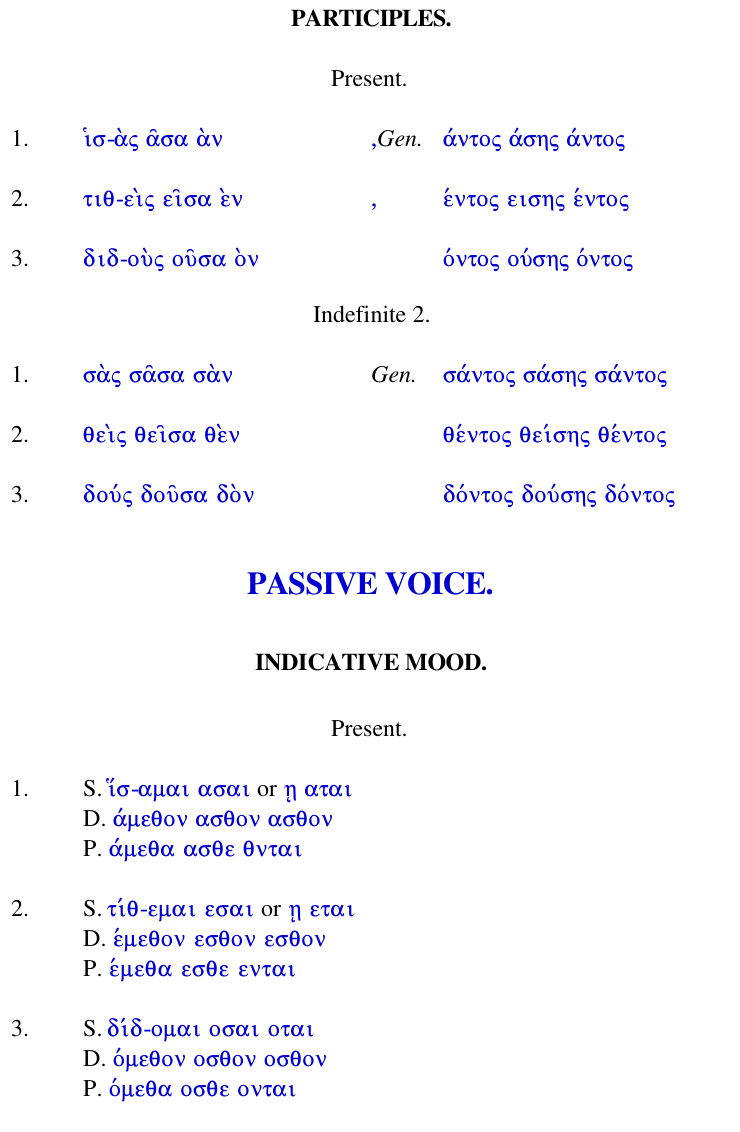
Editorial note: Source-reading note (WES_WW14.PDF, physical page 174): the Greek/Hebrew forms and their layout near “participles present 1 ijsa v a sa a n gen a ntov a shv a ntov 2 tiqei v ei sa e n e ntov eishv e ntov 3 didou v ou sa o n o ntov ou shv o nt”; “v dou sa do n do ntov dou shv do ntov passive voice indicative mood present 1 s i samai asai or h atai d a meqon asqon asqon p a meqa asqe q” are not fully established by the transcription. The linked source image preserves the original type for comparison. The original type remains the reference for unresolved letters, accents, points, and layout. Additional-source investigation: an independently typeset 1872 printing of Wesley's Works, vol. XIV, has been located. Its Greek and Hebrew grammar tables provide a second witness, but the available comparison does not securely establish every flagged letter, accent, vowel point, or column boundary in this passage. Any bounded repairs established in this section are identified in separate transcription-correction notes; consult both scans for the remaining unresolved details. Source type and layout, physical PDF page 174; Independent 1872 printing of Wesley's Works, vol. XIV.
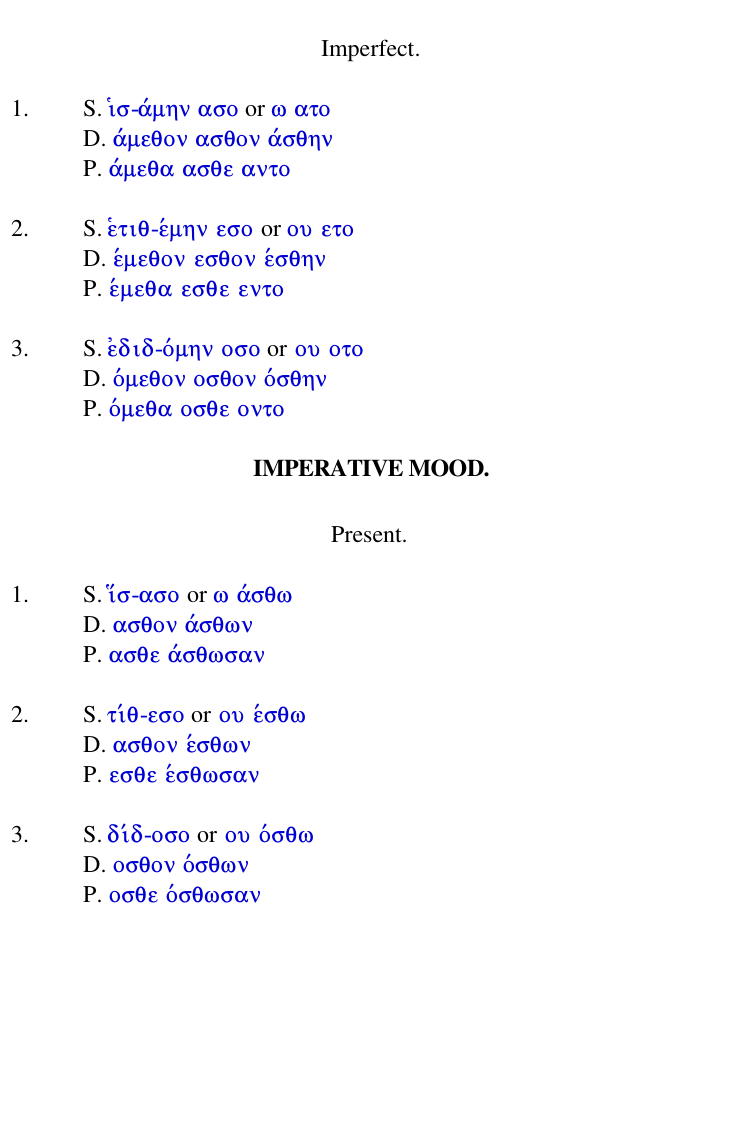
Editorial note: Source-reading note (WES_WW14.PDF, physical page 175): the Greek/Hebrew forms and their layout near “imperfect 1 s ijsa mhn aso or w ato d a meqon asqon a sqhn p a meqa asqe anto 2 s ejtiqe mhn eso or ou eto d e meqon esqon e sqhn p e meqa e” are not fully established by the transcription. The linked source image preserves the original type for comparison. The original type remains the reference for unresolved letters, accents, points, and layout. Additional-source investigation: an independently typeset 1872 printing of Wesley's Works, vol. XIV, has been located. Its Greek and Hebrew grammar tables provide a second witness, but the available comparison does not securely establish every flagged letter, accent, vowel point, or column boundary in this passage. Any bounded repairs established in this section are identified in separate transcription-correction notes; consult both scans for the remaining unresolved details. Source type and layout, physical PDF page 175; Independent 1872 printing of Wesley's Works, vol. XIV.
Editorial note: Source-reading note (WES_WW14.PDF, physical page 176): the Greek/Hebrew forms and their layout near “optative mood ei qe present 1 s ijsai mhn ai o ai to d ai meqon ai sqon ai sqhn p ai meqa ai sqe ai nto 2 s tiqei mhn ei o ei to d ei meqon ” are not fully established by the transcription. The linked source image preserves the original type for comparison. The original type remains the reference for unresolved letters, accents, points, and layout. Additional-source investigation: an independently typeset 1872 printing of Wesley's Works, vol. XIV, has been located. Its Greek and Hebrew grammar tables provide a second witness, but the available comparison does not securely establish every flagged letter, accent, vowel point, or column boundary in this passage. Any bounded repairs established in this section are identified in separate transcription-correction notes; consult both scans for the remaining unresolved details. Source type and layout, physical PDF page 176; Independent 1872 printing of Wesley's Works, vol. XIV.
Editorial note: Source-reading note (WES_WW14.PDF, physical page 177): the Greek/Hebrew forms and their layout near “subjunctive mood ea n present 1 s ijsw mai a a tai d w meqon a sqon a sqon p w meqa a sqe w ntai 2 s tiqw mai h h tai d w meqon h sqon h sqo” are not fully established by the transcription. The linked source image preserves the original type for comparison. The original type remains the reference for unresolved letters, accents, points, and layout. Additional-source investigation: an independently typeset 1872 printing of Wesley's Works, vol. XIV, has been located. Its Greek and Hebrew grammar tables provide a second witness, but the available comparison does not securely establish every flagged letter, accent, vowel point, or column boundary in this passage. Any bounded repairs established in this section are identified in separate transcription-correction notes; consult both scans for the remaining unresolved details. Source type and layout, physical PDF page 177; Independent 1872 printing of Wesley's Works, vol. XIV.
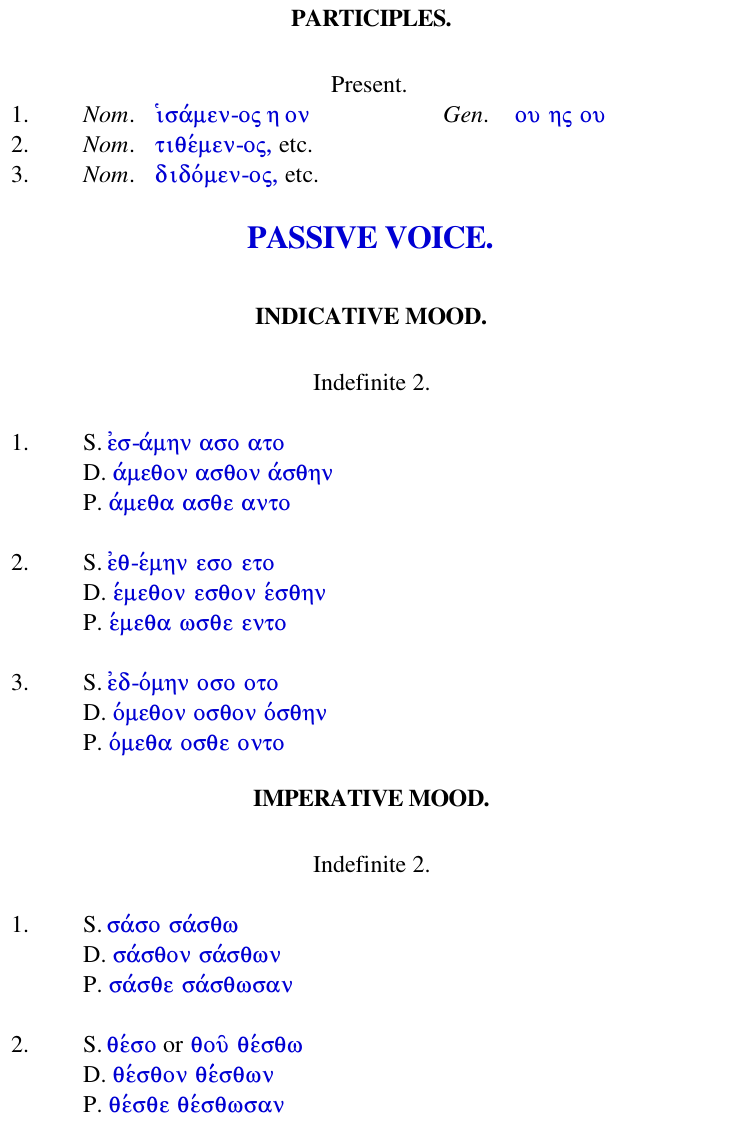
Editorial note: Source-reading note (WES_WW14.PDF, physical page 178): the Greek/Hebrew forms and their layout near “participles present 1 nom ijsa menov h on gen ou hv ou 2 nom tiqe menov etc 3 nom dido menov etc passive voice indicative mood indefinite 2 ” are not fully established by the transcription. The linked source image preserves the original type for comparison. The original type remains the reference for unresolved letters, accents, points, and layout. Additional-source investigation: an independently typeset 1872 printing of Wesley's Works, vol. XIV, has been located. Its Greek and Hebrew grammar tables provide a second witness, but the available comparison does not securely establish every flagged letter, accent, vowel point, or column boundary in this passage. Any bounded repairs established in this section are identified in separate transcription-correction notes; consult both scans for the remaining unresolved details. Source type and layout, physical PDF page 178; Independent 1872 printing of Wesley's Works, vol. XIV.
Editorial note: Source-reading note (WES_WW14.PDF, physical page 179): the Greek/Hebrew forms and their layout near “3 s do so or dou do sqw d do sqon do sqwn p do sqe do sqwsan optative mood ei qe indefinite 2 1 s sai mhn sai o sai to d sai meqon sai sqon ” are not fully established by the transcription. The linked source image preserves the original type for comparison. The original type remains the reference for unresolved letters, accents, points, and layout. Additional-source investigation: an independently typeset 1872 printing of Wesley's Works, vol. XIV, has been located. Its Greek and Hebrew grammar tables provide a second witness, but the available comparison does not securely establish every flagged letter, accent, vowel point, or column boundary in this passage. Any bounded repairs established in this section are identified in separate transcription-correction notes; consult both scans for the remaining unresolved details. Source type and layout, physical PDF page 179; Independent 1872 printing of Wesley's Works, vol. XIV.
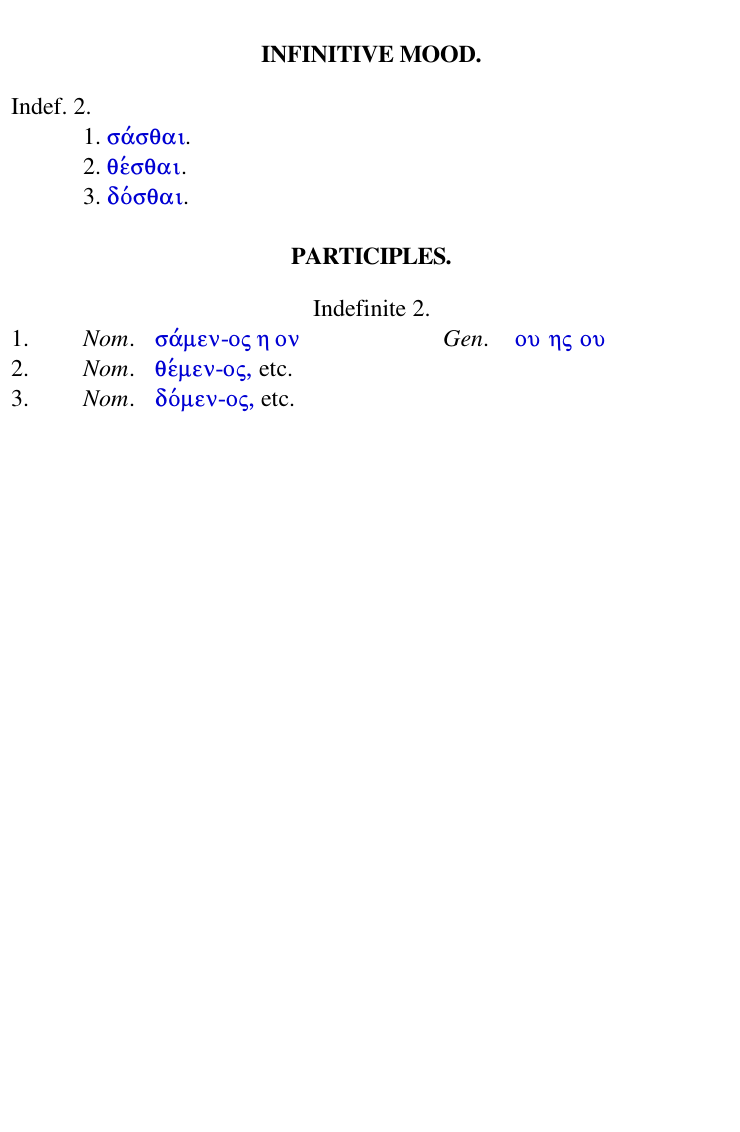
Editorial note: Source-reading note (WES_WW14.PDF, physical page 180): the Greek/Hebrew forms and their layout near “infinitive mood indef 2 1 sa sqai 2 qe sqai 3 do sqai participles indefinite 2 1 nom sa menov h on gen ou hv ou 2 nom qe menov etc 3 nom do ” are not fully established by the transcription. The linked source image preserves the original type for comparison. The original type remains the reference for unresolved letters, accents, points, and layout. Additional-source investigation: an independently typeset 1872 printing of Wesley's Works, vol. XIV, has been located. Its Greek and Hebrew grammar tables provide a second witness, but the available comparison does not securely establish every flagged letter, accent, vowel point, or column boundary in this passage. Any bounded repairs established in this section are identified in separate transcription-correction notes; consult both scans for the remaining unresolved details. Source type and layout, physical PDF page 180; Independent 1872 printing of Wesley's Works, vol. XIV.
Shown as originally typeset — this section is a table or verse grid whose layout does not translate cleanly into running prose.
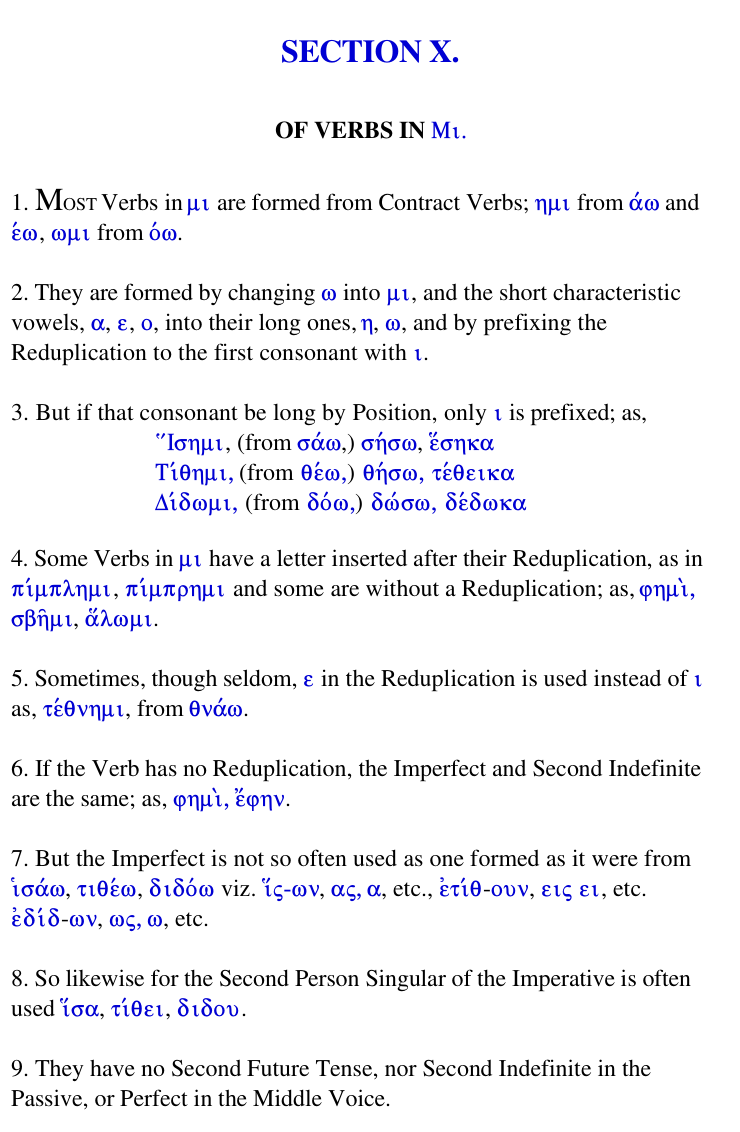
SECTION X.
OF VERBS IN Μι.
1. MOST Verbs in μι are formed from Contract Verbs; ημι from άω and
έω, ωμι from όω.
2. They are formed by changing ω into μι, and the short characteristic
vowels, α, ε, ο, into their long ones, η, ω, and by prefixing the
Reduplication to the first consonant with ι.
3. But if that consonant be long by Position, only ι is prefixed; as,
%Ισημι, (from σάω,) σήσω, ἑσηκα
Τίθημι, (from θέω,) θήσω, τέθεικα
Δίδωμι, (from δόω,) δώσω, δέδωκα
4. Some Verbs in μι have a letter inserted after their Reduplication, as in
πίμπλημι, πίμπρημι and some are without a Reduplication; as, φημὶ,
σβῆμι, ἁλωμι.
5. Sometimes, though seldom, ε in the Reduplication is used instead of ι
as, τέθνημι, from θνάω.
6. If the Verb has no Reduplication, the Imperfect and Second Indefinite
are the same; as, φημὶ, ἐφην.
7. But the Imperfect is not so often used as one formed as it were from
ἱσάω, τιθέω, διδόω viz. ἱς-ων, ας, α, etc., ἐτίθ-ουν, εις ει, etc.
ἐδίδ-ων, ως, ω, etc.
8. So likewise for the Second Person Singular of the Imperative is often
used ἱσα, τίθει, διδου.
9. They have no Second Future Tense, nor Second Indefinite in the
Passive, or Perfect in the Middle Voice.

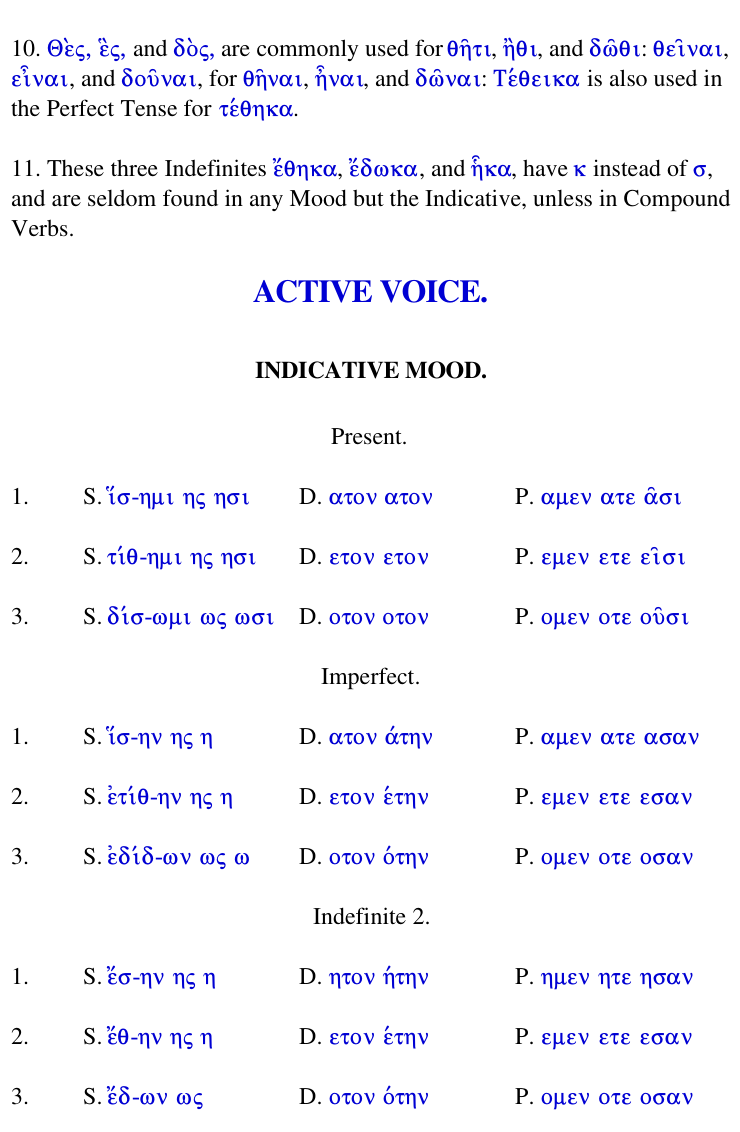
10. Θὲς, ε{ς, and δὸς, are commonly used for θῆτι, η}θι, and δῶθι: θεῖναι,
εἰναι, and δοῦναι, for θῆναι, ἠναι, and δῶναι: Τέθεικα is also used in
the Perfect Tense for τέθηκα.
11. These three Indefinites ἐθηκα, ἐδωκα, and ἦκα, have κ instead of σ,
and are seldom found in any Mood but the Indicative, unless in Compound
Verbs.
ACTIVE VOICE.
INDICATIVE MOOD.
Present.
1. S. ἱσ-ημι ης ησι D. ατον ατον P. amen ate ᾶσι
2. S. τίθ-ημι ης ησι D. ετον ετον P. εμεν ετε εῖσι
3. S. δίσ-ωμι ως ωσι D. οτον οτον P. ομεν οτε οῦσι
Imperfect.
1. S. ἱσ-ην ης η D. ατον άτην P. amen ate asan
2. S. ἐτίθ-ην ης η D. ετον έτην P. εμεν ετε εσαν
3. S. ἐδίδ-ων ως ω D. οτον ότην P. ομεν οτε οσαν
Indefinite 2.
1. S. ἐσ-ην ης η D. ητον ήτην P. ημεν ητε ησαν
2. S. ἐθ-ην ης η D. ετον έτην P. εμεν ετε εσαν
3. S. ἐδ-ων ως D. οτον ότην P. ομεν οτε οσαν

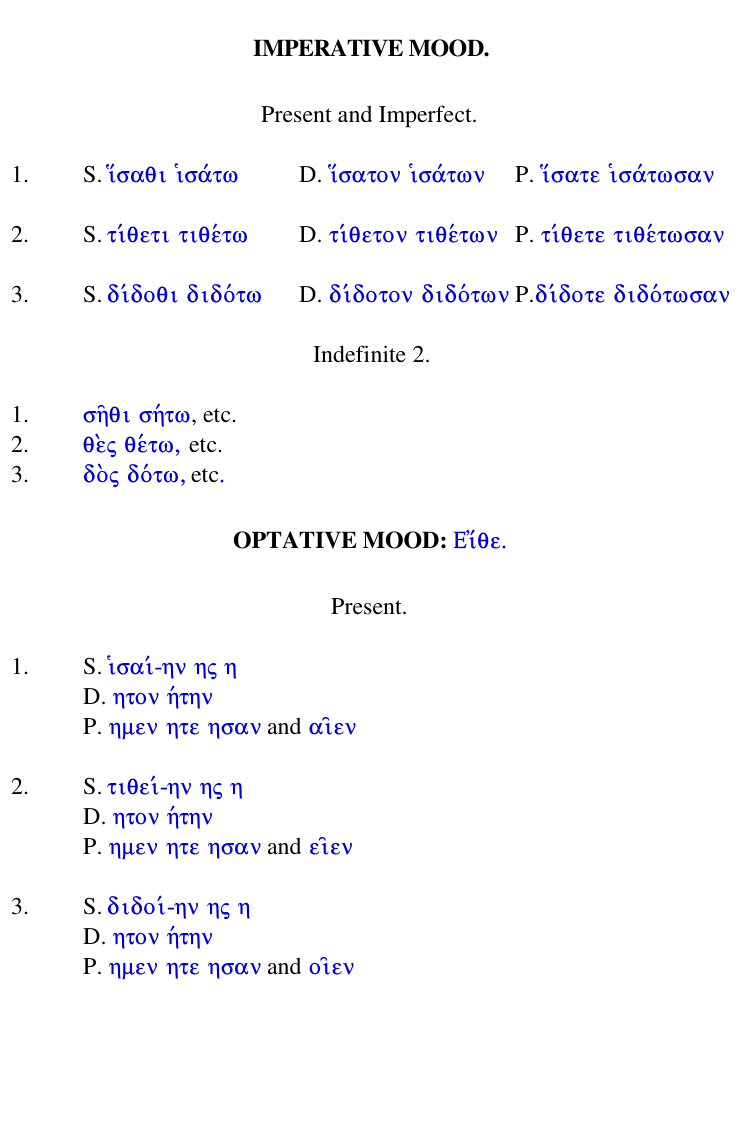
IMPERATIVE MOOD.
Present and Imperfect.
1. S. ἱσαθι ἱσάτω D. ἱσατον ἱσάτων P. ἱσατε ἱσάτωσαν
2. S. τίθετι τιθέτω D. τίθετον τιθέτων P. τίθετε τιθέτωσαν
3. S. δίδοθι διδότω D. δίδοτον διδότων P.δίδοτε διδότωσαν
Indefinite 2.
1. σῆθι σήτω, etc.
2. θὲς θέτω, etc.
3. δὸς δότω, etc.
OPTATIVE MOOD: Εἰθε.
Present.
1. S. ἱσαί-ην ης η
D. ητον ήτην
P. ημεν ητε ησαν and αῖεν
2. S. τιθεί-ην ης η
D. ητον ήτην
P. ημεν ητε ησαν and εῖεν
3. S. διδοί-ην ης η
D. ητον ήτην
P. ημεν ητε ησαν and οῖεν

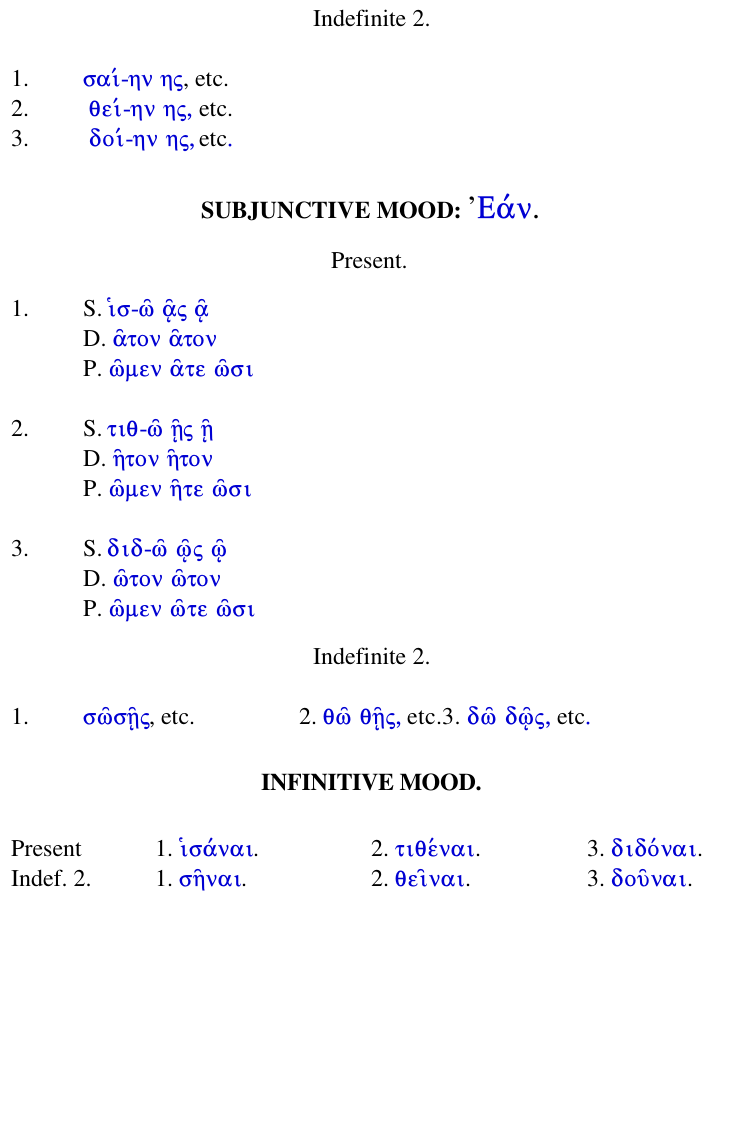
Indefinite 2.
1. σαί-ην ης, etc.
2. θεί-ην ης, etc.
3. δοί-ην ης, etc.
SUBJUNCTIVE MOOD: ’Εάν.
Present.
1. S. ἱσ-ῶ ᾷς ᾷ
D. ᾶτον ᾶτον
P. ῶμεν ᾶτε ῶσι
2. S. τιθ-ῶ ῇς ῇ
D. ῆτον ῆτον
P. ῶμεν ῆτε ῶσι
3. S. διδ-ῶ ῷς ῷ
D. ῶτον ῶτον
P. ῶμεν ῶτε ῶσι
Indefinite 2.
1. σῶσῇς, etc. 2. θῶ θῇς, etc.3. δῶ δῷς, etc.
INFINITIVE MOOD.
Present 1. ἱσάναι. 2. τιθέναι. 3. διδόναι.
Indef. 2. 1. σῆναι. 2. θεῖναι. 3. δοῦναι.

PARTICIPLES.
Present.
1. ἱσ-ὰς ᾶσα ὰν ,Gen. άντος άσης άντος
2. τιθ-εὶς εῖσα ὲν , έντος εισης έντος
3. διδ-οὺς οῦσα ὸν όντος ούσης όντος
Indefinite 2.
1. σὰς σᾶσα σὰν Gen. σάντος σάσης σάντος
2. θεὶς θεῖσα θὲν θέντος θείσης θέντος
3. δούς δοῦσα δὸν δόντος δούσης δόντος
PASSIVE VOICE.
INDICATIVE MOOD.
Present.
1. S. ἱσ-αμαι ασαι or ῃ αται
D. άμεθον ασθον ασθον
P. άμεθα ασθε θνται
2. S. τίθ-εμαι εσαι or ῃ εται
D. έμεθον εσθον εσθον
P. έμεθα εσθε ενται
3. S. δίδ-ομαι οσαι οται
D. όμεθον οσθον οσθον
P. όμεθα οσθε ονται

Imperfect.
1. S. ἱσ-άμην ασο or ω ατο
D. άμεθον ασθον άσθην
P. άμεθα ασθε αντο
2. S. ἑτιθ-έμην εσο or ου ετο
D. έμεθον εσθον έσθην
P. έμεθα εσθε εντο
3. S. ἐδιδ-όμην οσο or ου οτο
D. όμεθον οσθον όσθην
P. όμεθα οσθε οντο
IMPERATIVE MOOD.
Present.
1. S. ἱσ-ασο or ω άσθω
D. ασθον άσθων
P. ασθε άσθωσαν
2. S. τίθ-εσο or ου έσθω
D. ασθον έσθων
P. εσθε έσθωσαν
3. S. δίδ-οσο or ου όσθω
D. οσθον όσθων
P. οσθε όσθωσαν

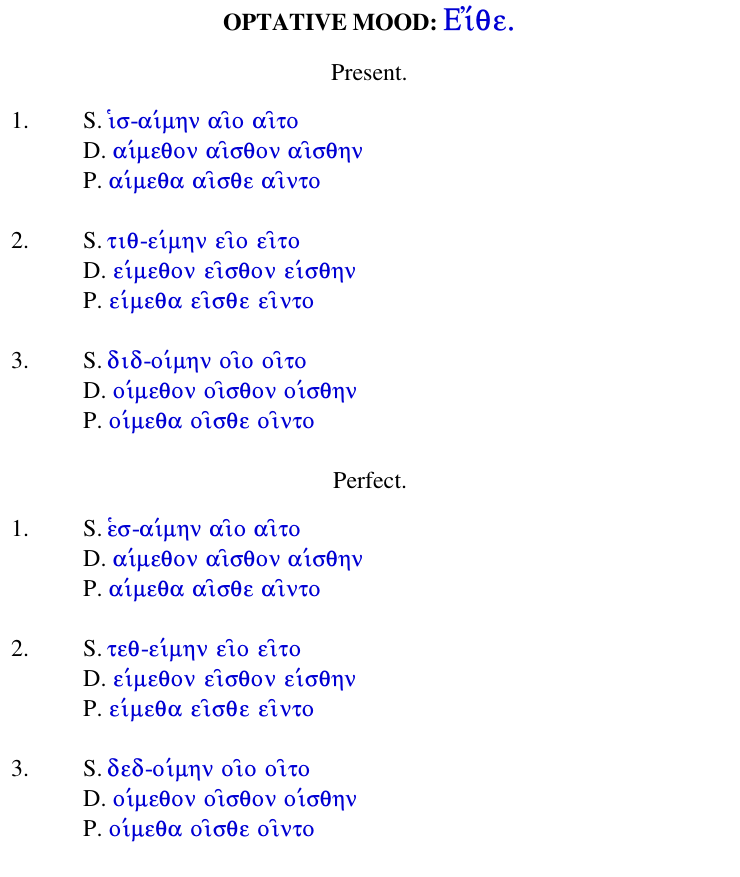
OPTATIVE MOOD: Εἰθε.
Present.
1. S. ἱσ-αίμην αῖο αῖτο
D. αίμεθον αῖσθον αῖσθην
P. αίμεθα αῖσθε αῖντο
2. S. τιθ-είμην εῖο εῖτο
D. είμεθον εῖσθον είσθην
P. είμεθα εῖσθε εῖντο
3. S. διδ-οίμην οῖο οῖτο
D. οίμεθον οῖσθον οίσθην
P. οίμεθα οῖσθε οῖντο
Perfect.
1. S. ἑσ-αίμην αῖο αῖτο
D. αίμεθον αῖσθον αίσθην
P. αίμεθα αῖσθε αῖντο
2. S. τεθ-είμην εῖο εῖτο
D. είμεθον εῖσθον είσθην
P. είμεθα εῖσθε εῖντο
3. S. δεδ-οίμην οῖο οῖτο
D. οίμεθον οῖσθον οίσθην
P. οίμεθα οῖσθε οῖντο

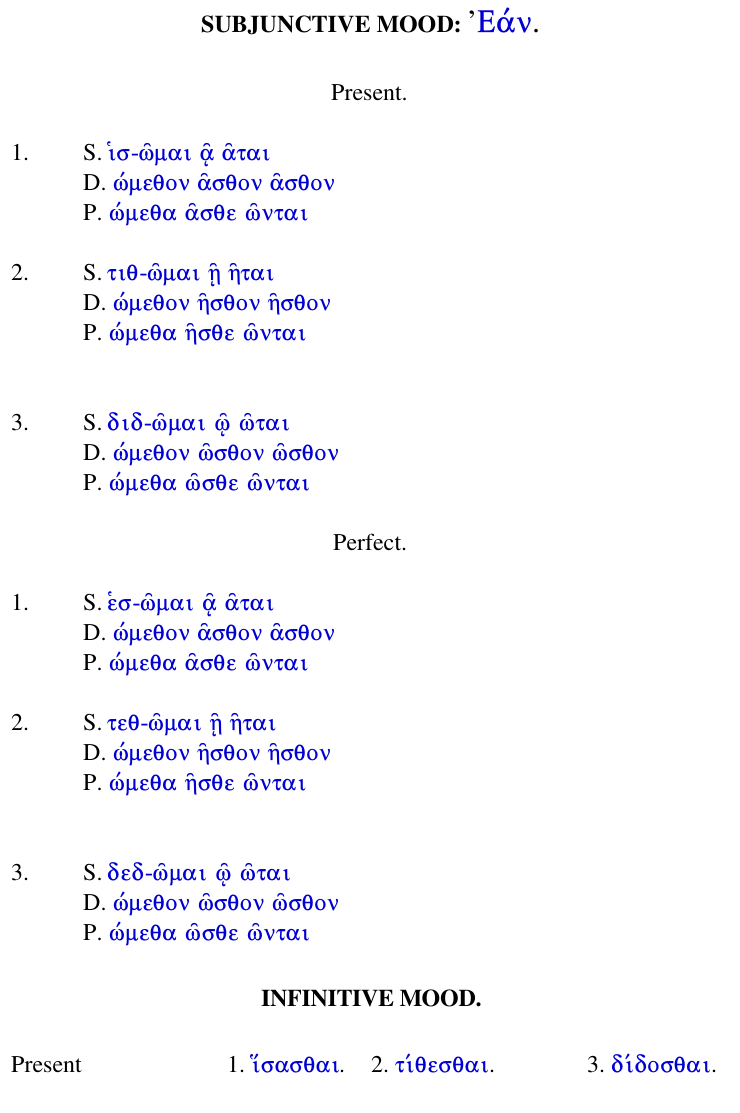
SUBJUNCTIVE MOOD: ’Εάν.
Present.
1. S. ἱσ-ῶμαι ᾷ ᾶται
D. ώμεθον ᾶσθον ᾶσθον
P. ώμεθα ᾶσθε ῶνται
2. S. τιθ-ῶμαι ῇ ῆται
D. ώμεθον ῆσθον ῆσθον
P. ώμεθα ῆσθε ῶνται
3. S. διδ-ῶμαι ῷ ῶται
D. ώμεθον ῶσθον ῶσθον
P. ώμεθα ῶσθε ῶνται
Perfect.
1. S. ἑσ-ῶμαι ᾷ ᾶται
D. ώμεθον ᾶσθον ᾶσθον
P. ώμεθα ᾶσθε ῶνται
2. S. τεθ-ῶμαι ῇ ῆται
D. ώμεθον ῆσθον ῆσθον
P. ώμεθα ῆσθε ῶνται
3. S. δεδ-ῶμαι ῷ ῶται
D. ώμεθον ῶσθον ῶσθον
P. ώμεθα ῶσθε ῶνται
INFINITIVE MOOD.
Present 1. ἱσασθαι. 2. τίθεσθαι. 3. δίδοσθαι.

PARTICIPLES.
Present.
1. Nom. ἱσάμεν-ος η ον Gen. ου ης ου
2. Nom. τιθέμεν-ος, etc.
3. Nom. διδόμεν-ος, etc.
PASSIVE VOICE.
INDICATIVE MOOD.
Indefinite 2.
1. S. ἐσ-άμην ασο ατο
D. άμεθον ασθον άσθην
P. άμεθα ασθε αντο
2. S. ἐθ-έμην εσο ετο
D. έμεθον εσθον έσθην
P. έμεθα ωσθε εντο
3. S. ἐδ-όμην οσο οτο
D. όμεθον οσθον όσθην
P. όμεθα οσθε οντο
IMPERATIVE MOOD.
Indefinite 2.
1. S. σάσο σάσθω
D. σάσθον σάσθων
P. σάσθε σάσθωσαν
2. S. θέσο or θοῦ θέσθω
D. θέσθον qe>>sqwn
P. θέσθε θέσθωσαν

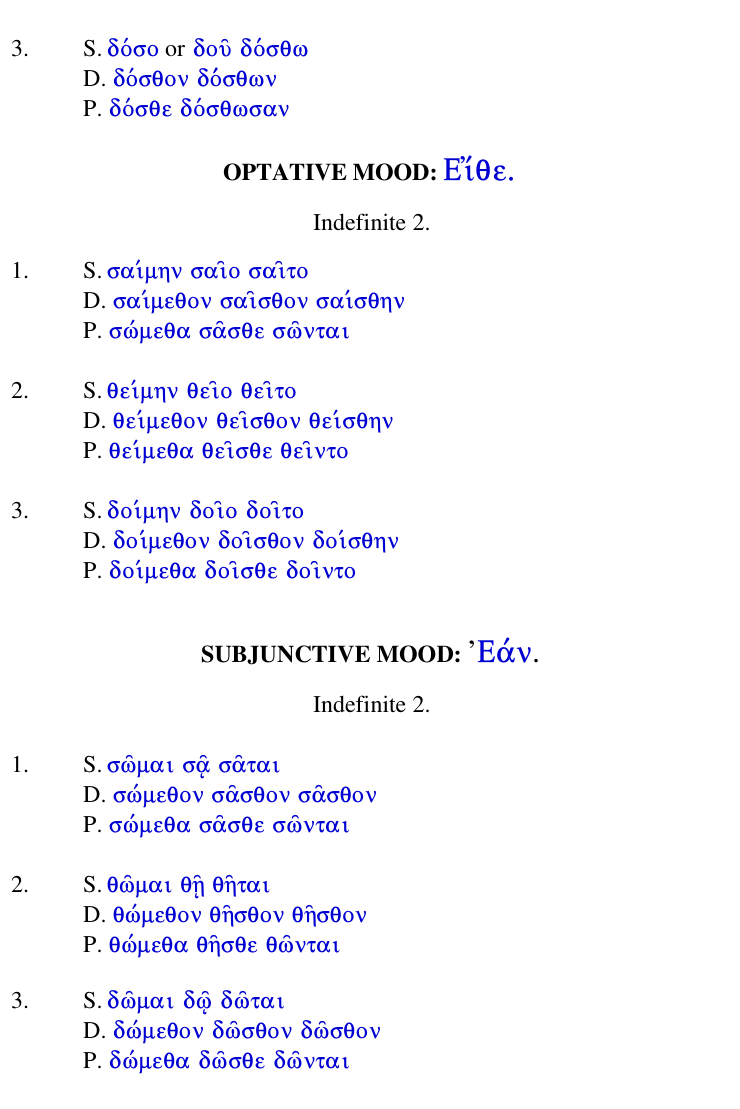
3. S. δόσο or δοῦ δόσθω
D. δόσθον do>>sqwn
P. δόσθε δόσθωσαν
OPTATIVE MOOD: Εἰθε.
Indefinite 2.
1. S. σαίμην σαῖο σαῖτο
D. σαίμεθον σαῖσθον σαίσθην
P. σώμεθα σᾶσθε σῶνται
2. S. θείμην θεῖο θεῖτο
D. θείμεθον θεῖσθον θείσθην
P. θείμεθα θεῖσθε θεῖντο
3. S. δοίμην δοῖο δοῖτο
D. δοίμεθον δοῖσθον δοίσθην
P. δοίμεθα δοῖσθε δοῖντο
SUBJUNCTIVE MOOD: ’Εάν.
Indefinite 2.
1. S. σῶμαι σᾷ σᾶται
D. σώμεθον σᾶσθον σᾶσθον
P. σώμεθα σᾶσθε σῶνται
2. S. θῶμαι θῇ θῆται
D. θώμεθον θῆσθον θῆσθον
P. θώμεθα θῆσθε θῶνται
3. S. δῶμαι δῷ δῶται
D. δώμεθον δῶσθον δῶσθον
P. δώμεθα δῶσθε δῶνται

INFINITIVE MOOD.
Indef. 2.
1. σάσθαι.
2. θέσθαι.
3. δόσθαι.
PARTICIPLES.
Indefinite 2.
1. Nom. σάμεν-ος η ον Gen. ου ης ου
2. Nom. θέμεν-ος, etc.
3. Nom. δόμεν-ov, etc.